 |
| Doing it, finally |

Sunday, November 24, 2013


Wednesday, November 20, 2013
Marion, Massachusetts
 |
| K, me, and Spirit in October at the dock |
Spirit arrived at the house on Front
Street today and tonight she sleeps in the driveway, her mast
unstepped and in the grass of the front yard. It's been an eventful
and difficult few months. We discovered shortly after my last
post—or maybe before—that the wooden mast probably needed to be
replaced. There are a couple of prospects for aluminum replacement
masts, and another option is the repair of the existing wooden mast.
My preferred option, cutting a spruce tree in Aroostook and allowing
it to cure, was not chosen. My second preferred option, wrapping the
thing in duct tape and sailing to the Azores anyway: also shot down.
 |
| Autumnal sea grass at Old Landing in Marion |
We also didn't live aboard as much as I
would have liked. I stocked the boat with groceries and toiletries
and dishes, but the comforts of a family dwelling—laundry and
electricity and hot water and plumbing—are often too hard to turn
down, as they also were seven years ago, with Secret. Can it really
have been that long? Yes.
 |
| The last row of the season |
Exactly three nights were spent at
anchor, two nights in harbors we'd already visited, once off the
Elizabethan Islands alone, open to the current. We didn't make it to
Nantucket or Martha's Vineyard. And still I focus on the things that
were not done, rather than those that were. Spirit, herself, is
exquisite. Beamy, roomy, comfortable, warm, thoroughly equipped.
She's the perfect boat, already a personality, a boat I cannot bring
myself to call an “it” whatever you landlubbers may do.
 |
| Mast coming down at sunset, as the boatyard dudes pounded down the boom gallows with a rubber hammer, far more viciously than I would have |
But she is not yet a home. I remain
perennially homeless. The most stressful thing about these
in-between periods, the stretch between adventures, is a feeling of
constantly imposing on the kindness of strangers, or at least friends
and family. So we're in a holding pattern, and in the meantime, as
we mast-hunt and paint and powerwash and decommission, draining water
from the holding tank and the engine and the water bladders, we
prepare also for another winter ashore.
Sunday, September 29, 2013
Bridgewater, Maine
 |
| September 29 -- 2009 |
Leaving the farm is going to be harder
than I at first thought, I must admit. I also must admit that I've
been grieving for much of the last month, maybe still grieving even
for the objects I lost at sea—not exactly the objects but the
ideas. The leather notebook with five years of story seeds. The
dream journal with four months of dreams.
I know I must regard these things as
ephemera, as things that are lost, and I feel I should be strong
enough by now to let the things go. To let all things go. As I must
let this place go if we really decide to adventure again. But I am
dragging my feet.
The longer I farm, or whatever it is
we're trying to do here, the more I realize that it's simply an act
of heroic emotional resilience. I understand why farmers don't want
their kids to be farmers. Because there's tragedy in it, and death,
and I simply can't bring myself to eat or harvest the food in the
garden as I write, knowing that I'm leaving it, that I'm leaving this
land. I simply don't have the emotional strength for it.
Which maybe is okay. Maybe all shall
be well and all manner of things shall be well. Maybe it's okay that
I just ate four leaves of kale with my rice tonight. We've learned,
also, that the boat needs its wooden mast replaced, so whatever
departure may not be as imminent as I'd hoped. And of course as soon
as I learned that I was desperate to leave this place—leave this
earth, these roots—always wanting what I cannot have.
Wednesday, September 04, 2013
Aroostook County, Maine
I came back home to find a house
infested with fleas. It's our fault, really—not for the fleas but
for the mice, and not really for them either but for the cat, which
was left out to become feral and live in a truck. Which didn't work to keep the
mice away. Mice are the reason we adopted him in the first place,
less than a year ago. It's the reason why, catless, we had fleas
last summer—we'd catch one mouse, and the next would move in,
bringing with it its own troop of fleas.
So I was unsurprised to find a mouse
dead between layers of crocheted afghan on my second day back. It
was big, too, bigger than the tiny field mice with tails as twice as
long as their bodies, the ones that generally move in. I thought it
was dead because of the clouds of methoprene I'd sprayed on
everything for the swarming fleas. I kid you not. I could see them
squirming on the kitchen floor.
The mouse was big, with a big belly,
and the next night the cat caught three baby mice in a row, in the
same spot, and ate them all, nose to tail. I was told, later, that I
should have snatched them away and bashed their heads in. I was
cowering in horror in the back part of the house. However strong my
fear of being a girly girl, I hate mice.
So the fleas are driving me to
depression, and new appreciation for the quotidiana of medieval life.
One day, I thought to myself: if they're like that here now, we're
going to have to start preparing for black plague. (One should
assume by now that I will correlate any entomological shift to
climate change.) That same day, driving to the store for yet another
chemical (I'm on my fifth), I heard there's a case in Kyrgystan.
Black plague. The first in twenty years. Probably from fleas.
Fleas also bring a form of shame. It's
not the shame that comes with bedbugs or lice, but it's pretty close.
It's the same feeling as when you find mouse turds in your
condo--everyone leaves bread in the bread box, fruit on the counter,
dry pasta in the cupboard—but suddenly your doing so is a
condemnation: you! You there! You're not clean enough! Do you see
the way you live? It's disgusting.
And that empty popcorn bowl that you
leave for morning becomes a scarlet badge.
So the last week has been a bit
depressing for me. But the fleas—and grief about the things I have
lost, still—and grief at leaving this place for an uncertain
expanse of time--and leaving now, with summer's end in
full bloom, giant crickets jumping away from the weeds around the
back step, echinacea with drooping purple heads, yellow jerusalem
artichoke named for the sun and smelling of honey and love, burdock
beginning to tangle, and sugar maple beginning to turn—all of it is
breaking my heart.
Sunday, September 01, 2013
From Aroostook County, Maine, to Newburyport, Massachusetts, and back again
I have awaited long the day when I
could announce with a drumroll that I am again Casting Off, not
merely metaphorically, but actually. I thought I'd be able to say
that last month, when K. signed on the dotted line for our new boat,
a 36' Mao Ta cutter, Spirit, Secret's successor. She's a blue-water
cruiser, a double-ender, an ocean crosser. We are, or will be soon,
at last Casting Off. Here she is:
 |
Three feet longer than Secret, but
wider, beamier, bigger in every dimension. Already I am in love. So
this post was intended as triumphant, as with Caesar's armies
returning from Sparta, or wherever—but instead I have chaos and
disaster and loss to report—although also their underbelly, their
paired twin: hope and light and freedom. Here's how it went.
It's our second day on the boat, August
1, and there's a grand festival going on in swanky Newburyport, our
current hailing port. The Yankee Homecoming, of all things,
featuring live music all week, dinghies piled up on dock, fireworks,
fried dough and clam chowder in the streets. The whole nine yards.
We come to town to buy a guidebook and charts and an Eldridge for
tides plus to stock up on groceries and water. We drop $350 among
West Marine and Home Depot and Market Basket. I send out my
money-earning email at the library. Then we wait at a bench beside
the dinghy dock as the RIBs motor drunkenly away, and the band cleans
up, and the teenagers engage in elaborate mating rituals.
We await the turning tide so we can
cruise gleefully back to the boat with nary an oar stroke. Two days
before we'd been unable to row against the outgoing current on the
Merrimac River. This time there's almost a full moon, and we use the
oars more to steer than to row. We get back to Spirit briskly and
tie up. K. hefts a few bags on deck but leaves more bags below to
steady the dinghy while I clamber aboard.
Then the fatal flaw of hubris. We
don't drop the teak ladder. I don't ask for it, and it isn't offered.
Both of us think I can make it over the freeboard (far higher from
the water than was Secret's) without assistance. After all, I did it
more or less effortlessly two days before.
I don't. You can see what's coming,
but I couldn't. It's just like when people talk about car accidents.
All I remember are brief snapshots, everything happening at once. I
remember having one foot on deck and the other back in the dinghy,
and feeling spreadeagled, like I wasn't going to make it. I remember
looking back at the dinghy and seeing water coming over the side. I
remember floating away, with the blue-colored paper bag from West
Marine floating away in front of me, and thinking: that's $100!
K. yelled after me to grab the next
mooring ball. (Moorings, for the uninitiated, are like anchors
permanently affixed to the bottom of the harbor, to protect the
ecosystem and to aid the mariner.) I tried, but was unable to. It
was then I realized what a fix I was in. The current was sweeping by
at a rate of at least six knots. I realized I had to swim, and swim
hard. The next mooring was the last before the open Atlantic. The
water was cold. The tide had already swept off one of my shoes, and
was threatening to carry away my flannel.
I swam hard. I caught the mooring
ball. And then I realized I was in a deeper fix. Could he see me?
Would he know I was safe and not swept out to sea? How long would it
take for someone to find me? How long could I hold on? How long
before hypothermia set in?
I didn't know then what I know now:
that the dinghy had completely overturned. That everything in it was
lost. That my partner in crime managed to hold on, barely, and pull himself on deck
to immediately radio the Coast Guard. When I thought of my backpack,
containing my computer and my camera and my purse—everything of
value I'd brought with me onto the boat—I assumed K. would have
rescued it first thing. I just worried about my computer getting
wet.
I used my yoga breath. I took turns
with my arms, holding on with one side, then the other. Even then, I
realized how quickly I'd become tired. I thought about letting
myself drift back, thinking that maybe I could hoist myself onto the
stranger's boat and find a way to get warm and to radio my location.
But then I stopped that line of thought: if I let go, there was
almost no way I'd be able to grab onto anything again. My body was
carried back in a straight line by the current, parallel to the
boat's waterline.
Then I saw the Coast Guard light up its
boat. I started to yell for help, worried that they'd go out to sea
rather than see me at the mooring two boats down. They heard me,
and minutes later I was wrapped in a blanket and safe.
I can testify that the major emotion one feels on being rescued by
the Coast Guard is embarrassment. I couldn't believe that I'd made
such a fool of myself. If only I'd been skinnier, stronger, more
limber, I could have made it over the freeboard. If only I'd been
humble enough to ask for the ladder. If only I could be a
responsible human being, for once in my life.
As I expressed my humiliation, my
apology, they were resolutely affirmative: “It happens all the
time. There's nothing to be embarrassed about. It's our job.”
Thank God for the US Coast Guard and
George Washington who established them, lo those many years ago, at
this very port, Newburyport on the Merrimac River, for exactly this
reason—wicked tidal currents and related carnage.
After I was warm and safe and drinking
hot tea, I began to worry about my computer. Had K. put it on deck?
Of course he had. It would have been his first priority. It had to
be safe.
But of course it wasn't. To paraphrase
Oscar Wilde by way of Dave Eggers: to lose two computers is a
tragedy. To lose three seems careless.
These are the things I've had to think
about over the last three weeks, as I've begun to process not just
the loss of $2500 worth of gear, but also a five-year-old Moleskin,
almost full of story ideas, my dream journal, my everyday journal, my
legal pad with assorted yoga notes and boat lists. I am attempting
faux Buddhism about it: they are just things, after all. It's just
money. The important ideas I'll remember.
And in another universe, if the
abstract mathematicians are to be believed, I am dead. In another
universe, the computer is salvaged and we are just pissed at
each other. In yet another, we're still looking for the perfect
boat. In another, we have never met.
In the last universe: I didn't lose my
data when I bought a computer two years ago. I didn't institute a
rigorous weekly backup process. I didn't recover everything despite
myself, as a result of my own insane persistence. I'm not typing
right now into a file recovered from my Aroostook backup, on a
program recovered from the backup, listening to music recovered from
the backup, using settings recovered from the backup.
All this to say: nothing was lost
except some money, ephemeral ideas, and my pride. God has his
reasons when we don't understand his reasons. If you'd told me that
when I was beating my breast over my computer data loss two years
ago, I'd probably have hit you. But you would have been right.
So maybe now, in my 35th
year, halfway to 70, I'm starting to learn some things. I'm learning
that the life I've chosen is one of risk. I haven't lost three
computers because I'm careless, but because I've chosen to risk
valuable things in order to achieve a higher goal. To some sheer
adventure as a cause celebre is insufficient—especially maybe to
our families, our parents. But we've chosen this life because it's
the one we want, even if it means losing things. Losing money.
Losing health, whether by hypothermia or by shoulder bursitis from
too much backpack-carrying. Losing dreams, and ideas, and the
stories that may have been borne from them.
That's our tax on the life we've
chosen. The life we continue to choose. So all hail Spirit, our new
vehicle of destruction and rebirth. We live in Spirit while Spirit
lives in us.
Sunday, July 07, 2013
Tweedle-dee Dee—he’s on his hands and his knees
 |
| My Papou does battle with the spirit of Robert Johnson (as I said once before) |
Saying, “Throw me somethin’, Mister, please”
“What’s good for you is good for me”
Says Tweedle-dee Dum to Tweedle-dee Dee
So today maybe a coherent post. I've
been working on a series about Bob Dylan and plagiarism, my ongoing
thesis that Bob Dylan stole every line of “Love & Theft”--also
his only album with the title in quotes on the cover, and itself a
theft of another title, the academic book Love & Theft:Blackface Minstrelsy and the American Working Class.
Last week, doing research, I learned from the definitive Bob Dylan
trivia and fan forum, expectingrain.com (taken from “Desolation
Row”--the place where “everybody is making love, or else
expecting rain”) that my long-held thesis is commonplace. JohnnieRay says, “Just my contribution to the 'every line in “Love &
Theft” is stolen from another source' myth.”
It's
just a myth, and you can read my contributions here [Dylan], and last
week Bob did battle with the spirit of Robert Johnson, as did my
Papou in the above photograph. Robert Johnson stole from the devil
at the crossroads—you know that old legend, surely: he went to the
crossroads, the place where the devil visits, with only his guitar,
and when he got there he traded his soul for the ability to play.
And Bob stole from Robert Johnson, and the American working class
stole from black culture it attempted to “control and repress” by
using blackface minstrelsy.
Man hands on misery to man.It deepens like a coastal shelf.
Get out as early as you can,
And don't have any kids yourself.
But
maybe what we also hand on along with misery is art, and artifact.
A
brilliant article by Robert Cohen in the Believer, an
issue of which I haven't read cover to cover since my commuting days
on the Chicago El, says it better than I ever could:
“The
Hebrews ripped off the Canaanites. Virgil ripped off Homer, Dante
ripped off Virgil, Mathew and Luke ripped off Mark; Shakespeare
ripped off Plutarch, Eliot ripped off Shakespeare, Dylan rips off
everybody, and—my sweet lord—George Harrison ripped off the
Chiffons. And so it goes.”
He
ends: “...still impelled onward, I would argue, by the same old
longings, the same old methods.”
Friday, July 05, 2013
Into the eye of the storm
 |
| Bad, blurry photograph taken to legitimize my existence to you, dear reader, thus proving that I am, in fact, at work |
During the second week of my (genuine,
not textual) solitude here, I have committed to putting a new plant
in the ground each day, no matter that we're already into July, no
matter that I am unable to commit to a place enough to be sure that I
won't be in Laos when these things fruit. Or, more likely, that
they'll freeze in the middle of fruiting, which breaks my heart every
year, and every year I plunge headlong right back into it.
Nevertheless: I am planting.
Today I gave in and went to the
greenhouse, where seedlings are half-price, which means I am late but
not hopeless. The greenhouse, a tubular structure with sheeted
plastic flapping in the breeze, was empty save of robust seedlings.
I took what I wanted and left my cash beneath a pen near the door.
That's a small town for you.
This fall, at least, we will have
cucumbers, squash, and peppers, those warm-weather vegetables I
always procrastinate starting. And I came home and dug the cucumbers
right into the ground. I have so much more ownership being the only
one responsible for doing everything—even taping the hose where the
lawnmower ran over it, even skewering the sprinkler into the ground,
even missing the roots and frying leaves of my plants this morning,
despite knowing better. If I don't do it, it doesn't get done, and
if I do it badly, that's only my fault, too.
So every day I go dig something into
the ground. I use a trowel and s three-pronged pitchfork that
probably has a fancier name to dig out weeds. I am combating my
tendency to work for twelve hours one day and do nothing for eleven,
when I know, truly, that it's better for my soul to work an hour a
day for twelve days in a row. Consistency is the magic, ephemeral
spell.
Wednesday, July 03, 2013
Thunderstorms within your purity
 |
| Arugula, lettuce, radishes, and radish greens |
Dinner tonight is more or less the
garden's first harvest. Arugula, lettuce, and radish piled high on a
bed of grocer chicken and tortilla. Someday it'll be my chicken,
my wheat (unless the catamaran gets to me first). The first week I
was here, the vast quantity of what remained to be done immobilized
me, but this week I've been attacking the wild in manageable chunks.
Every single day past the equinox
always feels too late, even February when I could be starting beet
seedlings, and in fact it's never too late. I still have all of July
to plant late crops, and every day I can hack away at another corner,
and harvest enough to eat. In December I can harvest jerusalem
artichoke and kale (unless the catamarans get me). So for the last
three days in a row I've had dirt under my nails and deer flies
biting my ears.
I can't explain how happy it makes me
to have brand new plants in my body for dinner. As always I'm also
towing around a trail of guilt, as for anything good I accomplish I
experience simultaneous pride for my accomplishment and guilt for my
pride, but then if I abandon my farm to weeds I feel guilty about
that, too. The psychologists of joy attest that gratitude is linked
to joy—but I feel guilt rather than gratitude: guilt for what's
good, for showing off, or being cheesy, or bragging.
Well: arugula vitamins banish guilt
with their peppery verve.
I think sometimes about how we old
sailors have managed to swallow the anchor so thoroughly, the old
adage about sailors who leave the sea. They swallow the hook, and
we've beaten ours into a plough-share. It's the same kind of
nesting, the digging of the hoe into the dirt, the way an anchor
buries itself in sand—but there's a feeling that the earth is
swallowing us too, as we dig our roots into it, or struggle to get
away. The dark ground is a blank slate on which I paint with tools,
nesting seedlings and making rows, and the future is, too—blank,
unknowable, and potentially delicious.
Monday, July 01, 2013
Bridgewater, Maine
 |
| Cat and dog love each other |
Well, the rain beating down on my
window pane
I got love for you and it’s all in vain
Brains in the pot, they’re beginning to boil
They’re dripping with garlic and olive oil
I got love for you and it’s all in vain
Brains in the pot, they’re beginning to boil
They’re dripping with garlic and olive oil
--Tweedle Dum and Tweedle Dee
It has been raining here almost constantly on the days when there are not deer flies buzzing around in the sun. If that sounds like complaining it's because it is and also an excuse for everything that's not planted, everything that's not done. The thing they don't tell you about farming (or maybe they do) is what hard work it is. Maybe that's why everyone wanted to get out of it.
Which makes me--or maybe it's K.'s continuing adventure across the Atlantic, where he lost his rudder and two sails and ended up stranded adrift amid the gulf stream, essentially--more on that when I have more details--spend all day looking at Wharram catamarans on the internet. Here. I'll show you the one that made me fall in love, years ago:

I don't know why that particular photograph made me fall in love, but who can explain love? And all my love for all of the Wharram cats in southeast Asia is all in vain, as Bob Dylan so elegantly quoted himself quoting Robert Johnson singing to Willie Mae. My grandfather used to eat brains with garlic and olive oil, but I can't help thinking that the brains in a pot reference is to Macbeth, because everything comes back to Macbeth. Brains with garlic and olive oil are what Greeks eat for Christmas.
Maybe I've been alone with my cat and dog and garlic scapes and boat searches and Dylan for too long. I want the rain to stop. I want to get on a train with a suitcase in my hand and ride and ride. I want to find a catamaran and beach her amid ruins and then sail wing and wing away.
Thursday, June 27, 2013
Aroostook County, Maine
We bathe in oil. We drink it. We clothe ourselves in it, line our homes with it, feed it to our babies and animals and plants, baptize ourselves in it like water. We suck the earth dry of its dinosaur marrow.
That much is true. What is less certain is how much our atmosphere will change as a result of our 450-year-long binge. I applaud the president's stance yesterday, his resolve to do what he has the executive privilege to do and the Supreme Court mandated, however little what he is able to do may matter in the face of looming apocalypse. The challenge is that even his first stab at the 40 percent of electricity emissions--which is huge, don't get me wrong--but doesn't count fracking or meat or cars--not to mention Walmart or airplanes or agriculture--is nowhere near enough.
What he deserves the most respect for is his affirmation of this quest as a moral one. He is doing what he as one man can--and although he may be the most powerful American alive, although only perhaps--it's about time for us to realize that we live not in a democracy but in a corporate oligarchy and that our real leaders are CEOs and Chairmen of Boards--and his call to us is to do the same, to do the best we can as singular people. For me, yesterday, that meant calling my bank. Perhaps moved by Obama's announcement that he would pursue an executive oil strategy, giving up on a bipartisan one, I finally called my mutual fund company and initiated divestment.
On NPR, a coalworker called to protest, angry, saying: Of course I care about my children's future--I have two boys and I'd do anything for them! But I have to feed them first!
Feed them, yes. But what would you feed them--dust?
That much is true. What is less certain is how much our atmosphere will change as a result of our 450-year-long binge. I applaud the president's stance yesterday, his resolve to do what he has the executive privilege to do and the Supreme Court mandated, however little what he is able to do may matter in the face of looming apocalypse. The challenge is that even his first stab at the 40 percent of electricity emissions--which is huge, don't get me wrong--but doesn't count fracking or meat or cars--not to mention Walmart or airplanes or agriculture--is nowhere near enough.
What he deserves the most respect for is his affirmation of this quest as a moral one. He is doing what he as one man can--and although he may be the most powerful American alive, although only perhaps--it's about time for us to realize that we live not in a democracy but in a corporate oligarchy and that our real leaders are CEOs and Chairmen of Boards--and his call to us is to do the same, to do the best we can as singular people. For me, yesterday, that meant calling my bank. Perhaps moved by Obama's announcement that he would pursue an executive oil strategy, giving up on a bipartisan one, I finally called my mutual fund company and initiated divestment.
On NPR, a coalworker called to protest, angry, saying: Of course I care about my children's future--I have two boys and I'd do anything for them! But I have to feed them first!
Feed them, yes. But what would you feed them--dust?
Tuesday, June 25, 2013
Om bhur bhuvah svah
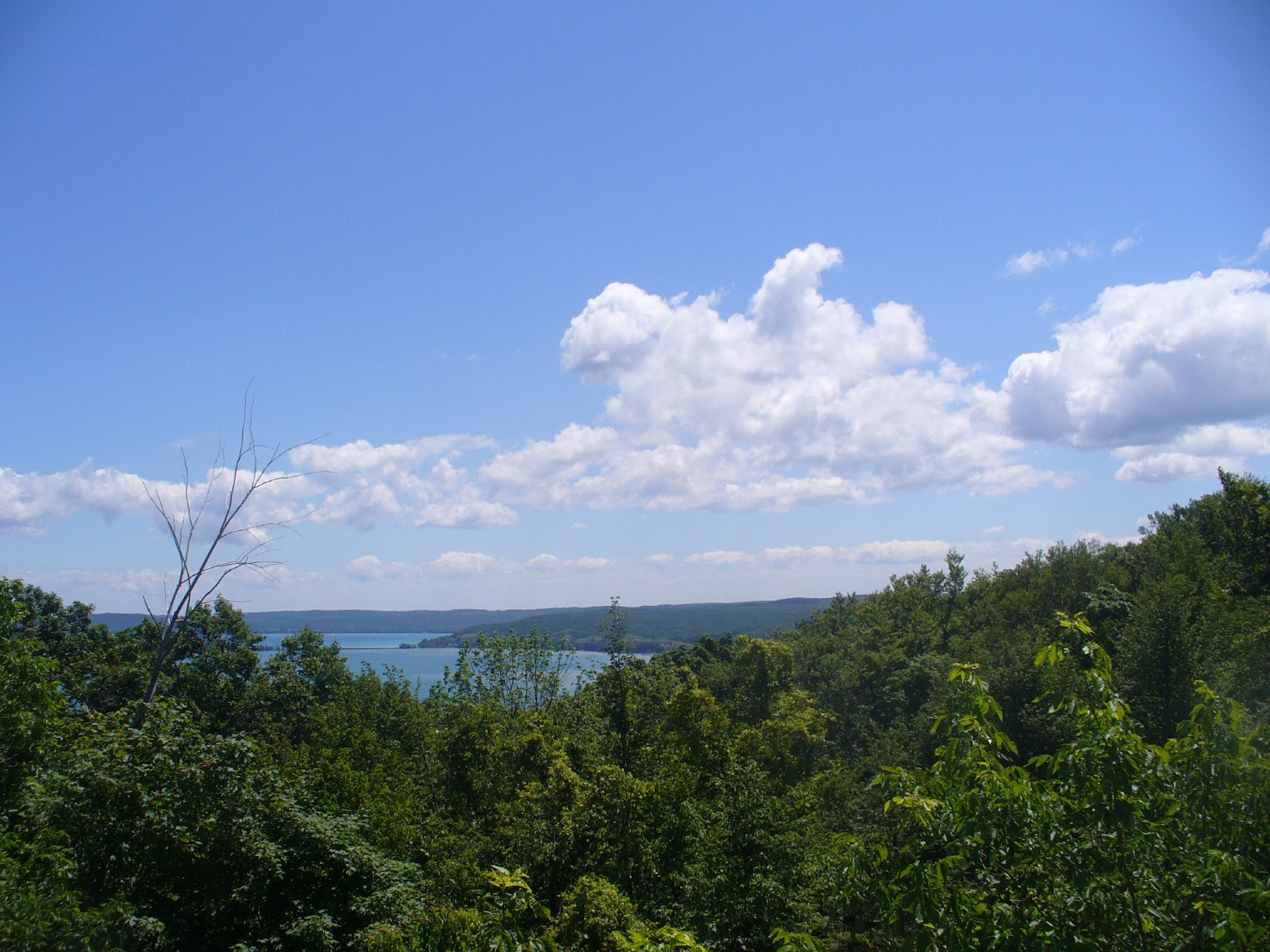 |
| Sleeping Bear Dunes National Lakeshore, as framed by Earthbender Iris Jenks Henry, immediately before the battery in the camera died |
One of the things I've been doing is
writing sixteen-sentence prose pieces. I call them essays, or
something. My favorite thing about modern essay, other than the
blog, is the way it combines various ideas into one, read Brian Doyle
and Patrick Madden and the Festival of Faith and Writing (the best
conference in the greater US of A), and the way it can jump from one
idea to another, the way it does with this sentence, and this short
story at Haystack, and the way I keep thinking that I can
self-publish, like a self-titled EP, Melissa Jenks, the Short
Stories, but I'm too chicken, and then I think about the article I
read in fu**ing Oprah about vulnerability. Of all places.
It reminded me of a lot of the things
that I've been reading about brain chemistry and human evolution (pop
quiz: what happened 100 million, 1 million, 100,000 years ago?) and
how scientists (of the hard and not the Christian variety) believe
that homo sapiens evolved its complex brain architecture in response
to compassion. And that dogs evolved their domestication with us at
about 40,000 years ago; and that many of the things about the ways
that our neurons map up against our evolutionary architecture has a
connection to morphogenic fields; and Darwin wrote about red fields
of algae bleeding from South America in Voyage of the Beagle (nota
bene: he was a 25-year-old biologist aboard a clipper rounding Cape
Horn by sail, in the noble day of sail, when Captain Josh Slocum was
out there in his Spray, and all of us and our bilious climate change
were just a gleam in their eye, praise Jesus); and now I carry my
Shadow behind me and he pees on my floor when he is anxious and I am
alone as my life partner sails across the Atlantic and I realize how
Ahab's wife must have felt, not to mention all the wives and
sweethearts that were never to meet. I'm here with my dog, my
Shadow, and my shadow, my terror at the silence of the strawberry
moon. And also the television, the only thing aside from meditation
and dreaming that offers alpha waves for the evolved brain.
And the internet, I suppose. I propose
this as a cautionary tale. I am home, like Emily Dickinson who
wouldn't leave hers, but I have MBPN and factory-farmed pork and myth
and the USPS and the future falling backwards behind me as I look up
at the stars and thunder in the sky. Yeah, I'm home.
Whatever that means. With my Southeast
Asia on a Shoestring and Joy of Cooking laid out in front of me.
It's weird, being here, the end of June, one month of spring already
gone, half the garden not planted, because of us, our pursuit of
adventure or art or whatever it is. Rolling thunder rumbles.
(Answer, inverted, if I could figure
out the html: dinosaurs explode because of asteroid, neanderthals
evolve tools, and homo sapiens emigrate Africa.)
Sunday, June 16, 2013
Grand Rapids, Michigan (by way of Marion, Massachusetts, and Muskegon, Michigan)
 |
| An Ingrid interior--a boat on the boat list |
Traveling again, this time for my
parents' fortieth wedding anniversary (believe it or not) and a
three-day camping trip with Sonia and her two beautiful boys. We
pulled into a campground I'd chosen on the internet, sight unseen,
with thunder roaring and lightning cracking directly overhead, rain
flooding the ranger station, at ten at night—me coming directly
from the airport and two awake children in the car. Luckily the kind
ranger allowed us the use of a cabin for one night, because when we
pitched the tent in the morning, we discovered we had no poles. Not
to worry. The 1920s army tent we'd brought as a playplace for the
children pitched just fine. Another victory for the brave,
foolhardy, impulsive travelers who do not plan.
As is this one: K. is currently in the
middle of the Atlantic, racing to Bermuda. Check here. He is on the
little pink boat, Elusive, almost dead last. It's okay. It's a
rookie boat, class C, and although we'd had our names on the crew
list since last year, it was only when we took the brave and
foolhardy step of waltzing through the yacht club doors to handwrite
our names on the bulletin board that we got a call. So he gets to
cross (or half-cross—let's call a spade a spade) the Atlantic
before I do.
I'm not jealous. Really, I'm not.
Okay, I am. Desperately jealous, but
also so immensely thrilled and pleased for him. His first real ocean
race, his first experience with a structured watch list, and five
blessed days in blue water under sail.
He'll come back either ready to settle
down and farm again, or even hungrier for one of the steel ketches
he's been surfing online, the ones with built-in woodstoves that we
could sail to Iceland or Greenland or through the Northwest Passage.
Casting Off has been metaphorical for a time now, but it's a good
reminder that it could always become literal. Again.
And tonight we dined on kale and beets
and local fennel sausage in downtown Grand Rapids, a town which has
suddenly, and without my noticing, become hip. I used to say, when I
visited my family here, that it was like stepping back in time to
1952. But now it feels the opposite—like stepping forward to, say,
2020—a place where all cafes have their own greenhouses, and art
galleries host their own deejays, and every bar stocks
jalapeno-infused local vodka. One can only hope.
Sunday, June 09, 2013
Aroostook County, Maine
 |
| Ann Armstrong, in the fabric studio |
And just like that, it's gone. So fast
the time passes, even if I was able to accomplish much of what I
wanted at Haystack: even flax paper haiku. I wrote almost every day
with Betsy Sholl, former Maine poet laureate, an absolute gift—she is an
astonishing wordsmith—and now have friends dotted around the
hemispheres: in Grand Rapids and Poland and Capetown and Austin and
Providence. And the best thing about spending two weeks with a
community of artists is the new beauty I find in the world.
These people see all material as a
substance to be crafted, to be shaped according to the muse, to be
made more beautiful at all costs. Maybe some people think that's
unimportant. But those people are wrong.
I came home (you know with what effort
I type that word) yesterday, limping in the Volvo, praying the whole
way, and using Deepak Chopra-style visualization along with deep
breathing and a light touch on the gas. Within in ten minutes of
being here, K. had the engine cover off and discovered oil leaking
into my spark-plug wells. Which means he had the problem fixed in
another twenty, but it also means I could have lit my engine on fire
during the twenty-minute drive home. Allegedly. Thank goodness for
small mercies.
I even assisted: bringing a tool as
requested without having to figure out what the word meant. And I
cleaned some receptors with alcohol, q-tips, and paper towels. I'll
be a mechanic yet.
The bridge off Deer Isle, though. The
thing is a blue behemoth, with a 25-mile-per-hour speed limit, and
all week I stalled every time I dropped down to a low speed and
climbed a high hill. No shoulder—only ocean—on the bridge. All I
could think was that I'd stall at the top, which panicked me, so I
imagined instead the relief I'd feel on the other side. Or the
relief I'd feel, pulling into the white trailer, with its dim traces
of mold, and my Shadow, and the partridge nesting, and the jerusalem
artichoke as high as an elephant's eye. Saying: I didn't stall
once!
So: I didn't stall once. I left my
haikumobile as ephemera, a minor tragedy, but only a minor one. And
now the bell no longer tolls my hours and my meals—I am responsible
for myself again. The respite is over.
Sunday, June 02, 2013
Haystack Mountain School of Crafts
 |
| Birchbark canoe at the Haystack Gallery, built according to ancient Penobscot tradition |
One thing that has been a constant
source of conversation around here—and maybe it's just because I
keep bringing it up—is the intersection between art and commerce.
Maybe I'm an idealist in believing that it's possible to make objects
that appeal to a wide audience, in such a way that they can sustain
(read: feed) the artist, and these things can also achieve critical
success. These are not easy questions. I love the things being made
here—they are exquisite, magical, beautiful—and gradually coming
into being, made by my friends—but I worry that these things aren't
accessible to a wide audience.
Some people simply say: no. They
aren't. 99 percent of people will never understand art and aren't
even worth trying to reach. But I vehemently disagree.
Yes, we have a major problem in
education in this country. Many people don't understand art, or
can't see its value, because they've never been taught to. But
people can still consistently recognize beauty, and they could not
fail to see the beauty in the work being created here. Maybe its
purpose, they could question. Beauty for beauty's own sake.
A friend of mine back home, a
beer-drinking Nascar-watching member of the hoi polloi, has recently
fallen in love with Beethoven and Mozart. He sits in his backyard,
listening, as arpeggios swell, and this to me is proof of the triumph
of music. All of us have little beautiful things we treasure—maybe
just for the memories they bring us, of a beautiful moment, a
beautiful time. I'm still not sure what art is, if I can define it.
Although, to paraphrase Emily
Dickinson, I know it when I feel like the top of my head has been
blown off.
We had a lobster bake on the picnic
rocks by the ocean last night. My first lobster bake, my first
lobster eaten with my hands by the sea, and maybe my first Maine
lobster ever, believe it or not. It was delectable, of course,
ambrosia of the sea, no more so than when sucking the juice from the
claws, distilled ocean nectar. But I have to say—and please don't
shoot me—Cape Cod lobster gives them a run for their money.
In other news, my car broke down on
Friday. Which leaves me with a mechanical problem to solve during my
four last precious days of focus. I am trying not to play the
martyr. But seriously. Could I have worse timing? Of all the gin
joints in all the world where a Volvo could funk out.
Wednesday, May 29, 2013
Deer Isle, Maine
 |
| Town of Stonington |
The idea behind an Open Studio
Residency is that the studios of all different disciplines are open
to artists of various disciplines, to visit, explore, ask questions,
and perhaps experiment with others' materials. And almost all of the
studios here are of disciplines I've never explored: wood, metal,
jewelry, pottery, glass, paper. I am drawn most to the paper and
book artists, which makes sense. So yesterday I made paper for the
first time, from shared flax, small discs of paper on which I hope to
type.
After that, I don't know. Maybe I will
sew them in a circular binding. Maybe I'll frame them in leather and
hang them as a haikumobile. Maybe I'll convince an assistant to
teach me to weld. Maybe I'll have the 3D printer build me a
three-dimensional story. Maybe I'll carve in clay so I can tile a
bathroom with words.
Certainly, ideas are not lacking after
spending even three days together with people such as these. The
most freeing thing about this openness is the way it makes any idea
viable. This place is nothing if not fertile loam for creative
growth. Stu Kestenbaum, a poet and the director here for twenty
years, talks about the creative process seriously, in a way that
makes clear the decades of hands-on experience he's had making it
happen, watching it happen. There's a depth behind his words that
makes me as serious about it as he is. He's spent his life watching
artists grow, cultivating them the way others would plants.
Always, my subconscious rewards
creative play. It's almost as if we have to distract ourselves for
image and imagination to germinate. The question I continue to
return to is: how do I know what I want? How does that part of
myself decide? The diversity of craft represented here is
mind-blowing—artifacts that I could not have conceived. But still
somehow all of these people have the same level of certainty about
their craft, and not just about their craft but each specialization
within it, materials within each specialization, each shape, each
color, each microscopic decision.
Maybe choice is the central player in
art, even when the number of choices is infinite. Maybe we like
talking about that less—the numinous subconscious goop guiding all
of these decisions—because whatever part of us choosing is a
mystery. And still, somehow, a part of us knows.
Sunday, May 26, 2013
Like you and me
 |
| View from Deer Isle. Also gives a sense for the weather we're getting.
It is an odd thing, coming together
with other artists, especially because all I really need to work as
a writer is a desk, silence, solitude, paper, and pen. Already,
after dining, I have to sneak away to find some table I can
appropriate as a desk, some quiet room where I can hide away. Which
seems counterintuitive. Why would I need to come together with
others if all I need then is to get away from them? Why should they
waste space and electricity and reverse osmofied saline water on
someone who's not going to use the welders or the Fab Lab?
Perhaps because I am most likely the
only person already parsing this experience in language, already an
anthropologist and journalist among all of these strangers. It's an
odd assortment. There are the academics, who earn their living
closest to their craft, but along with academia comes its fellowships
and grants and college politics of tenure and which dean funds which
piece of equipment. As much as I love academics, there's a sense
that they are most calloused to what they do.
In conversation so far, it's those that
are closest to art as creation who resist ascribing meaning to it
most strongly. Those that make things into other things, who
manipulate matter into a different form say these things have no
intrinsic value, that they need not be ascribed monetary value.
But then what use does all of this
serve? Even these words, as always I am meta-metafying. I'm a firm
believer that art must hold its place inside capitalism, in commerce. We tell stories so they can be heard.
Created objects are vessels that hold meaning.
It is all that makes us human. First
we find food. Then we find caves. Then we paint the caves. This is
what we do, what we have always done, for better or for worse. Homo
Aestheticus, as a book in the library here claims. A quote: “art
is a biologically evolved element in human nature.”
So why am I here? Already I
contemplate engraving haiku on stone, paper, wood, cloth. Although I
haven't written a poem in ages. Already I mull turning stories into
objects, somehow, turning stories into poems, “covering” someone
else's poem as a haiku. The shortest of short forms are fascinating
me, for some reason, what I can excise from my work and have the work
still stand alone—this as a result of already talking to sculptors
and blacksmiths and metalworkers who talk about the division between
work with subtracts and work which adds, speaking a foreign language,
an unintelligible tongue that still somehow satisfies.
|
 | ||||||||
| Stairs and corridors and cabins at Haystack |
Friday, May 24, 2013
En route from Aroostook County to Deer Isle, Maine
 |
| Here now. My room. |
194 statute miles
Another traveling post. This site
started as one devoted to travel, and so it remains, as long as my
feet remain itchy with wanderlust. I resolved silently, a while
back, not to mention my alternate career as a fiction writer for at
least a year; I'm not sure I made it. So again, I'm coming out as a
writer of fiction, something I hesitate to mention on these pages.
Nevertheless, I have been accepted to
the Haystack Mountain of Crafts (donate!) Open Studio Residency for
artists of all disciplines. I applied almost on a whim, the day I
received my first rejection for the Iowa Writers' Workshop, not
thinking I had a shot at the prestigious residency, hoping at least
for a chance at a summer workshop. But I was accepted for both,
which simultaneously daunted and thrilled me. Especially after I
searched online for some of my fellow artists.
Here is some of their work (I think, if google can be trusted):
 |
| Megan Biddle |
 |
| Nancy Koenigsberg (Sculpture made of coated copper wire and glass beads) |
 |
| Jiyoung Chung (Made of paper! I think. Korean joomchi) |
 |
| Rama Chorpash (Fiber art designed according to the topographic contours of Central Park.) |
 |
| Melissa Craig |
People are traveling from Hawaii,
Texas, Oregon, Ireland. Many have had solo shows at New York City
galleries. Others are professors of their craft—metalworkers,
glassblowers, papermakers, enamelists. I am an anomaly as a
novelist, at least so far as I know. They are real artists--in museums, in permanent collections. The only other writer I
discovered is a former Maine poet laureate. More exalted company than I
could have dreamed.
As I sit here writing on paper during
my road trip lunch, I keep thinking they've made some kind of
mistake, that I'll be turned aside at the door. But it is fear, of
course, fear of the magnitude of the gift being given. Let's just say I'm very pleased to be a participant with such fierce companions in arms.
Wednesday, May 22, 2013
Every moonbeam
 |
| Burdock in wok |
Last night I made burdock root for the
first time. Here's the recipe I used, and it took much convincing
both myself and others. I let the sandy whole plants K. dug up from
the garden sit in the sink in water for about a week before I could
bring myself to clean them, before I could contemplate eating them.
When I first searched online for them, what I was looking for was an
effective way to kill them.
Murder them, I should say. Their roots
go sometimes three feet deep, according to the internet, and I feel
like I've seen them go deeper. Even the smallest, innocent-looking
little weed seedling sprouts a massive, impenetrable, herculean root.
When they grow, they become tree-like shrubs with purple flowers
that quickly turn into clinging prickly seedpods that cling to
anything they touch, especially a dog, or a dog's tail, or gloves, or
a hat, or my hair.
I hate them. I've been doing
everything I can to kill them since the day I figured out what they
are, but unless you dig up every last hair of a root, unless you
catch and burn every last burr—they sprout up again come spring.
 | |
| Burdock kinpira with pan-fried whole trout, caught at Lake No. 9 that morning--it doesn't get any more local than that. (Except yes, the lemon came from the IGA, and the basmati rice came from Thailand. Sticklers.) |
I knew they were, theoretically,
edible. It's one of those rural myths up here. “You know, you can
eat burdock.” So I was surprised to discover, that when I searched
“best way to dig up burdock root” that what I discovered was
urban foragers, Japanese sushi blogs, and how-to sites on making
burdock tea. Evidently burdock, called gojo in Japan, and in
restaurants where my sister eats, is a food perfectly designed to
supplement the immune system, providing mammoth amounts of manganese
and vitamin C and who-knows-what-all vitamins.
Still, I had to convince the collected
assembly they were not poisonous.
The flavor is unique. I struggle to
describe it—something, perhaps, like a musky wild mushroom, an
oyster or a shiitake, with a hint of earth and parsnip. Surprisingly
delicious, although still tough. I'm not sure if that's because I
didn't let them steam long enough, or because I let them sit in my
sink for a week, or because they were stringy new ones. In any case,
I can check that off my to-do list. And if we ever run out of things
to farm, we can always sell dehydrated burdock-root tea.
 |
| K. likes to do sushi-style bites. This is rice with fried bluefish, from Massachusetts last year, and Thai nam chim, sweet chili sauce. Delectable. |

Monday, May 20, 2013
Walking the blues
 |
| Homo sapiens evolved about 100,000 years ago. Incidentally, this data is a bit old. We hit 400 parts per million last week. Chart from Datafuzz. |
Another climate change post, I know. I
wrote a letter to my pastor about divestment and he said it's good if
people have a “bee in their bonnet” about these things. So I
suppose I have a bee in my bonnet. I've been looking for ages for a
succinct infographic that can explain to people what's going on with
carbon dioxide and climate change, and all along all I've needed is a
simple graph.
The problem with most of the articles I
see on carbon dioxide is that they only address the problem over the
last couple of decades. “It's the hottest year since 1971!” or
whatever. Or they address it over the last 100 years. Even
climatologists will try to compare now to the 1890s. Or, if they're
particularly enlightened, they address the rise of industrialism
during the seventeenth and eighteenth centuries, how we began spewing
carbon into the air at the advent of the Industrial Age.
Although that may feel like a long
time, the button factories of Victorian Britain, really it's very
recent in global climate cycles. So essentially we've been burning
shit since we discovered fire.
Another of the challenges I've
discovered in talking about climate change is how unwilling people
are to accept human evolution. Yes, they believe in dinosaurs and
carbon dating and the pyramids and the fossil record. Yes, they
believe in the big bang and cosmic goo and the quantum mechanics that
allows computers to function. But humans came from animals? Hold on
there a minute. Never mind that 99 percent of our genetic material
is identical to that of an ape. Never mind that we've not found just one missing link but several—the various branches of evolving
primates that led, eventually, to homo sapiens.
It's more than that. It's this sense
that somehow evolution devalues us and devalues our God. But if you
really read about it, really study it—it's hard to imagine a more
beautiful or elegant method of creation.
Faith is not incompatible with science.
Can't we just agree on that? Science, itself, as any scientist
would agree, is a form of faith. Faith in data, faith in abstract
mathematics, faith in the power of numbers and proof and the
predictability in matter in motion.
And carbon dioxide is matter. Every
time you exhale, you contribute to the carbon dioxide in the
atmosphere. Trees breathe it in, we breathe it out. It's the most
basic ecosystem, the balance of chemistry in our atmosphere, and we
didn't even know about it till 100 years ago. After we'd already
begun to contribute to the radical spike of its presence all around
us.
Even if you're the brave humanist to
believe in evolution, do you know the difference among what happened
during the planet's history during the last 100,000, 1 million, or
100 million years? I didn't, up until a couple of weeks ago. But
now I know that 100 million is when the dinosaurs were around.
Neanderthals started their era about 800,000 years ago.
And homo sapiens? The first evidence of "abstract consciousness" comes from perhaps 100,000 years ago. We started our
exodus from Africa around 70,000 years ago, give or take, riding the wave of
receding glaciers you can track on the above chart, riding the end of our last ice age for a very long time. Around 40,000 years ago we conquered the planet. As far back as then when homo sapiens in Russia were burying their children with millions of beads. Then the Lascaux caves and fertility goddess figurines then Stonehenge and Jesus.
And now it's getting hot around here. Hotter than when the dinosaurs were here. Twice as hot as at any point in human evolution. Things are changing, and they're going to change more and more quickly, and they're going to keep changing until we are honest about ourselves and our technology and our civilization.
And now it's getting hot around here. Hotter than when the dinosaurs were here. Twice as hot as at any point in human evolution. Things are changing, and they're going to change more and more quickly, and they're going to keep changing until we are honest about ourselves and our technology and our civilization.
This American Life mentioned “war-time
measures.” They mentioned that government climatologists, paid by us to report on the data, are lying to us because they're afraid that they'll be fired if they tell the truth. Numerous state climatologists have been fired by Republican officials for their honesty about global warming. These same climatologists are quietly buying second homes far, far above sea level. But This American Life also profiled the Freedom Riders of a new generation,
the founders of a movement that could save all of us. I hope to be
one of them. They also say that trying to convince us, all of us, who bathe in oil, drink it, breathe it in--too start a movement is like asking slaveholders to be the abolitionists.
I find myself becoming more and more
conservative, in the truest sense, in the sense that we must
conserve. When did conservation and conservative become
incompatible? I am not a traditional conservative, more of a green
socialist. But the only method we've found for motivating human
behavior on a massive scale is capitalism, as brutal as its methods
may be. Which means every breath of carbon has to cost more if we're
going to bring down its level. Yes, this means that poor people will
starve, will roast, will freeze. But they're going to do that
anyway, and much worse, if we fail to address the actual
science. Which means cap and trade, and radical disruption of our civilization, and that's if we're blessed.
Friday, May 17, 2013
I'd forgotten work today
 |
| Asparagus, first year, gone to seed--you can see the rest sprouting in the distance |
The asparagus is growing. I wrote about
it last year, when we rooted the year-old octopus-shaped slips of
plants, as a symbol of permanence. If we plant asparagus, that means
we're staying. Perennials mean that one is perennially rooted in one
place.
Or so I believe. The asparagus is
going to seed, as it's supposed to in its second year, although I've
been desperate to sample some. I tried one bite, raw, of a piece the
cat knocked off.
Maybe what I like about impermanence is
how its a blank slate on which to draw. The unknown elements in the
future.
A farm is a new adventure each season.
Based on three years of experience now, I still have no idea what to
predict. Certain crops will fail utterly. Others we will drown in
and have to throw away. It's impossible to know what will succeed
and what will fail, but we have to keep trying, with each, with
utmost faith.
The perennial garden grows every
year—this year I'm able to identify handily the jerusalem artichoke
and echinacea coming up, and the rhubarb is sprouting little alien
brains by the day. I may even get a pie this year. The fiddleheads
are going gangbusters, and I still haven't made my way out to collect
any. The rhythm grows familiar.
Last year at this time I was nesting
the asparagus roots in the ground. It's almost a prayer, planting
things like that, entrusting them to this speck of earth. Trusting
myself to husband them. Trusting they will bear fruit in time, in
two years. Next year, we can eat asparagus omelets all spring.
And still the unknown beckons.
Subscribe to:
Posts (Atom)