Showing posts with label happiness. Show all posts

Friday, August 29, 2014

I saw a black branch

Shadow
And then my dog died.  In truth he died before my last post, a reason for my delay, and in truth he wasn’t exactly my dog either, even after all of these years.  After all of the times we walked and snowshoed together.  The border patrol used to buzz us in their helicopter, till they got used to us disturbing their radar, two little linked shapes strolling along the border.  He was never really my dog, despite that, although I wanted him to be.

Winter walk
All those walks together I remember.  The times he dragged me out, our mid-afternoon post-writing walk become an ecstatic habit, him leaping vertically and twisting in the air, overjoyed, tangling himself in his leash.  The times I dragged him onward, in ninety-degree August, towards the end.  The years I had him trained off leash, and he ran in front, along side, snuffling after rabbits and deer.  The times we went in fresh-crusted snow and he broke through the surface, yelping, while I floated on top in my snowshoes and he, panting, plunged on.

At rest, among books, like a good literary dog
I felt a slave to him sometimes, his neediness and whining, but on cold winter nights in Maine he’d jump and share my bed with me.  He’d sleep beside me and I loved him, loved wrapping my arms around his heft, his warmth.  I taught him “noses,” the command, and he’d touch my nose with his, and Eskimo kiss, not licking my face (I don’t like that) unless completely overcome by affection and unable to help himself.

In winter
One night, back when K. was here working on the boat and I was still traveling in Asia, the two of them sat together in the garage and when K. went to go back in the house he couldn’t get Shadow to wake up.  He couldn’t move him, couldn’t wake him, couldn’t rouse him—as if he were already half in the ether, already half-gone.  He could have drifted off into nothingness that night, without me.  But something called him, and he awoke, and pulled himself to arthritic feet, dragged himself up the stairs and waited another two months for me to come back.
Looking right at me
When I flew in it was the first thing he wanted to do, noses, reaching and snuffling his nose for me, his clouded, half-blind eyes seeking me out.  He waited for me.  Three days after I flew in he was shrieking because he couldn’t stand up, couldn’t get down the stairs.  Two days later his hips gave out and he couldn’t walk.  He lay in the dirt and cried.  Till we gave him oxycodone and barbituates and he passed.
At rest, in love
It kills me; he waited.  This despite how we tormented him over the years with our adventures, our absences.  We abandoned him again and again, leaving him with family that loved him, maybe more than we could, but how could he understand the inexplicable?  I swear he understood English, and each time I whispered where we were going and how long we’d be gone (when I knew) and that we’d come back, whispered in his glove-soft ears.  Maybe he believed me;  maybe he understood.  Because he waited.  Despite my disloyalty, despite traveling almost all of the time I had with him, the years he had on this planet, leaving him in the care of others.

Molting, as summer came on
The night before he died I held him.  I keep remembering how he couldn’t lift himself from the dirt, how we made a blanket nest and spread out a tarp beside him and slept in the dirt next to him.  Sometimes K. allowed me a shift nested against Shadow and I curled up against his heft and put my arm around him, crooked at ninety degrees, so that my bad shoulder could rest on his weight, supported, and I could let my whole weight rest on his body, all of me, and he was still strong enough to take it, he welcomed it, my weight releasing onto his weight.  We breathed together.  My breath calmed and his breath calmed and we sighed together.

In better days, hiking--I'm so happy now we took him with us on the Pinhoti Trail
The next morning he was suffering and couldn’t walk and we made the decision and put him down and it was both brutal and necessary.  He died in the dirt.  He was in pain.  He couldn’t walk anymore.  He was crying all of the time from pain, under his breath, trying to keep us from hearing.  He got up and walked around, briefly, just fifteen minutes before the lady came with her hypodermic needle.  It made me question what we were doing but not really—it was just another gift, towards the end, one more sniff around the yard.  What they use to euthanize dogs is an overdose of barbituates, the same as for Michael Jackson, and when she injected him, already tranquilized, he smiled.  A kind of high, a drifting into space.  And then he was gone.

Our winter snowshoe path beaten down
Half of me wants immediately to return to Maine and begin breeding husky-shepherd-wolf puppies, a whole sled-team’s worth, training them to be bird dogs or hunting dogs or service animals.  Other people say:  no more animals.  It’s too hard.  But I think although animals open our capacity for suffering they also open our capacity for joy.  Suffering is the human condition.  But so is joy.  My life would have been smaller without Shadow in it.

It’s also hard to imagine going back to Maine without him.  What kind of place will it be without him beside me?  It’s hard to remember the last time we dragged him away from his home for the sake of our adventure.  It’s hard to think of his face, his liquid eyes, his black-gummed smile, his velvet ears.

I’ve never lost a dog before.  I’ve never really had a dog before, and I have this sense that my grief is unseemly, if not indulgent.  Thinking back I remember my distaste for other people’s grief at the death of their dogs.  But unlike when a person dies, it seems that Shadow has been erased, that he ceased to exist, that no one wants to talk about him or acknowledge their grief.  You can’t have a funeral for a dog.

But he loved me better than a human being ever could.  He loved me completely and unconditionally and more and better than a human being.  His love was simple, without flaw, without grudge, freely give and freely received.  When I scratched his belly, when I gave him the hard pat he loved, he dissolved in joy.  I loved him with all my heart.  And he loved me.  I am grieving now not the end of his pain but how much worse a place the world is without him.

How many people are lucky enough to have their Jungian shadow made manifest?  How many women are able to become wolf maidens?  I keep hearing his whine, caught, distant, in the creaking of black branches.  I see tufts of his hair caught in the grass.

I suppose I wish I’d spent more time with him when he was alive, but who doesn’t wish that when someone dies?  I spent as much time as I was capable of spending at the time.  I never believed he could really disappear.  And now I have to be a person in the world without him.

I feel like Peter Pan.  I’ve lost my shadow, and with it my ability to fly.  All those walks together, not many, not enough.  His beautiful perfect soft glove ears are gone forever.  Ashes.  Ashes, ashes, we all fall down.  He’s in the wind now.  In the trees.  In the starlight.  Isn’t that what heaven is? His consciousness become all consciousness.  My Shadow.

Into the distance

Friday, April 18, 2014

Nong Khai, Thailand

Mekong River
12 April - 18 April

Nong Khai reminds me of Newburyport, a city built along the edge of a river.  Nong Khai nestles along the Mekong, which is wide and swift and deep.  It feels almost like a beach town without all that decadence.  Just barges laid out in the river as restaurants and bars, lights glimmering in reflection morning coffee on terraces looking out on slow-moving water.

All the good things about the beach minus the sand.  Here we hit songkran full blast and it bowled us over.  People who don’t understand songkran, the Thai water festival at the time of the lunar New Year, somehow don’t think it’s possible.  You go around with a super soaker and it’s okay to shoot cops and old ladies.  Cops and old ladies dump buckets of ice-cold water on your head in return.  You are soaked from head to toe, all the way to the inside of your underclothes.  You wander the streets and borrow buckets of water from families to heave at pickup trucks, their backs filled with entire families.  Thai families offer you food from their roadside dinners as you walk.

It’s a mind-bending experience, a beautiful celebration of the hottest point of the year, when all you want is to have water heaved at you.  After it was over, we walked past a lady watering her garden from her driveway.  I wish it was still songkran, I said.  Then I’d be able to be splashed by water every day.  We celebrated in and around the Mutmee Guesthouse, with a vibrant group of expatriates, a surprise in what I thought would be a backwater town—German-Turks and Filipinas and Brits and Guinea-Portugese travelers or “work vacationers” as they call themselves, people who had lived there for years sometimes, teaching or doing development work.

Here I watch, for the first time, the Buddha procession, where people splash Buddha statues and priests with flower-scented water.  Yes, even them.  Statue after statue parades down the street, some hundreds of years old, on the backs of pickup trucks or strapped to the tops of cars, decorated with flowers and garlands, with laughing prepubescent priests alongside, throwing water down on us as if it were rain.

Wednesday, July 03, 2013

Thunderstorms within your purity

Arugula, lettuce, radishes, and radish greens

Dinner tonight is more or less the garden's first harvest. Arugula, lettuce, and radish piled high on a bed of grocer chicken and tortilla. Someday it'll be my chicken, my wheat (unless the catamaran gets to me first). The first week I was here, the vast quantity of what remained to be done immobilized me, but this week I've been attacking the wild in manageable chunks.

Every single day past the equinox always feels too late, even February when I could be starting beet seedlings, and in fact it's never too late. I still have all of July to plant late crops, and every day I can hack away at another corner, and harvest enough to eat. In December I can harvest jerusalem artichoke and kale (unless the catamarans get me). So for the last three days in a row I've had dirt under my nails and deer flies biting my ears.

I can't explain how happy it makes me to have brand new plants in my body for dinner. As always I'm also towing around a trail of guilt, as for anything good I accomplish I experience simultaneous pride for my accomplishment and guilt for my pride, but then if I abandon my farm to weeds I feel guilty about that, too. The psychologists of joy attest that gratitude is linked to joy—but I feel guilt rather than gratitude: guilt for what's good, for showing off, or being cheesy, or bragging.

Well: arugula vitamins banish guilt with their peppery verve.

I think sometimes about how we old sailors have managed to swallow the anchor so thoroughly, the old adage about sailors who leave the sea. They swallow the hook, and we've beaten ours into a plough-share. It's the same kind of nesting, the digging of the hoe into the dirt, the way an anchor buries itself in sand—but there's a feeling that the earth is swallowing us too, as we dig our roots into it, or struggle to get away. The dark ground is a blank slate on which I paint with tools, nesting seedlings and making rows, and the future is, too—blank, unknowable, and potentially delicious.

Wednesday, May 15, 2013

Accendi una luna


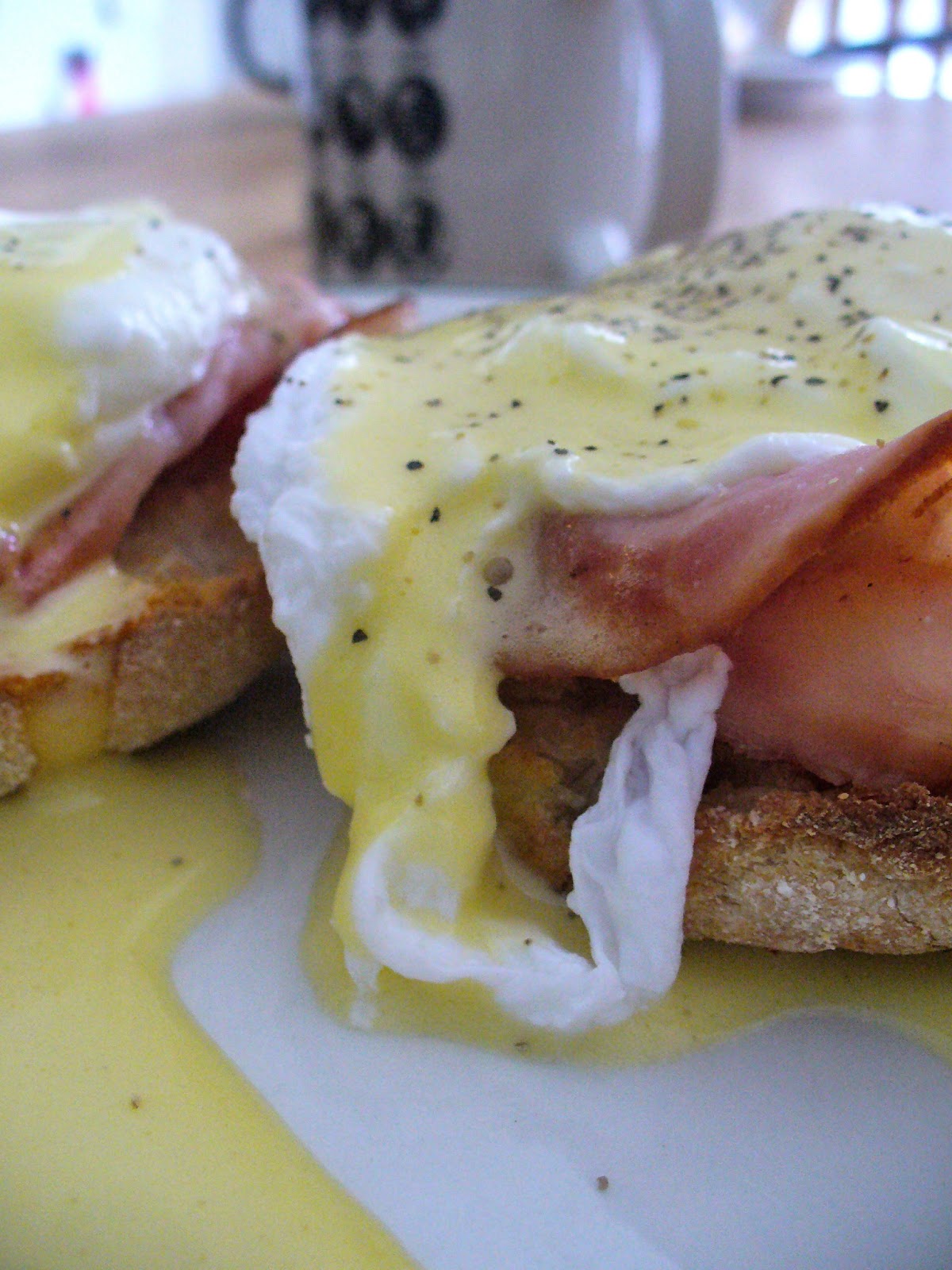
Local egg benedict

Sometimes I make homemade hollandaise. It is among my many talents, and not one acquired lightly. It started at one point, after s/v Secret, if I recall—when I decided to eat for breakfast what I really wanted most. Which is, always, always, always eggs benedict.

The world's most perfect eggs benedict is made by Ann Sather, in Chicago. Or maybe I only remember it as such because it was my first—with ham off the bone and cinnamon rolls as a first course. Cinnamon rolls you could eat with a spoon. A spoon! That's how gooey they were. Chicago. Good times.

So I decided I'd learn, and I started with a packet of McCormick powder, and then I broke out Joy of Cooking, and now the only thing keeping me from eggs benedict is the stick of butter and three egg yolks hollandaise needs. It also takes a fair amount of time, although not the time you'd expect: it's time of assembly, and getting everything to come out hot at the same time. The hollandaise will sit in a bath of warm water for a fair bit, but to get a perfectly poached egg at the same time as seared ham and a toasted english muffin is no mean feat. It's a skill I've glad I've learned now that I live someplace where there is no Ann Sather.

I did some fun cooking in Chicago. I learned how to bake and how to make homemade yogurt and mayonnaise and dehydrated a year's worth of food for the Appalachian Trail. But with the amount of amazing cuisine there was around, the surrounding milieu of culinary genius (in the Ravenswood area where my apartment was, there were restaurants of twelve different ethnicities within walking distance) it was almost a crime to cook for myself. Now here in the woods there is no takeout—no decent pizza—no delivery—no Thai—and I have learned, of necessity, how to cook these things. If I want eggs benedict, I must make it myself.

Luckily, sometimes, the neighbors across the street give us eggs, from their chickens. Now I am surrounded on two sides by neighbors with chickens, and I am unable to commit. Quelle surprise. But I get their cast-off eggs, and them I poach, and whisk, and photograph.

Saturday, November 17, 2012

And plead and beg

A Creative Life, from Alt NYC
An infographic I've been meaning to post for a while, that I found courtesy of A Single Layer.  It really captures some things I've been thinking about lately--to start with, do what you live.  Like the whole jobs thing, unemployment as a crisis.  I truly believe that the forty-hour-a-week job with some big company and benefits is going away, along with traditional manufacturing jobs.  And what's rising in its place is cottage industry, small business--people making soap or jam or pickles or books or kayaks in their basement and selling them, mainly on the cyber-web.

Jobs can't be created ex nihilo, not by Democrats, not my alleged "job creators," not by anyone.  Just by ourselves.  We create our own jobs, we shape our own lives.  So just do what you love, whatever it is.

Is it that simple?  Not really.  Because there's all the rest of the stuff on the list, which mainly involves other people.  The community, the church, collaborative partners--whatever you want to call it.

My favorite example is Gaughin and Van Gogh, as much as they are over-used models for the creative genius.  But how great is that?  You go out and paint all day, earn barely enough rent to cover the upper room in your yellow house, and then you come home and get drunk and argue about the meaning of the horizontal and vertical line and cut off your ear and hang out with harlots.  Maybe that's what all of us need in life.

Wednesday, July 18, 2012

Seen people blessed

Salad 
I found this blog this week, another Maine farming family, but one that doesn't seem to share the angst and anxiety, the sturm and drang, I thwart myself with all summer.  I said to two separate friends last week that gardening/farming is an act of wrestling with constant failure, and so easily I forget about all the anxiety from last year, all the failures--the cucumber beetles and hail and blight--and now when I look back on photographs, they seem to be taken from a lush tropical rainforest that magically produced vegetables.

Nevertheless, I made my first salad all from garden vegetables this week, and it feels like a huge accomplishment.  Arugula, red and green oak leaf lettuces, snap peas, green onions.  Tomatoes from the store, a fresh radish pickle as garnish.  It was possibly the most delicious greenery I've ever eaten.

I'm not going to lie about the effort it required--sometimes the harvesting feels like the most difficult part.  Getting out of the house with a pair of scissors and a bowl when I'm hungry and just want a snack, and trimming around the base of the lettuce plants and dumping the slug-infested leaves into the compost and finding good ones and filling the bowl up.  Cleaning dirt from the onions, worm-eaten spots from the radishes.  Convincing myself to put it all together into something delicious.

I, too, have things coming up from the ground that came from last year's plantings, most notably echinacea (cornflower) and Jerusalem artichoke, which has hit the big time as "sunchoke," so called by Gordon Ramsey.  And four or five volunteer tomatoes, all sprung up at the end of a row of leeks.  It's all very exciting, these little gifts that the universe bestows.  But the garden I have is never the garden of my dreams, or even the lush paradise I remember from the past.

Tonight I caught another PBS documentary--why are they all so good?--about harlequin romance novels.  It filmed various women, one in Japan, another in India, all hooked on the genre, juxtaposed with a male model who poses for covers and a British romance novelist.  The surprising thing, the beautiful thing, was watching these people, all so different, all searching for love in their own way.  And those who, after spending all their time longing for the romance they read about in books, realize that the love they're looking for has been there all along.  In their own home, with their own husbands or lovers.  That love, too, can only be found in the moment.

I'm trying to realize that this summer.  Failing most of the time, just as with the garden, but trying anyway.
Send us now into the world in peace, and grant us strength and courage, to love you, and serve you, with gladness and singleness of heart.
That's what I pray in the liturgy.  That's the reminder.  If only I can remember to grow my vegetables with gladness, and singleness of heart.

Wednesday, June 27, 2012

Do the things we choose


Didn't work as well as I'd hoped. Maybe my ribbon is dying, in addition to crumpling and ripping through. Physically decaying as I type. As far as I know it hasn't been changed since my grandmother's time, so it's not a big surprise. That's the next step--find a ribbon, buy some anti-corrosion oil, figure out why I can't get a justified left margin or a single space when I hit the space bar. Still. This was fun. I'm absolutely addicted to my Hermes Rocket. Some photos:

My desk--basil, Burroway, siblings, coffee, typewriter
Crumpling ribbon driving me crazy.  One does understand Jack Kerouac better than previously.

Saturday, June 16, 2012

Loch raven

June sky
The sky today was low and lean, the shade of purple it only gets this time of June. I forget how lucky we are, in these long, long days. The sun only hits at this angle this far in the north. Only here do we get this quality of light. Praise be to God.

Monday, September 12, 2011

Losing touch

The sky is blue in the water

I walked over two beaver dams today to get to the other side of the pond, and I’m writing right now while sitting on moss, surrounded by lily pads and felled cedar. I have about fifteen minutes before the real sun dips below the pines, and already it’s 58 degrees. My intention, all summer, has been to put on boots and trek over here, but when it’s warm enough to leave the long underwear behind, the bugs are too bad to sit still. I was inspired this morning, reading Glenna Smith.

She says, at 85, “At last I’ve learned to be aware of the world around me. I use all my senses all the time.” And she quotes Goldie Hawn, of all people: “Today, I’m the youngest I’ll ever be, and I had better make the most of it.”

Today is what constitutes a big outing in Aroostook County. I should have brought a thermos of coffee and a picnic. I’m trying to go into winter full armed this year, and this afternoon, spent with the alder and the fungi, will be an arrow in my quiver. It’s hard to feel, every day, the loss of another fifteen minutes of daylight. Once the dark descents, most nights I click on the television, and I'm realizing how corrosive that is.

Maybe what made my blog so interesting on the boat and on the trail wasn’t so much any adventure, but the lack of a television. I was forced to entertain myself, spending hours staring into a campfire or watching a sea cucumber pump sand through its digestive tract. We used to spend hours listening to music, playing cards by candlelight, the way people amused themselves before electricity. I still have gin rummy scores carefully notes in my little notebooks.

Now I feel peeved if I miss Jon Stewart, thankfully syndicated on Canadian channels. In the winter, the addiction to television gets worse. I wish I were brave enough to kill it entirely. I’ve never bought a TV, in my life, but I’ve been given at least a dozen. Misery loves company. But the hardest thing is kripalu, having compassion for myself, not condemning myself for my own weakness. I keep meeting yogis who attended trainings at an institute named for kripalu, the Sanskrit word for compassion.

To merely sit and be at peace for this moment, grateful for this place, for the warmth still in the atmosphere, for the dragonflies and spiders, for electricity and heat, grateful even for modern media. I want to assert my control over these digital influences. Maybe the true victory will be when I can own a television and still choose to spend an evening playing cards by candlelight.

Sunday, August 28, 2011

Marion, Massachusetts

Hunkering down today because of the alleged hurricane caused me to think about electricity. The storm itself died before it reached New England, as I suspected all long during the last week of mass panic, but after the wind arrived it was still strong enough to knock down countless trees and the power for the entire day. In some ways, it was the best day of my mini-vacation: I played pool, darts, and the piano, read back issues of magazines and the newspaper, ate food I had forgotten about and would otherwise go bad, and engaged in candlelit conversations on the deck while maples surrounding the house dipped and swayed.

The other source of entertainment was the police scanner. In between reports of yet another branch fallen on power lines, there were stories about domestic disturbances, children abandoned to swim in the storm surge, drunk women swaying through the parking lot of the local package store, and flooded causeways. As if everyone went crazy without electronic devices and televisions to keep their hunger at bay. Even the doctor and his wife across the street, outdoor enthusiasts and runners, broke out their giant battery-powered halogen lamp, as if light alone could keep away boredom.

It made me think about even a hundred years ago, when people had to do things like play games, make music, draw pictures, and write letters to keep themselves amused. How things have changed. A day without electricity made me realize that it’s the central source of civilized change, the civilization that I’m not always sure is a good thing. The times in my life when I’ve been happiest are those when I didn’t have electricity. When I lived in a tarp and spent my evenings gazing into campfires, or when I lived on a boat and burned hurricane lamps while I played cards.

I don’t want to minimize the benefits of the electronic age. I couldn’t be writing these words without electricity and its accoutrements. Yesterday I took a field trip to the Boston Museum of Science, where they have the world’s largest Van de Graaff generator, a device that generates lightning indoors. It was awe-inspiring and loud and made me feel like a kid again as I plugged my ears. But it was also shocking (ha!) to see how powerful are the forces that run our lives. To envision the fluid stream of electrons animating our wires, our walls, and our fingers.

As dusk fell tonight, we broke out candles, Shabbas votives made in the Dominican Republic. Maybe I’m not ready to give up my electricity, but a furlough from it every now and again seems a good thing. Sometimes my furlough lasts months or years, on a trail or a boat. Sometimes just a day. Maybe those of the Jewish faith are correct in taking that Sabbath every week. If I were brave enough, maybe I would too.

Wednesday, May 04, 2011

Something isn’t right

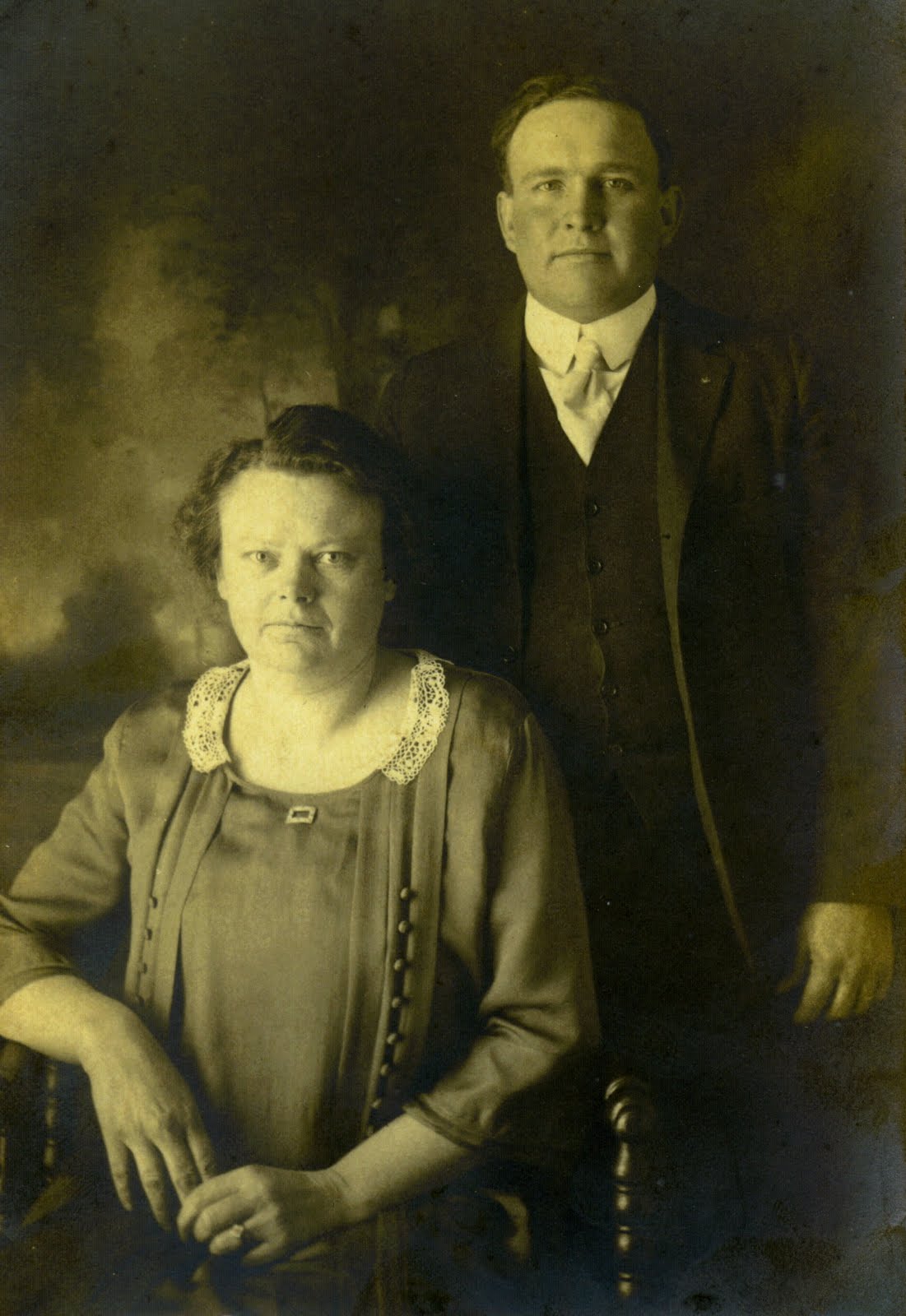
Cora and Floyd Jenks, married November 10, 1915

One of the amazing things about the last couple of days has been the giant box of photographs uncovered at my grandmother’s house. I guess a couple of my cousins, maybe my aunt, knew it was there, but I don’t think any of us knew how many of them there were. We’ve discovered letters and photographs from the 1800s, full scrapbooks with handwritten notes, my grandmother’s high school yearbook with all of her friends’ inscriptions. The story that’s captured all of our imagination, though, is that of Cora Douglas and Floyd Jenks.

I grew up hearing the stories about Cora, my grandfather’s mother. She was beautiful, and artistic, and musical. She sang a perfect soprano, and would bail on chores in order to draw pictures in the apple orchard. Looking through the box of photographs, hers is the presence that has come most alive. We’ve found her paintings, and a photo of her with her camera in hand, the baby book she made when her first son was born. She seemed to have thought of herself as a delicate flower, and took pictures of herself and her sisters in elaborate poses.

"The last rose of summer, blooming alone" --Cora's inscription

She and my great-grandfather Floyd were desperately in love. They married when she was twenty and he 24. Under a picture of the rose-strewn bower where they were married, Cora wrote “Where two hearts were made one.” She and Floyd would harmonized together during hymns in church, and moved to their own farm, five miles from her parents. She became pregnant, and named her first baby Douglas, her own maiden name.

Then she became pregnant again, only ten months later, in 1918. She contracted influenza, while pregnant, during the epidemic of 1918, and died only three weeks after my grandfather was born. He always blamed himself for her death, and evidently his father and brother did, too. The baby boys moved back to live with their grandparents, and spent the first five years of their lives being cared for by Agnes, Cora’s older sister. Agnes was eight years older and unmarried, a spinster.

Five years later, Floyd married Agnes, the woman whom my grandfather always called “mother.” She’s the one who made both boys boiled-egg sandwiches, on bread smeared with an inch of lard, every day for lunch before they walked to school. She’s the one who kept the Belding farm together, who made the butter, who cooked and cleaned. She’s the one who had a fifty-inch waist, according to family legend. When I hear farm wife, I think of her.

Floyd couldn’t go to church after Agnes’s death. When he heard the hymns they used to sing together on the radio, tears streamed down his face. When he died, a year after Agnes, he chose to be buried next to Cora.

My grandparents now rest beside Agnes, in a little graveyard beside a potato field, beneath a maple tree. Both women have become real people in my imagination. I imagine they loved each other, and that they both loved the boys. I imagine that Floyd loved both of them in different ways. He loved Cora with youthful fire, with passion. He loved Agnes with the day-to-day love that comes from hard work, and sacrifice, and steady, regular habit. Which is better? I don’t know. Cora remains 24 years old forever in our memories, but Agnes is the one who got a lifetime of contentment and companionship.

Agnes and Floyd, married 1924

Wednesday, April 13, 2011

California-style, I found myself singin'

Little house at the edge of the woods

I wanted to post these Lessons from 10 Days of Self-Help. When I was in Chicago with my sister, we gave each other a yoga retreat, right in the apartment, while the girls were napping. We’d talk about life, where we were, and we came to the conclusions below.

I finally feel like I’m anchored here, like I can remember what happiness feels like. I don’t think you ever really know when you’re happy, but you know afterward. Every day I wake up, and think: was I happy yesterday? And I answer: yes.

It’s mainly because I’ve been following the path my sister and I talked about.

1. If you can't do it from a place of love, don't do it.
2. There are only ever really two options: do the dishes or don't them. (See below.)
3. Let it go.
4. No regrets.
5. Tell people how you really feel. Don't try to small talk if you can't.
6. If you don't have anything to say, just ask how others are doing and really listen.
7. Nobody is bad at yoga. Just like nobody is bad at anything else in life. Someone just may not have practiced a pose enough yet.
8. Practice makes perfect, or however that famous Buddhist guy says it. [“Practice, and all is coming.” Sri Pattabhi Jois]
9. Get rid of useless stuff that just drags you down in life. Each thing you own is one more thing to worry about.
10. Take care of yourself. Treat yourself kindly. Do not harm yourself.
11. Don't be scared to try the next difficult step, in yoga, and in life. You can't fail.
12. Quiet your thoughts. Let them drift by.
13. Don't try to do a million things at once and fit as many activities and achievements into a period of time (be it five minutes or a lifetime) as possible. Meditating, even amid the chaos, is just as important as getting stuff done. Often it is more important, because it allows you to know what must be done.
14. Peel off the band-aid. Admit you have a mouse problem. Or a rat problem. Or a lice problem. Or an alcohol problem.
15. Procrastination is fear.
16. Don't agonize about loading the dishwasher, doing the laundry, sweeping the floor. Do it or don't do it. Then you can do yoga.

Here’s the “do the dishes or don’t do the dishes” story, courtesy of festivus.net. (Click for the original post.)

I read another story that I’ve been trying to keep in mind when I get crazy angry about all the unfair things. The story was about a woman whose husband no longer drank, but was still what they call a “dry drunk” — still exhibiting all the symptoms of alcoholism, just no longer drunk while doing it. And she began to exhibit the symptoms of a dry drunk’s wife, still trying to control him, make him behave the way she wanted, believing it was his behavior that caused their unhappiness, and if she could change it, everything would be better.

She decided that things would be better if he took more responsibility for household chores, so informed him that he would now be doing the dishes from now on (this is called: setting yourself up for disappointment). The first night he was supposed to do the dishes, he just got up and left the house after dinner. She called an Al-Anon friend in a rage, explained the situation. “And so now if I do the dishes, he’ll think he doesn’t have to!” she said. “So don’t do the dishes,” her friend said. “But then the dishes won’t be done!” “So do the dishes,” her friend said. “But then he won’t!” “So don’t do the dishes.” “But they have to get done!” “So do them!”

Eventually she realized that these were truly her only two options. Should they be the only two options? Were they fair options? Those questions don’t really matter, because they don’t change the fact that those are the only two options. The third option, “Fix my husband,” doesn’t actually exist, but putting all your energy into it provides a great distraction from reality, and a great scapegoat for your problems. “If only he would do the dishes,” instead of, “If only I would stop trying to force him to change in order to fix my unhappiness.”

I think about that story a lot, whenever I get into a rage. I try to simplify my options. My co-worker, for example. Goddamn, I hate her. I hate that she asks me questions. I hate that she does her job wrong. I hate that I have to clean up after her… hey, wait a second. I don’t have to clean up after her. But if I don’t, then the work won’t get done! Then clean up after her. But if I do clean up after her, then she just keeps getting away with it. Then don’t clean up after her.