Showing posts with label farm. Show all posts

Monday, August 17, 2015

Aroostook County, Maine

Last days in Massachusetts, summer at Mary's Pond
It's probably not obvious that I've been slowly posting my log from my Appalachian Trail hike, which lasted three weeks and took me to about the mid-point of New York state on the AT.  Then Big County (K.) and I took a dory trip around Buzzard’s Bay—a week of camping and rowing and chilling out in the sun and on the water.  Then a week at camp with his brother and family, and then a week camping up the coast of Maine with some of our friends—one couple we know from the Appalachian Trail in 2004 and other County friends.

I believe I’ve spent more time in a tent than in a bed in the last two months—which is exactly as summer should be, in my opinion.  But we finally pulled into the two-year overgrown driveway on Snow Road, early and unexpected, and our neighbor called the state trooper because we hadn’t been there in so long.  Now we’re figuring out what to do with two years of burdock and goldenrod and fallen trees.  K. is hand-scything the lawn and I’m piling it in the compost bin.  I’d like to pretend I’m hand-baling hay, but I am not that skilled.

We are back in Aroostook itself.  Which means no internet, except at the super-slow library.  Last time we were here I eventually relented to $60 a month satellite internet, but I’m trying to resist this time.  There’s a peculiar kind of silence in an internet-free zone.  More and more I find that when I have it I can escape into the internet as into a kind of void.  And now that I don’t have it, I actually want to make use of it for things like pictures, words.

If that’s what it takes.  Franzen allegedly disables his wireless cards so that they can’t access the internet, going so far as to stick an ethernet cable into its port and cut it off, then sanding down the port so the computer can never again access the internet.  I have that stillness here.  Silence and stillness.  As if the County is a time capsule, or a time machine, taking me back into the past.  The house, other than accumulated mouse crap, is as it was.

I’ll continue to email in posts as I have internet access, maybe filling in some gaps in the past few months, maybe not.  I think of this as a literal world-wide-web log, a ‘blog, for myself in the future as much as for anyone else, and I want at least my anniversary hike to be preserved.  I’ve been adding links to my 2004 hike, too—again, for myself as much as for anyone else—it’s been so fun for me to go back and read those posts, to remember who I was then.  So much of it I remembered, and so much I forgot.

Wednesday, August 20, 2014

Marion, Massachusetts

Family
Coming back to the United States of America has meant a lot of change.  Some things I am happy about:  drinking water from the tap, paper towels in bathrooms, the fourth of July, cooking for myself, guacamole, cheese.  Being able to flush toilet paper down toilets without worrying about it.  Best of all:  pointing my feet at people without being rude.  Things I have not missed:  socks.  hoodies.  coats.  long underwear.  cold. 

I’ve been traveling a lot since I returned to America, and I am alleged to be writing about travel, and yet somehow travel within these United States feels less deserving of catalog.  But that is my own stingy prejudice, I know.  I spent two weeks in Chicagoland and a week in Ann Arbor—sampling local cuisine, attending local cultural events, and visiting local farms—all of which I would be proud to advertise if it were in Vietnam or Laos.  Why not here?

So.  On we go.
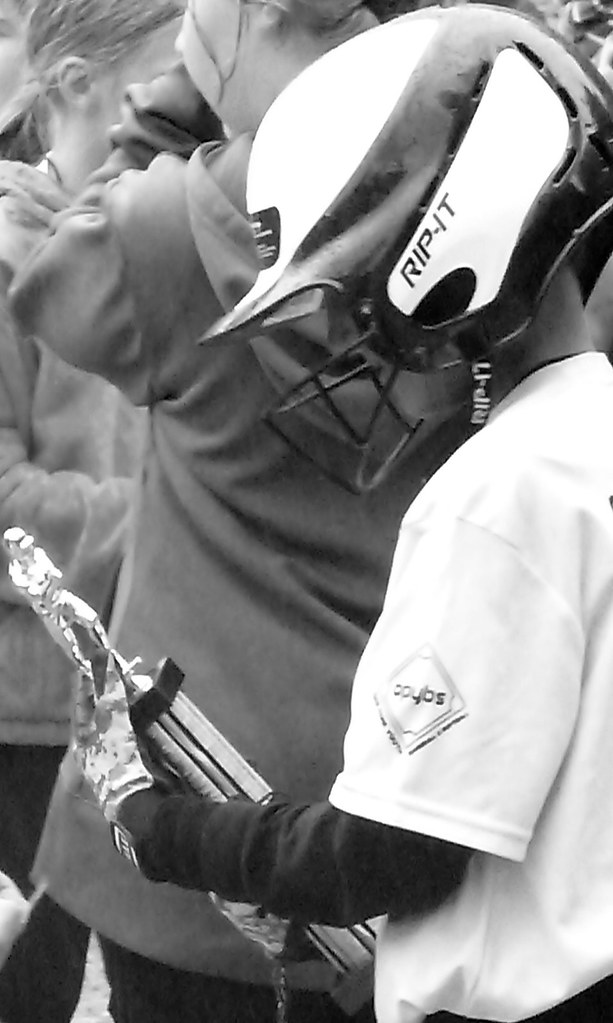
Sophia examines her trophy in private
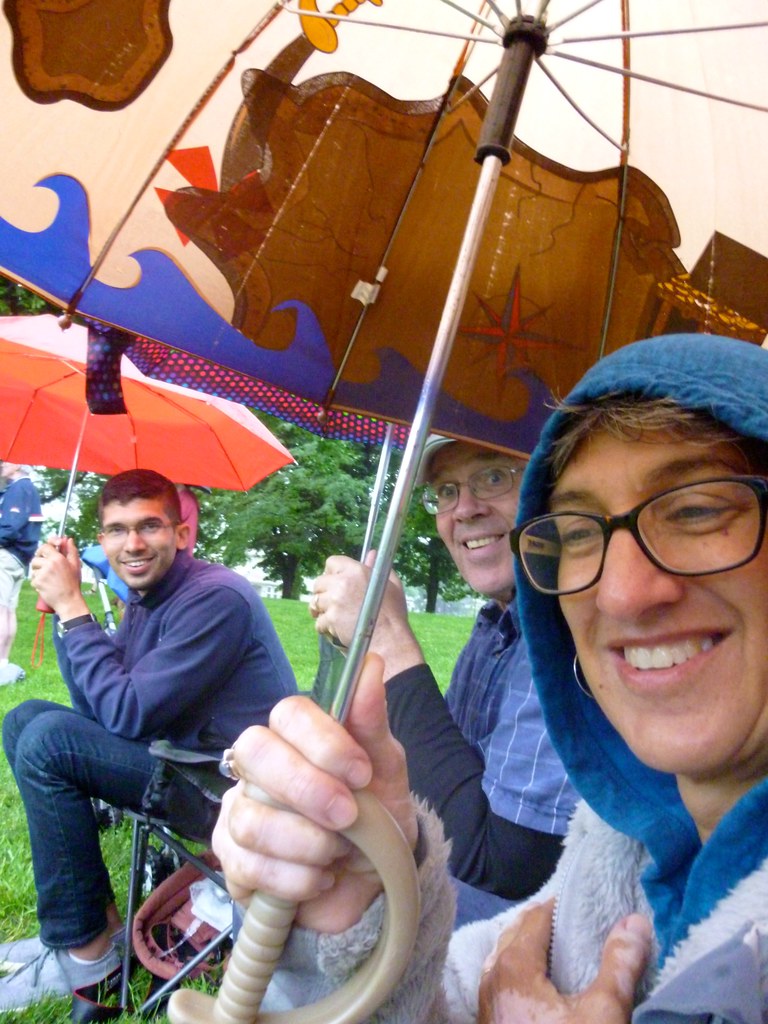
On my third day after arrival I attended my niece’s championship baseball game, during which she scored the winning run, in the bottom of the ninth inning, thus winning the entire season after losing to the opposing team the previous night.  Too good to make up.  We sat in the rain to watch her, all five of us—my entire immediate family.  Do we resemble each other?
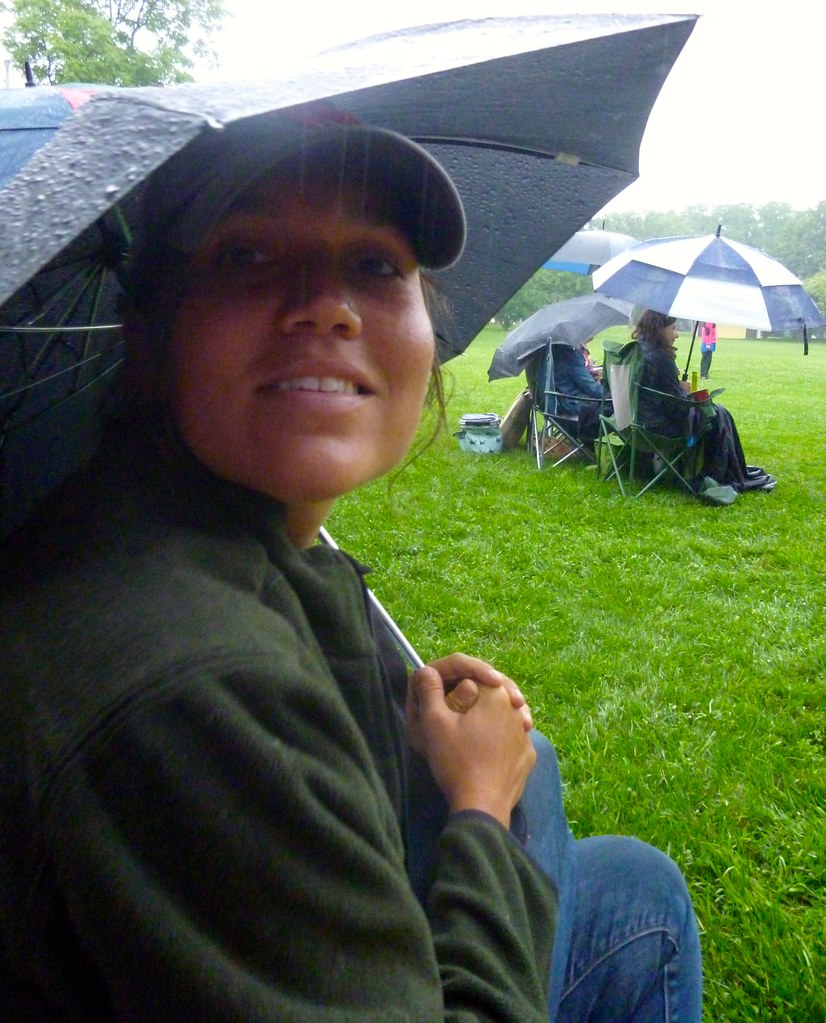

Beautiful sister
Then there are these interesting signs, still hand-painted, at Pan’s in Oak Park.  It’s a local grocer where my friend Amy used to shop when she lived down the street, when I lived several more blocks down, for three years.  We used to walk here and to the Avenue Ale House, our local, and the Mexican restaurant across the street.  It’s now something else, maybe high-end Mexican, next to the gastropub where this time I enjoyed Chicago gin and a burger made of local ingredients.  House-made ketchup.  Farm-to-table greens.
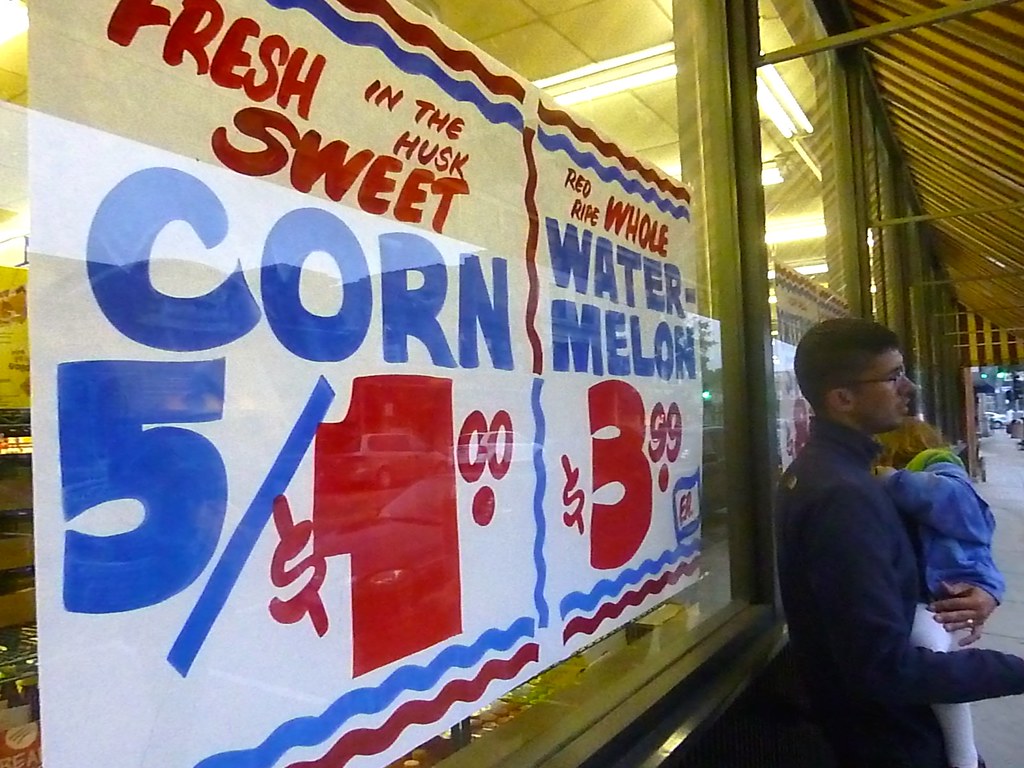

Fresh in the husk
In Ann Arbor, I visited a farm where we fed pigs corn.  I felt less bad about eating them after I saw them, in a farm’s usual way of hardening one against life’s cold realities.  I saw where they brewed their beer, and met co-op workers, who travel and freely work for room and board, at farms around the country.  This farm, Mulberry Hill, which runs a CSA (community-supported agriculture), also just held its own Ann Arbor version of Burning Man.
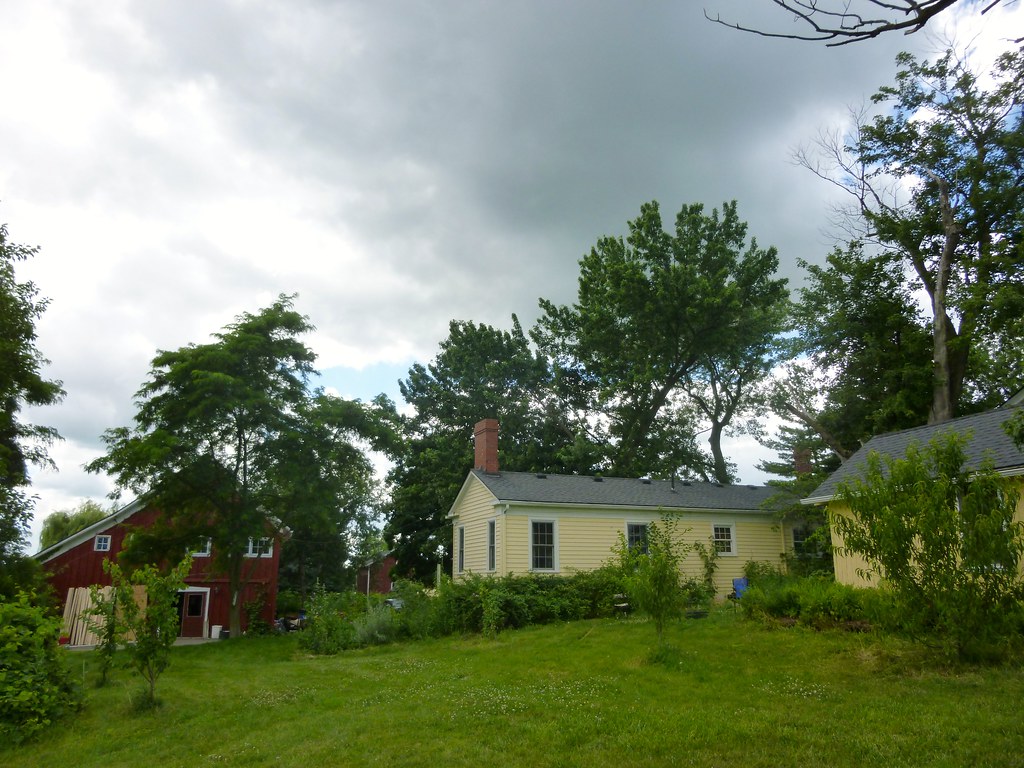

Ann Arbor farm

Although I complain about eating meat, I feel better about eating pigs after spending some time with them.
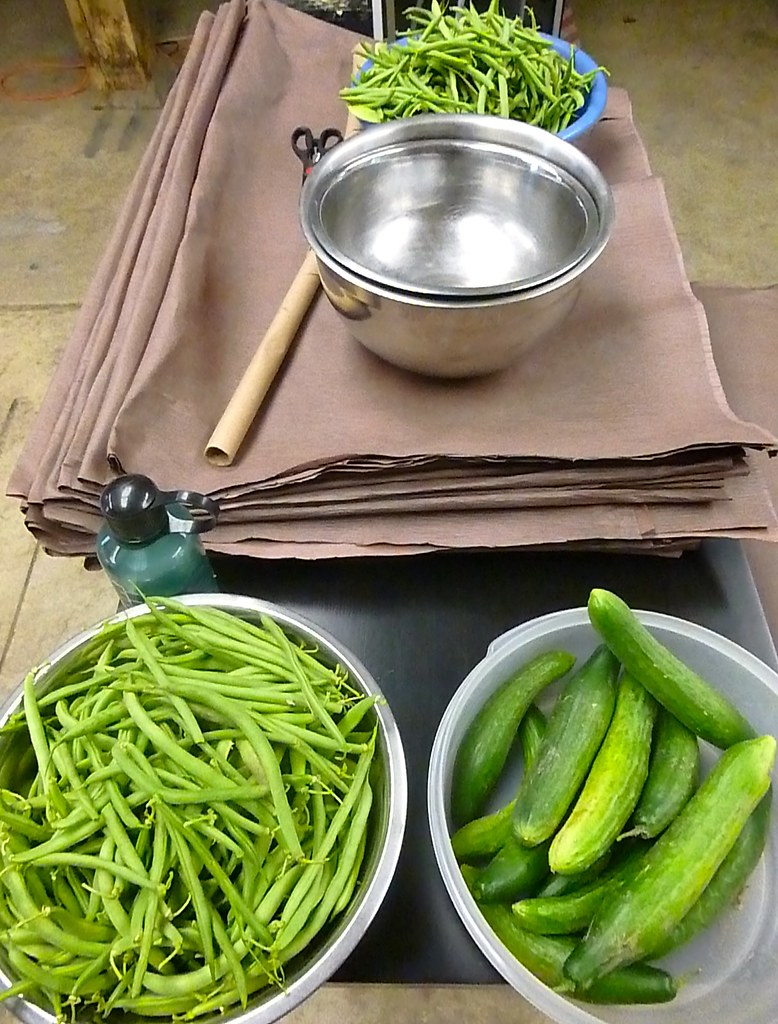
Cucumber and beans being prepared for CSA delivery
Sonia and I went for lunch at a vegan restaurant with vertical gardens.  We envisioned our own life of pro-gluten tee-shirts.  “Ask me about my gluten deficiency.”  I had vegetarian and organic mac and cheese, with local butternut squash in the sauce.  It was nutty and delicious.  We wanted to ask for extra gluten in our meals, but did not.
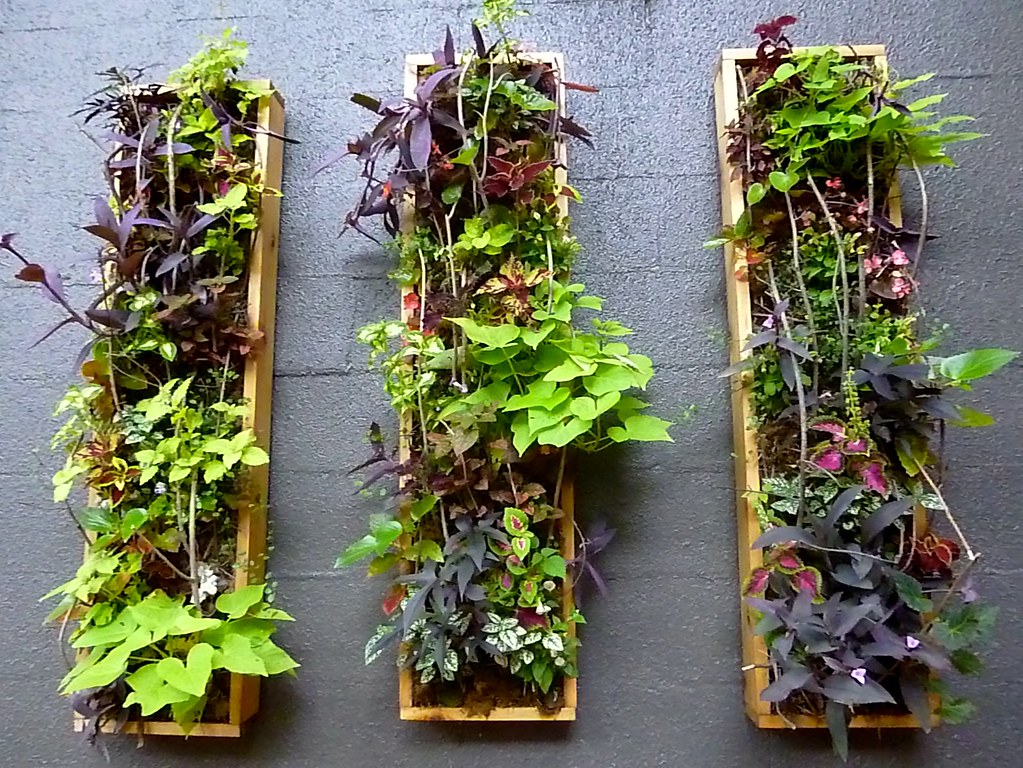
Vertical gardens, although it's hard to tell
My sister and I made paleo Thai food.  What, you say?  You didn’t know cavemen harvested rice kernels as they hunted and gathered?  That they pounded palm kernels together for sugar?  Well, now you do.

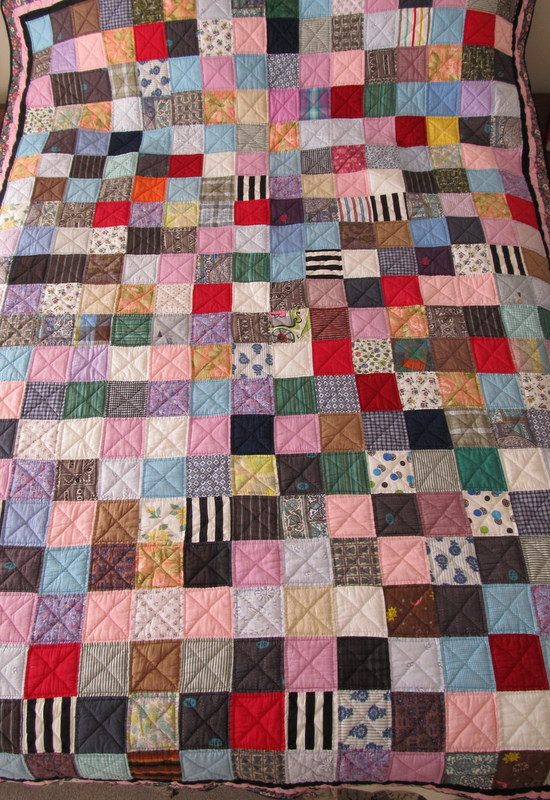
We also started quilting.  I am addicted, now, to patchwork, in all forms.  I bought a book on it, at an Ann Arbor book sale.  With pictures of the Baltimore album quilts, of which I'd never heard.

A quilt at the American Museum, not my photograph
And then I started searching online finding things like this:
Knitted patchwork, not my photograph
Or this:
Called a scrap-buster, but my favorites are the crazy quilts that use randomness as an organizing principle
(not my photograph)
Or this:
Something called domino knitting, where each block leads into the next--again, randomness, and I love it
(not my photograph)
Now I’m back in Marion, working on another boat project.  No travel, but future posts about teak and mahogany, the joys of hand sanding with 200-grit.  I slowly slip back on my socks.  The fan goes quiet.

Spirit, under construction
Here, too, I photograph beaches made of marble.  Regatta races in the fog.  I wrap my Thai fabric around my shoulders.  I want to be in two places at once.

Beach made of marble
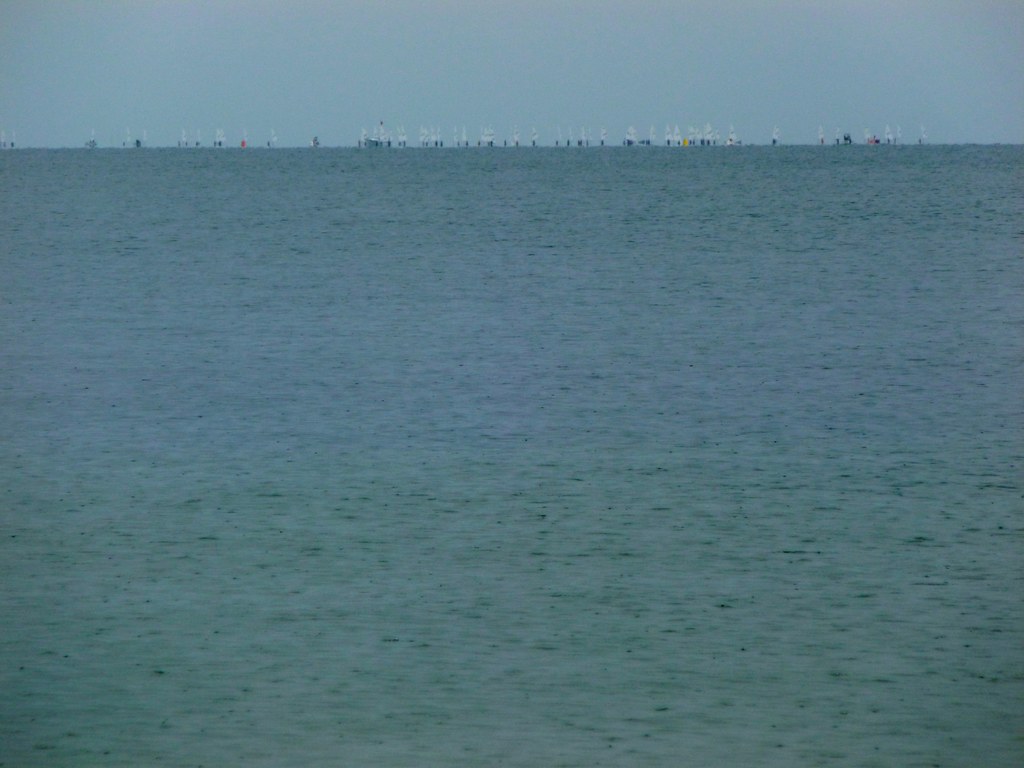
Regatta in fog
Here, too, I am grieving, grieving and miserable.  My ability to speak and read and write Thai has been put in suspended animation, somewhere below consciousness, somewhere I can’t access.  I fall down body-image rabbit holes, something that didn’t happen as much in Thailand.  There is was normal for me to be bigger than an average person.  Here Americans look at me with cold scorn.  I photograph the surface of the water in Marion harbor, wearing my Bangkok tie-dyed clothes.  People stare.  Men.  I look at them and smile and they don’t smile back.  I wish I’d been brave enough to dye and dread-lock my hair, too.

I’m hungry all of the time because of no more Thai food.  Meal here consist of meat.  Bread.  Cheese.  I’ve eaten my last moo daeng, pad Thai, pad see eu, curry, som tahm, gai yahng.  I’m already forgetting how great it is to hear Thai, see Thai, speak Thai—food, language, people.
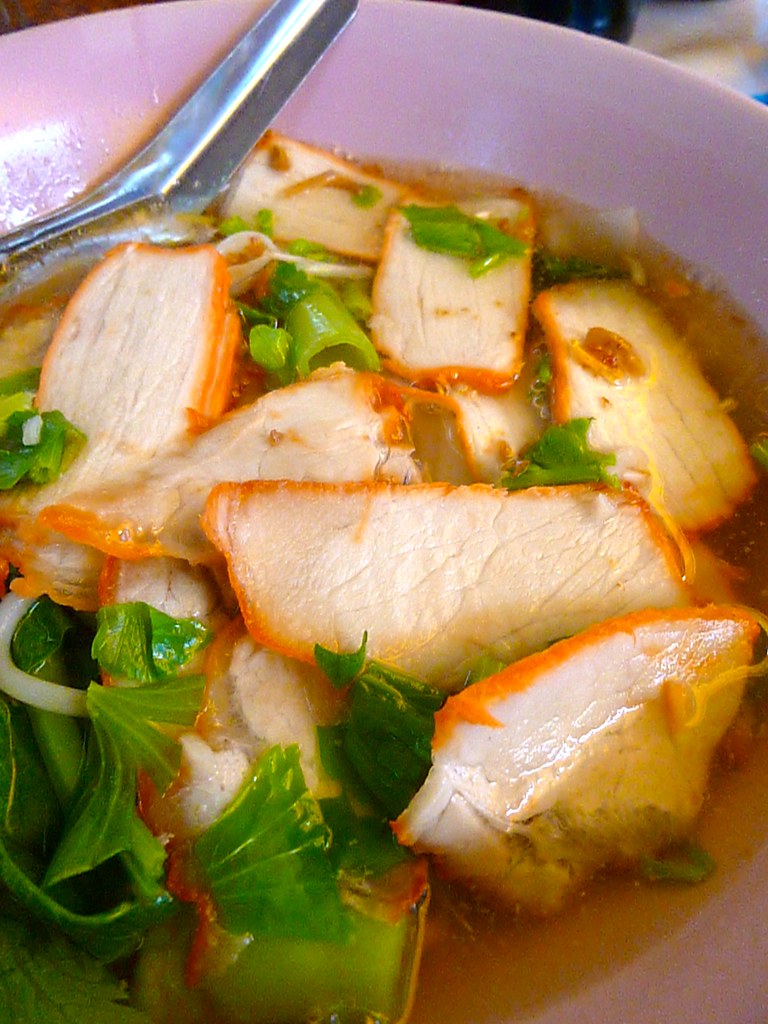
Moo daeng (red pork--okay, it doesn't look like I'm protein-starved based on this bowl)

Late lamented pad Thai
I even miss the smell the Argentine kid at Bluefin complained about, saying, on his first day in Asia, wrinkling his nose:  what I didn’t expect was the smell.

Every so often I catch a whiff of it here, in this air that smells like nothing, a whiff of the dank, fetid, rich smell of something rotten and it remains me of home.  What I wrote in my journal the first morning in Bangkok was:

It smells the same.  The humid air.  That eucalyptus and incense smell in the morning.  The mildewed bathrooms.

Is it the lack of light and vitamin D that brings me depression here?  Is it the meat-heavy diet?  My brother attributes the exponential rise of depression in modern America to the toxic hormones in our factory-farmed meat, animals that live and die in trauma, and the stress hormones in their bodies that go into ours.  In Thailand I lived on vegetables and rice and oil.  I ate fragments of egg and meat in almost every meal, but barely more than fragments.  When I bought a chicken skewer at the market I wolfed it, protein-starved.

Or am I deluding myself?  I had plenty of anxiety and depression in Thailand, too—fear of locals, fear of strangers, days when I just wanted to speak English and order pizza and stay in my room.

Or is it just aimlessness now that I’m back, not knowing what or where I want next?

Sunday, March 30, 2014

Maecharim, Thailand

Home
Chiang Mai, Thailand:  19 March - 26 March
Nan, Thailand:  27 March
Maecharim, Thailand:  28 March - 30 March

On the move again, after a full week in Chiang Mai.  Despite its full-on tourist-town status, it did have gorgeous gilded temples and spectacular night markets.  As much as I despise these tourist-track stops (the banana pancake trail, after Alex Garland and Lonely Planet) they draw us in.  I think the elephant-pants trail would be a better name.  All the backpackers where elephant pants, and everyone sells them.  I looked for a pair for a while, and then stopped when I was unable to find a single design that did not incorporate elephants.  It’s difficult to feel cavalier about elephants as decor when I know about the pajaan.

Nevertheless, some things are easier if we’re not the only farangs in town.  We shopped, ate farang food as a break—my halfway marker.

But now we head back in the wild.  Almost everyone (that we have met and I have read about) heads north from here, through Chiang Rai and the Golden Triangle and onto Huay Xai—or by bus direct to Luang Prabang, the next backpacker stop.  But we head east instead, into Nan province, the northern district that remains one of the least frequently visited areas of Thailand.  My parents are running a weeklong English camp at the school there, the school their time in Thailand helped build.

Although my visa soon expires, so we’ll only be able to stay a couple of days, I still wanted to see them and help in any way I can.  If I’m honest, though, I also had a selfish reason for wanting to come.  It’s been my failed intention all along to visit the sites where I lived as a child, and this is the first real chance I’ve had.  The apartments and complexes where I lived in Bangkok are being razed.

This house, though, is where we spent two quiet summers.  Living in a concrete house on mission grounds, bathing from the collected water dip bucket in the concrete bathroom with the drain on the floor, no electric after dark—where I read all of Sherlock Holmes.  Twice.

I feel like those precious summers meant more to me in some way, than other chunks of my childhood—inspiring me to live sustainably and ultralight as much as possible.  To cast off:  money, desire, other people’s expectations.  There, at this house, I collected an egg from a chicken in our backyard, and fried it, still warm.  Thence comes my love of farming as an avocation, my love of seeing where food comes from.

Also, maybe, my continued love of fried eggs.

So in coming here, to the mountains of Nan district, I want to come home.  Sometimes I’m this desperate wandering child, clutching any scrap of home around myself for warmth.  Maybe this is the closest thing I have to a home, the only building where I lived as a child that still exists.  A home where I still don’t belong.

The house is bedraggled and cobwebbed and padlocked, but it looks exactly right.  Smaller, maybe, as people always say on going back.  The backyard doesn’t possibly look big enough for chickens.

One night there Dad drives us up the rutted dirt road to the refugee camp that used to be here.  Lao refugees from the communists across the border.  My whole childhood I thought the people we moved here for were Cambodians, refugees from Pol Pot, but I never asked.  Most of the people here were Hmong, fighting with Americans against Lao guerrillas.  Many of them emigrated to the States.

The forest is hazy and brown, from all of the burning.  In hot season, the farmers burn the undergrowth.  I used to call this slash-and-burn agriculture, but there’s not so much slashing.  It just seems like a carbon-intensive and old-fashioned way to make biochar.

We see a bamboo hut, and speculate on its rental costs.  This is really the middle of nowhere.  No elephants in sight.

A photograph by Ron Jude -- read his interview here:  Set the woods on fire

Tuesday, March 18, 2014

Nam Sohm, Thailand

12 March – 18 March

K. and new friends
We're in the heart of Eesan, or so I hope. A place where only farang fans come. The husbands of the ex-bar girls. Maybe that is too false-hearted of me. Too ugly.

Although also true. We told a tuk-tuk driver in Bangkok that we were headed to Eesan to get away from farangs, and he said: but they're still there. “Fans” are there. “Fan” is the Thai word for intimate partner or spouse, a borrowed word from English. It's a fun word to use. Whenever I say that K. is my “fan” I feel like a celebrity.

So the town is chock-full of ancient decrepit boyfriends with cute perky Thai girls in braces. But I'm the only female traveler in town, and people seem shocked to see us—what brought you here? They ask. We don't get many tourists here. It only makes sense when I explain that my brother has a friend from here, and she told us to come visit her family. The only people that come here have a connection.

Which is exactly what we're looking for. Despite the fans, there is cultural wellbeing here, a sense of true authenticity. In short, it's the best week we've spent in all of Thailand (and that includes the week at the beach villa).

For one thing, the food. As always, the food. Prices are more or less standardized across Thailand, so a bowl of noodles or a simple dish over rice is always basically B30-40 ($1-1.2o), with the notable exception of tourist resorts and restaurants. But what is not standardized is quantity and quality. What B35 buys you at a city bus station, a half-full bowl of broth-heavy soup (albeit still delicious, arguably better than the best Thai food in the States), a bowl that leaves you needing to find a chicken skewer to fill up, is probably half of what B35 buys you here. Here, we go out for noodles and receive giant tureen-sized bowls chock-full of noodles and meat and bean sprouts and greens, more stew than soup. We almost can't finish them. Almost.

I'm actually able to have Thai conversations here, able to hang out with Thai people and cook and eat with them and do: what? Live a normal life, but in Thailand. People here are happy to see two goofy Americans drive by on a miniature bike (miniature only in comparison to our size), happy to smile and laugh and not try to overcharge us, thrilled at my attempts to speak Thai. They are thrilled just that we are here visiting—like the old Thailand, the Thailand from fifteen years ago, the Thailand I remember.

It's also a vague relief to have a break from these places where there are a ton of sights to see and attractions to visit (not that there aren't plenty of temples and waterfalls to visit here, too, that we're not getting to), because all the sightseeing begins to feel oppressive. Like a duty necessarily carried out, not something pleasurable. Nam Sohm just feels like normal Thai life in a normal Thai town, about the size of Mars Hill, the town where we go grocery shopping in Aroostook, and in the same pastoral landscape. The town is surrounded on all sides by rice farmers, the same way we're surrounded on all sides by potato farmers in Aroostook.

Somtahm with sehn, noodles, added
People here make sense to me. They live the same kind of life I do at “home.” I compare prices with them, finally able to communicate in something approaching comfort. Meat, dairy, and potatoes are unsurprisingly cheaper in the States. Things like shallots and limes—exotic ingredients in the States but necessities for Thai cooking—are cheaper here. We eat food that we've never eaten before, like green papaya salad (somtahm) with noodles mixed in, an all-in-one Lao dish that they only make in this province. It's delicious and spicy, a refreshing change from noodle soup and sticky rice.

One of the lizards we ate for dinner.  A bearded dragon, I think, like the ones they sell in American pet stores.  The boys in the neighborhood go fish for them, with bamboo poles and noosed ropes.
We eat lizards: skinned and dried in the sun and fried and then pounded in the mortar and pestle with herbs and spices into a kind of meat salad, like lahp. They tell us they eat snakes and scorpions and rats (not city rats, they explain with a shudder—ground rats from the forest—which is better if only mildly so). They'd eat them more, I guess, but they say they're harder to come by now, harder to find, that it's hard work to get them. Unlike the tourist areas of Thailand, where I feel wrung dry by touts, here I feel dazed by my own wealth. We go the market and buy 100 baht ($3) worth of chicken and pork and innard skewers to share, and the lady shoves in a whole handful extra. People behind us comment that we've already spent 100 baht, as if it's an unearthly extravagance. I feel guilty for my mild indulgences, my B10 yogurt drinks that are still half of what a big bag of market soup costs, enough to feed a whole family.

Lizards, cooked, as lahp
Here, on a budget, we live like kings. We found a teak house, three-bedroom, for B1500 a month. It doesn't seem possible, and yet it is. I dread going back to the reality of the tourist track with its crepe and falafel stands, all-you-can-drink specials, reggae bars, and dance clubs. I'm just happy. I'm trying to just let myself be happy, not obsess about how little we're doing or how little time we have left or much there is we could see.

Sunday, September 29, 2013

Bridgewater, Maine

September 29 -- 2009

Leaving the farm is going to be harder than I at first thought, I must admit. I also must admit that I've been grieving for much of the last month, maybe still grieving even for the objects I lost at sea—not exactly the objects but the ideas. The leather notebook with five years of story seeds. The dream journal with four months of dreams.

I know I must regard these things as ephemera, as things that are lost, and I feel I should be strong enough by now to let the things go. To let all things go. As I must let this place go if we really decide to adventure again. But I am dragging my feet.

The longer I farm, or whatever it is we're trying to do here, the more I realize that it's simply an act of heroic emotional resilience. I understand why farmers don't want their kids to be farmers. Because there's tragedy in it, and death, and I simply can't bring myself to eat or harvest the food in the garden as I write, knowing that I'm leaving it, that I'm leaving this land. I simply don't have the emotional strength for it.

Which maybe is okay. Maybe all shall be well and all manner of things shall be well. Maybe it's okay that I just ate four leaves of kale with my rice tonight. We've learned, also, that the boat needs its wooden mast replaced, so whatever departure may not be as imminent as I'd hoped. And of course as soon as I learned that I was desperate to leave this place—leave this earth, these roots—always wanting what I cannot have.

Friday, July 05, 2013

Into the eye of the storm

Bad, blurry photograph taken to legitimize my existence to you, dear reader, thus proving that I am, in fact, at work

During the second week of my (genuine, not textual) solitude here, I have committed to putting a new plant in the ground each day, no matter that we're already into July, no matter that I am unable to commit to a place enough to be sure that I won't be in Laos when these things fruit. Or, more likely, that they'll freeze in the middle of fruiting, which breaks my heart every year, and every year I plunge headlong right back into it. Nevertheless: I am planting.

Today I gave in and went to the greenhouse, where seedlings are half-price, which means I am late but not hopeless. The greenhouse, a tubular structure with sheeted plastic flapping in the breeze, was empty save of robust seedlings. I took what I wanted and left my cash beneath a pen near the door. That's a small town for you.

This fall, at least, we will have cucumbers, squash, and peppers, those warm-weather vegetables I always procrastinate starting. And I came home and dug the cucumbers right into the ground. I have so much more ownership being the only one responsible for doing everything—even taping the hose where the lawnmower ran over it, even skewering the sprinkler into the ground, even missing the roots and frying leaves of my plants this morning, despite knowing better. If I don't do it, it doesn't get done, and if I do it badly, that's only my fault, too.

So every day I go dig something into the ground. I use a trowel and s three-pronged pitchfork that probably has a fancier name to dig out weeds. I am combating my tendency to work for twelve hours one day and do nothing for eleven, when I know, truly, that it's better for my soul to work an hour a day for twelve days in a row. Consistency is the magic, ephemeral spell.

Wednesday, July 03, 2013

Thunderstorms within your purity

Arugula, lettuce, radishes, and radish greens

Dinner tonight is more or less the garden's first harvest. Arugula, lettuce, and radish piled high on a bed of grocer chicken and tortilla. Someday it'll be my chicken, my wheat (unless the catamaran gets to me first). The first week I was here, the vast quantity of what remained to be done immobilized me, but this week I've been attacking the wild in manageable chunks.

Every single day past the equinox always feels too late, even February when I could be starting beet seedlings, and in fact it's never too late. I still have all of July to plant late crops, and every day I can hack away at another corner, and harvest enough to eat. In December I can harvest jerusalem artichoke and kale (unless the catamarans get me). So for the last three days in a row I've had dirt under my nails and deer flies biting my ears.

I can't explain how happy it makes me to have brand new plants in my body for dinner. As always I'm also towing around a trail of guilt, as for anything good I accomplish I experience simultaneous pride for my accomplishment and guilt for my pride, but then if I abandon my farm to weeds I feel guilty about that, too. The psychologists of joy attest that gratitude is linked to joy—but I feel guilt rather than gratitude: guilt for what's good, for showing off, or being cheesy, or bragging.

Well: arugula vitamins banish guilt with their peppery verve.

I think sometimes about how we old sailors have managed to swallow the anchor so thoroughly, the old adage about sailors who leave the sea. They swallow the hook, and we've beaten ours into a plough-share. It's the same kind of nesting, the digging of the hoe into the dirt, the way an anchor buries itself in sand—but there's a feeling that the earth is swallowing us too, as we dig our roots into it, or struggle to get away. The dark ground is a blank slate on which I paint with tools, nesting seedlings and making rows, and the future is, too—blank, unknowable, and potentially delicious.

Wednesday, May 22, 2013

Every moonbeam

Burdock in wok
Last night I made burdock root for the first time. Here's the recipe I used, and it took much convincing both myself and others. I let the sandy whole plants K. dug up from the garden sit in the sink in water for about a week before I could bring myself to clean them, before I could contemplate eating them. When I first searched online for them, what I was looking for was an effective way to kill them.

Murder them, I should say. Their roots go sometimes three feet deep, according to the internet, and I feel like I've seen them go deeper. Even the smallest, innocent-looking little weed seedling sprouts a massive, impenetrable, herculean root. When they grow, they become tree-like shrubs with purple flowers that quickly turn into clinging prickly seedpods that cling to anything they touch, especially a dog, or a dog's tail, or gloves, or a hat, or my hair.

I hate them. I've been doing everything I can to kill them since the day I figured out what they are, but unless you dig up every last hair of a root, unless you catch and burn every last burr—they sprout up again come spring.
Burdock kinpira with pan-fried whole trout, caught at Lake No. 9 that morning--it doesn't get any more local than that. 
(Except yes, the lemon came from the IGA, and the basmati rice came from Thailand.  Sticklers.)

I knew they were, theoretically, edible. It's one of those rural myths up here. “You know, you can eat burdock.” So I was surprised to discover, that when I searched “best way to dig up burdock root” that what I discovered was urban foragers, Japanese sushi blogs, and how-to sites on making burdock tea. Evidently burdock, called gojo in Japan, and in restaurants where my sister eats, is a food perfectly designed to supplement the immune system, providing mammoth amounts of manganese and vitamin C and who-knows-what-all vitamins.

Still, I had to convince the collected assembly they were not poisonous.

The flavor is unique. I struggle to describe it—something, perhaps, like a musky wild mushroom, an oyster or a shiitake, with a hint of earth and parsnip. Surprisingly delicious, although still tough. I'm not sure if that's because I didn't let them steam long enough, or because I let them sit in my sink for a week, or because they were stringy new ones. In any case, I can check that off my to-do list. And if we ever run out of things to farm, we can always sell dehydrated burdock-root tea.

K. likes to do sushi-style bites.  This is rice with fried bluefish, from Massachusetts last year, and Thai nam chim, sweet chili sauce.  Delectable.

Friday, May 17, 2013

I'd forgotten work today

Asparagus, first year, gone to seed--you can see the rest sprouting in the distance

The asparagus is growing. I wrote about it last year, when we rooted the year-old octopus-shaped slips of plants, as a symbol of permanence. If we plant asparagus, that means we're staying. Perennials mean that one is perennially rooted in one place.

Or so I believe. The asparagus is going to seed, as it's supposed to in its second year, although I've been desperate to sample some. I tried one bite, raw, of a piece the cat knocked off.

Maybe what I like about impermanence is how its a blank slate on which to draw. The unknown elements in the future.

A farm is a new adventure each season. Based on three years of experience now, I still have no idea what to predict. Certain crops will fail utterly. Others we will drown in and have to throw away. It's impossible to know what will succeed and what will fail, but we have to keep trying, with each, with utmost faith.

The perennial garden grows every year—this year I'm able to identify handily the jerusalem artichoke and echinacea coming up, and the rhubarb is sprouting little alien brains by the day. I may even get a pie this year. The fiddleheads are going gangbusters, and I still haven't made my way out to collect any. The rhythm grows familiar.

Last year at this time I was nesting the asparagus roots in the ground. It's almost a prayer, planting things like that, entrusting them to this speck of earth. Trusting myself to husband them. Trusting they will bear fruit in time, in two years. Next year, we can eat asparagus omelets all spring.

And still the unknown beckons.

Saturday, May 11, 2013

The way that Mama raised us


At least we managed to get the spring garden in this week, and the asparagus is coming up, the asparagus whose roots went in last year, and now the jerusalem artichoke and echinacea in the perennial garden are making their appearance alongside the horseradish and rhubarb. It sounds impressive. Maybe it is impressive. Already it's easy to see how much farther we are than at this time last year.

Every year it gets better, more accomplished, more precise. Last week peas, radish, chard, kale, and carrots all went in. It's actually early enough for a lot more, but it's also already easy to begin to wear out on digging up weeds and take a breather. I'm starting seeds in the glassroom, just basil and lettuce, but Thai basil this year.

It's easy to believe that already that's enough. I know that just the half-row of chard will be enough to keep me in greens through October. And the amount of carrots that got put in has quadrupled—in addition to all carrots planted last year that lasted in the crisper through last month. The north garden can be filled with the six pounds of onion sets I bought at Maine Potato Growers this week.

I begin to see how farmers specialize. If the only goal was growing garlic, all that would have to be done now is weeding, cultivating, harvesting, preserving—a job enough, but when you do that for every vegetable you want to eat, it's a lot more work. I'm trying to commit this year not to judge my success against the ideal, but just to try to do a little each day. It's amazing how much I accomplish with a consistent hour. But isn't it the way with everything?

Wednesday, April 03, 2013

All you need is love

To take good care of houseplants
So I decided I needed a garden project and since the garden is still covered in at least two feet of snow and it keeps snowing, even though allegedly I can start my beet seedlings--according to the gurus--I repotted the plants that had been sitting in the windowsill languishing. You can see their poor shriveled leaves in the above photograph, but also that it's trying its darnedest to flower.  I can be a bit too laissez-faire in all of my housekeeping endeavors.  If the plant is living happily sitting in water, then it can't be doing too badly, right?

Except maybe it's not living that happily
Seriously, it lived in the water for more than a year.  And I'm keeping the ivy in its vase.  But when this one with the speckled leaves died, I decided I needed to rescue the other one.  The glass is found glass from the land.  I like to think an old moonshiner used to live here, but it's probably just someone's garbage glass pile.

Here's what the roots looked like
So now I have a plant living in my office, facing towards the sun, yearning with its chlorophyll towards spring, as do I.  It's long and spindly, and the new cat hired to kill field mice keeps trying to eat it, but it sits in my window and makes me happy and reminds me that occasionally I do successfully dig in dirt and make things grow.  The too-early seeds, planted in a neighboring pot, withered when I uncovered them too early.  But whatevs.

And here's what it looked like at the end
Note that it is still dark out in the above photograph.  We finally had the time change a couple of weeks after I did this mammoth repotting project, and now we're getting some light in late afternoon.  Do you think it'll still flower?  I have my doubts.

Tuesday, October 23, 2012

You know who he is?

Friends J&N came over and made eggs benedict.  That's my fresh local organic rye bread in foreground.  Yes, I do like to brag about my bread.  Also generic Thai sriracha on the condiment tray, garlic hanging in the window, Aroostook potatoes in the cast iron, and K&N making hollandaise.  Good times.

K. and I drove to Marion yesterday, for a vacation among family, an extended vacation, which, if everything goes according to plan will take me Rhode Island, Illinois, a road trip to Chattanooga, and then a second road trip back to Camden, Maine, via Maryland.  That's the plan, at least.  We came bearing a van full of produce:  whole kale plants upended in buckets full of water, bags full of chard, carrots, turnips.  We came towing the dory, as yet officially unnamed, which I'm hoping we'll get to sail across to Martha's Vineyard (she says, half tongue-in-cheek) even though I'm still on the DL, limping along and unable to lift heavy objects with my right arm.  Or light objects from high or low places.

Nonetheless.  I refuse to allow it to stop me anymore, although it did exactly that for three months.  Although it also, essentially, took the harvest.  As usual, I'm realizing how much guilt has power to take the garden away from me, and pretty much, once July rolls around, guilt is a constant in the garden.  Everywhere I look, I see all of the things I could have done, all of the things I haven't done, all of the things that have gone by.

Harvesting the day we left was the same.  I strolled past at least a dozen cucumbers, left out for the frost, that I could smoosh with the tip of my toe.  I cut a bag of beautiful rainbow chard, not affected by frost, vivid orange and dark red, not a leaf of which we'd eaten.  Head upon head of cauliflower left brown and unpickled.

It's enough to bring on despair, and it did, for several months.  I don't know how many summers it'll take for me to learn the lesson that doing something small is better than doing nothing.  Or maybe I really did need three months of absolute rest.

Sunday, August 05, 2012

Talking about


K. made us BLTs for lunch today. His obsession with bacon annoys me, to the point where the smell or taste of bacon grease begins to turn my stomach, but he can still do wonders with the meat nuggets themselves. The sandwich was a slice of storebought Canadian greenhouse tomato, a sprinkling of bacon nuggets from breakfast, and piles and piles of lettuce I cut in the garden. Last night was Thai-style tom yum (shout out to my brother, who bought us the tom yum paste) with kohlrabi leaves and cilantro from the garden.

So, see, it's not a complete disaster. That's the thing. I'm constantly panicking about the state of some vegetable or another, when really the thing to do is just to eat it. Even if it's beginning to bolt. The sandwich was exquisite, maybe the platonic ideal of a BLT, something worth sacrificing swine for. Who knew a BLT was designed to be a salad on a bun, with a sprinkling of meat bits?

It's interesting to me how my expectations for myself and for the world moderate. I'm even becoming less of a purist about local food. Of course, the world would be better off if many more people would grow a much higher percentage of their own food. I'm proof that it's easy enough, and it wouldn't be bad to have some chickens scratching around for eggs and meat or a swine in the shed, either. But my tomatoes from Canada I will not give up and I refuse to feel guilty about.

There are all sorts of ways to build and design a more healthy society, but I think there's room for luxury, too. We're only human. We need things like melons in winter shipped from Mexico, like greenhouse-grown tomatoes for all months except this one, and then our tomatoes are still weeks away. The sooner begin to turn our minds around to how we can power this global village in a way that doesn't corrupt our atmosphere any more than it's already been corrupted the better.

Saturday, August 04, 2012

I remember the days


Empty beaver pond, dory lawn art, and garden--basil, peas, tomatoes, and turnip barely visible
Missing my grandparents as we head into August. I'm so glad K. had the opportunity to eat dinner at their house in their last year there, to see the breezeway and the garden, to taste my grandmother's food. I know I've written about it before, but August is when it comes back to me—the zucchini bread, the sliced tomatoes, the swiss chard. Especially because I cut my first swiss chard today.

Ridiculous, I know. We could have been eating it a month ago. A friend stopped by this afternoon, a fellow farmer who mainly farms his wood lot, selling what wood he culls in excess of what his family needs, after cutting it himself. Not clear cutting, as the neighbor is doing. I imagine doing the same, trekking out to chainsaw into hunks the trees that have fallen or will soon, dragging out the logs with my team of Belgians. But that'll have to wait until I figure out how to eat the vegetables in my garden.

I mention it, though, because he said what he learned from an old potato farmer: there's no such thing as 100 percent.

Isn't that great? How many times do we hear that on the news—at least I gave it 100 percent. But it's not true. None of us can give that much. None of us have that much to give. We all fail, all the time, we all fall short, we all stumble.

Especially in this business of getting things to grow. The two of us could eat chard every meal, three meals a day, until the frost, and the leaves would just grow back in time for us to make the cycle again. You doubt it, but it's true. Last year we cut them down to their nubbins before the first hard frost to blanch and freeze—frozen chard is a spectacular addition to spaghetti sauce during the winter—and a week later, after it warmed up a bit, the nubs were putting out new tender green leaves. So eating it all is an endless, impossible task.

My grandparents taught me not to waste—not money, not time, not food. But I'm realizing implicit in the enterprise of growing is sacrificing some of the harvest to the whims of fate, whether it's my own laziness or beetles or frost or rot. Moths and rust destroy here. It's a relief, though. When I give up doing justice to the massive quantities of vegetables out in the lawn right now, when I just accept that many of them will be lost, I can enjoy the five leaves of chard I snipped this morning and scrambled into my eggs.

Sunday, July 29, 2012

We don't really want a monster

A canker in the heart of the heart of the country
Lately, with the beaver pond going dry in the front yard, after, the rumor is--our neighbor shot sixteen beavers and finally got the last one maintaining the dam and it washed out in the middle of the night-- after the endless apocalypse of wood clear-cut on the back side of the house, and the parasites destroying wholesale all the young poplar in the back woods, I feel surrounded on all sides by destruction.  Perhaps that's because I'm surrounded on all sides by destruction.  Our world is fringed by death, nibbled at its corners by desolation.  No one can find a whole leaf in the forest, untouched by parasite, mold, blight, worm.

Now I walk on the edge of wasteland.  It's an interesting job, the job of a farmer, of bringing life out of all that death.  A front-row seat to nature, red in tooth and claw.  Even a grouse, a stupid one, that kept fluttering beside me as I walked, only a mouthful of feathers in the trail yesterday.

It's becoming almost obscene to me this year--maybe it's the heat--the worms clustered on the undersides of leaves, ripe with decay, their overwhelming fecundity, the sheer quantity of them.  As inexorable as sin.  Every day more of them, more trees red with autumn in July.  All the poplar will disappear, I don't doubt.  The tiny cold stand I make against them is inadequate.

Even us--the germs that twist in our gut, the mites that burrow in our skin, the bugs that drink our blood.  We're at their mercy, at the mercy of whatever grace allows us to keep on living.  I try to coax a few small things to life.  My pot of basil.  Our frilled carrots, leafing ever more bravely to the sky.

Sunday, July 22, 2012

Closer than

Some photos of the garden for today:

Chard, ready to eat
Garlic, and its scapes

Kohlrabi, only about golfball-sized

Wednesday, July 18, 2012

Seen people blessed

Salad 
I found this blog this week, another Maine farming family, but one that doesn't seem to share the angst and anxiety, the sturm and drang, I thwart myself with all summer.  I said to two separate friends last week that gardening/farming is an act of wrestling with constant failure, and so easily I forget about all the anxiety from last year, all the failures--the cucumber beetles and hail and blight--and now when I look back on photographs, they seem to be taken from a lush tropical rainforest that magically produced vegetables.

Nevertheless, I made my first salad all from garden vegetables this week, and it feels like a huge accomplishment.  Arugula, red and green oak leaf lettuces, snap peas, green onions.  Tomatoes from the store, a fresh radish pickle as garnish.  It was possibly the most delicious greenery I've ever eaten.

I'm not going to lie about the effort it required--sometimes the harvesting feels like the most difficult part.  Getting out of the house with a pair of scissors and a bowl when I'm hungry and just want a snack, and trimming around the base of the lettuce plants and dumping the slug-infested leaves into the compost and finding good ones and filling the bowl up.  Cleaning dirt from the onions, worm-eaten spots from the radishes.  Convincing myself to put it all together into something delicious.

I, too, have things coming up from the ground that came from last year's plantings, most notably echinacea (cornflower) and Jerusalem artichoke, which has hit the big time as "sunchoke," so called by Gordon Ramsey.  And four or five volunteer tomatoes, all sprung up at the end of a row of leeks.  It's all very exciting, these little gifts that the universe bestows.  But the garden I have is never the garden of my dreams, or even the lush paradise I remember from the past.

Tonight I caught another PBS documentary--why are they all so good?--about harlequin romance novels.  It filmed various women, one in Japan, another in India, all hooked on the genre, juxtaposed with a male model who poses for covers and a British romance novelist.  The surprising thing, the beautiful thing, was watching these people, all so different, all searching for love in their own way.  And those who, after spending all their time longing for the romance they read about in books, realize that the love they're looking for has been there all along.  In their own home, with their own husbands or lovers.  That love, too, can only be found in the moment.

I'm trying to realize that this summer.  Failing most of the time, just as with the garden, but trying anyway.
Send us now into the world in peace, and grant us strength and courage, to love you, and serve you, with gladness and singleness of heart.
That's what I pray in the liturgy.  That's the reminder.  If only I can remember to grow my vegetables with gladness, and singleness of heart.

Wednesday, July 11, 2012

Seen people cursed

I worry sometimes that I'm becoming too esoteric of a person, too random as a person. I love exploring ideas, but I also just want to be a normal person sometimes, with a normal voice. I want to say things like: it's driving me crazy that the arugula is blooming all of the time instead of producing leaves, but I know I should have planted it earlier, so it's all my own fault. Like how sad I am that I left my windows cracked through the last monsoon and now I have mold growing on the floor of my car. That even though I bought a non-locally produced watermelon for the Fourth of July, I have yet to complete cutting it up. Like we're watching the final episode of Battlestar Galactica tonight, and I'm so excited I could puke. Like I've always been a sci-fi dork, from back one I was a freshman and I read the entire five-book Foundation series, in order, as well as all of the anthologies of pulp sci-fi short stories from the fifties before anyone had landed on the moon.


So. That's what I'm doing today. Above is the sky from my walk with Shadow yesterday, back to the washout. I go to church on Wednesday nights in the summer, and today was the first night I made it in a month (a month of Sundays!) and it feels good to have been there on a night when the reading was David dancing in front of the ark of the covenant.

Beyond Battlestar Galactica, everyone should Google/Netflix/Tivo "The Fabric of Space" on PBS. Theoretical physics as show. A must-see.

Friday, July 06, 2012

Everybody held their breath

It's daisy season 

Today I woke up early and came to my desk early, as I do most days. Late for other people, early for me. Sometimes I regret my vampiric ways, that even in the high noon of summer I'm unable to rise and set with the sun. I insist on late nights, staying up till 1:30, 2, 2:30 every day. “Early to bed and early to rise,” etc. Is it true? Should I fight my nature? It's the debate all of us have, perhaps, with our natural tendencies. Even the bodies, the faces we were born with.
A quote, from Richard Hillman:
The Greek idea of fate is moira, which means “portion.” Fate rules a portion of your life. But there is more to life than just fate. There is also genetics, environment, economics, and so on. So it’s not all written in the book before you get here, such that you don’t have to do anything. That’s fatalism.
I've been thinking a lot about failure, as it connects to fate, as my destiny seems to be to consistently fall short at the things I aim to accomplish. For instance, last year the farm/garden, the farden, had an exotic newness to it. By that I mean that the hard work it required had adventure attached to it. This year, it feels more just like hard work. Which means that less has been done, or more has been done in specific areas (perennials), but in other areas I am far behind where I was last year.
That makes me feel bad about myself. The guilt I refer to frequently, as a necessary connector to my faith, almost a phantom limb. This years garden feels like a failure, and the more so as time passes. I experienced this last year, also: the challenge with farming/gardening is always being on the brink of failure. Any malevolent weather could wipe everything out. Any ravenous bug. Any time, here in the arctic north, that you miss the magic week of planting, the magic week of harvest. The awareness of time passing is like a roller coaster plunging.

Thursday, July 05, 2012

Independence Day

Sprinkler

My faith is situated some place between early-church mystic and holy-roller Pentacostalism on the chart, an odd place to be for an ex-Baptist who attends an Anglican church. Sometimes I flirt with Dostoevsky-style eastern orthodoxy or Cardinal Newman Catholicism, too. So what does it mean to be an early-church mystic? It means that the Spirit infuses all things, present in each moment, more present, immanent, than we can conceive. That God is present all around us, numinous, in the world.

It's funny how the Baptist evangelicalism I was raised with was so uncomfortable with the acts of the Spirit. Hysterical. We believed, yes, that He/It was one of the three parts of the triumvurate Trinity, the triune God, but were were much more comfortable with God the Father, the God of vengeance and the law, or blue-eyed Christ Jesus. The Holy Ghost made us think of the wild-eyed New Agers I was warned against in filmstrips. Really, the Spirit is the one that Christ leaves with us, the God that lives inside.

As I begin to find a place as a farmer, it feels like the Spirit is closer than ever. “The force that through the green fuse drives the flower,” as Dylan Thomas puts it, is not that the Spirit of God? That force which aligns coincidence and our archetypal subconscious, which speaks to us in dream, which uses signs and wonders to keep our attention—is not that the Spirit of God? “God's invisible qualities—his eternal power and divine nature” those that “since the creation of the world... have been clearly seen, being understood from what has been made, so that men are without excuse...” Are those invisible qualities not the Spirit of God? All we can see of God in the world—is not that his Spirit?

Maybe it's just the wildflowers springing out after the rain reminding me of the lilies of the field. Buttercups, daisies, pale purple clover, little off-white bells that remind me of purses. “They do not labor or spin. Yet I tell you that not even Solomon in all his splendor was dressed like one of these. If that is how God clothes the grass of the field, which is here today and tomorrow is throw into the fire, will he not much more clothe you, O you of little faith?”

That's me. She of little faith. A friend of mine suggests trusting that the force that drives the green fuse through the flower will drive it through me, too. But he's braver than I am.

And the skunk, our brave miniature skunk, came back too. We're going to try to convince him to become our pet. I may be taking baths in milk and tomato juice any day now.