Showing posts with label weather. Show all posts

Friday, March 06, 2015

Watermusic

Lace, cage
I live in a pretty lace cage.  Yesterday was the eleven-year anniversary of my start date on the Appalachian Trail, when I marched forth, and still, here the snow piles in drifts.  It is pretty hard to cut a mast, or install chain plates, or scrape bottom paint, with four feet of snow on the ground.  It's hard to imagine the harbor melting enough for a launch.

Snowshoes
Office
Cedar and wood stove in Maine, winter 2012
And yet we came down here to rebuild a boat because it's farther south, closer to the ocean and the Gulf Stream, and we could work almost year-round.  Instead, I miss my snowshoes and wood stove and office.  I could tell you the reasons for this chaotic stormy precipitous winter--how the ocean is 21 degrees warmer than normal and all of that warm water evaporates and then crystallizes and again falls on top of us, how the ocean rose five inches in two years in New England, how the changing climate has shifted the prevailing planetary winds south, allowing the Gulf Stream to be less mobile and giving those in Massachusetts all of Alaska and Maine's weather, how these scientific facts are not covered by the media because our news outlets including public radio are bought and sold by the same people causing this outlandish weather, and how this kind of climate chaos is the new normal--but you wouldn't listen.  You wouldn't divest yourself of fossil-fuel stock or organize or protest;  I haven't either.

Computer, vitamin D, toilet paper, window
I rearranged my room to face the window, an alleged treatment for depression, and already it is bearing fruit as this blog post.  February is a hard month for me, maybe the hardest.  Maybe it is for everyone and God made it the shortest month because we could only endure 28--or, in some years, 29--days of it.  March can't come fast enough.  But here when it came, it came with snow.

So the branches pile with drifts white as layer cakes.  The roots wait embalmed, and entombed, covered by what Eliot called "forgetful snow."  I hibernate.  The whole world waits, coiled to spring.

Tuesday, November 18, 2014

Riverside

A picture from the archives, February 2012 in Aroostook County, during a beautiful winter walk
The cold descends.  Today the high is not forty degrees, which is all right.  I keep thinking about my quest, in college, to believe that all weather is beautiful.  In its own way, of course.  When I think about that first year, 1995-96, my first winter since I was three, and one of the coldest on record in Chicago—trekking a mile across a wind-bitten campus through ice to send an email in the computer lab to my parents, twelve time zones away, in tropical sunshine—maybe believing that all weather is beautiful was my one defense.

If nothing else, the weather here is alien.  As an adolescent I was bewildered by the joke that one could always talk about the weather.  In Southeast Asia, there’s nothing to talk about.  Here, in Massachusetts, in New England, the weather is a constant threat, a constant source of anxiety, an endless well for conversation.

I hate it.  I hate having to think about the weather when discussing how far to drive on a certain day, to think of adventure and excursions as being limited by condition of roads, to think about sun in connection to laundry.  I don’t want to make a decision based on weather.  By contrast, in Thailand, in paradise, it is ninety degrees and sunny every day.  The sun rises at six and sets at six, with brutal regularity.  There is no need to carry a coat, nor even own a coat to carry.

So all weather has its own beauty.  The dense fog lifting off the orange-brown of a Plymouth County field.  The cold shuddering from a sleet-filled sky.  The four o’clock late afternoon sun on a brisk fall day.

Tuesday, February 12, 2013

Could I be


Birch, chopped
 Winter has been getting the better of me, I must admit. The first ice storm of the year sent trees down all along my snowshoeing trail, which entangle Shadow when I take him out and frustrate me. I'm forced to hold one broken tree aside while I push past another, and switches swat my face, leaving welts. Like that Frost line:
It's when I'm weary of considerations,
And life is too much like a pathless wood
Where your face burns and tickles with the cobwebs
Broken across it, and one eye is weeping
From a twig's having lashed across it open
I'd like to get away from earth awhile
There's a man who understands a New England winter. And how'd he deal with it? Liquor and suicide and eating his family alive from the inside. Is that the fate that waits for all of us?

No, that's the lack of vitamin D speaking, although at this point I'm up to 1000% a day. Plus the heat lamp, which is only supposed to be effective if I use it to support my circadian rhythm, meaning I'm supposed to have it on at 7:15 every morning. If I could get up at 7:15 in the morning, I'd probably be fine. Another case of bootstrap-ism. Pull yourself up by your bootstraps! Physician, save thyself!

Lately I've taken to walking through the woods with a handsaw grazing the snow. I attack the bent poplar with vicious intention. I take all of my anger out on them. Good for my anger, perhaps. Bad for my shoulder.

Wednesday, February 06, 2013

Neither one gonna turn and run


They’re making a voyage to the sun
“His Master’s voice is calling me”
Says Tweedle-dee Dum to Tweedle-dee Dee

We had a thaw here on two weeks ago, with a high of 50 degrees, and then a week of twenty below. It seems as if the climate has changed even since my first winter here, in 2004. Bizarre weather patterns breaking out all over the place, lows broken in California, highs broken here. No surprise for those of us who believe in global warming, but everyone else seems to find it remarkable.


Are we making a voyage to the sun? Are we going to turn and run? I have not called Goldman Sachs, my investment bank, home of my meager savings. I hope to convince them to divest. Maybe I should just write an open letter on these pages.

Dearest Goldman Sachs:

I am greatly appreciative of the work you do managing my money. I appreciate that much of my happiness in retirement--if, in fact, happiness is dependent on financial security--is dependent on your management. I appreciate that, even in difficult circumstances, you have made my investment savings grow, at a rate beating my CD by about 1000%.

What I am less appreciative is the demeaning names you call me behind my back. Although I am a “muppet”, I am also intelligent, well-read, educated, and driven. Just because I entrust my financial future to you does not mean that I am dumb. If that is your opinion, I would like to know. I am not a cow to be milked of whatever you can suck from me. I am not ahuman to your vampire squid.

I ask you to take a look at the evidence for climate change. Take a simple, unbiased look at what 99.5% of scientists, commonly accepted scientific theory, not that provided by your employees, the executives of carbon-based energy companies.

Will you please divest entirely from carbon-based energy sources? Even if you view me as food for your hungry vampire children, in need of cleaners and nannies and boob jobs and botox and gardeners and private school and Harvard, you must care about their future. You must not want them to live in a world of chaos, despair, disaster, and economic collapse. If so, do you think you can change course, you, middle-manager, sitting there, deciding whether or not to invest some muppet's pension in Exxon-Mobil?

Only you can slowly, but surely, turn around this great ship of state. Unfortunately, such power no longer is held by our elected officials.

Do you love your children? What about your grandchildren? If you love your grandchildren, do you believe they will love theirs? Their future rests in your hands.

I also believe it is a sound—nay, prescient--investment strategy, enriching us both. Warren Buffett is currently investing in alternative energy sources. If you choose to stop buying shares in buggy-whip-factory stock, your children may end up not just surviving apocalypse, but also retaining their position in the oligarchy.

Also, will you please refrain from manually abetting terrorists and mass murderers? [See HSBC.]

Sincerely,
Melissa Jenks

Wednesday, July 25, 2012

Transport is arranged

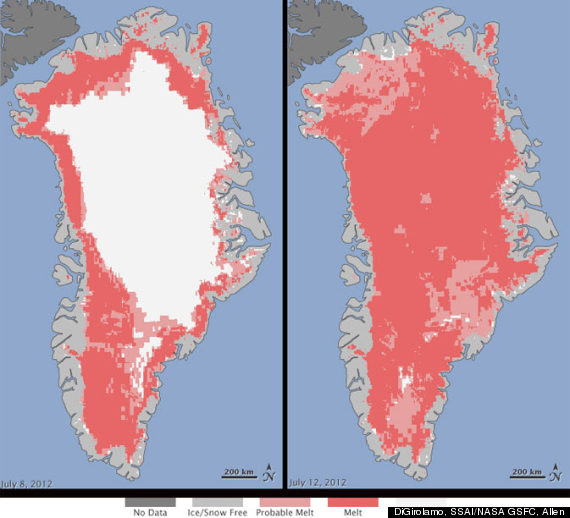
Greenland glaciers melting

There are things that terrify me. These are among them:

A Huffington Post article that explores the consequences of global warming, after the US experiences its hottest twelve-month period in recorded history: Climate Change Effects

Unprecedented amounts of ice are melting in Greenland. See above picture, and the following article:

My vote for the best short story of the last year: Diary of an InterestingYear

This interview with activist Stewart Brand, of the Whole Earth Catalog:  Environmental Heretic

He says:
We have thirty years before we face disaster: Europe, North America, and China becoming unable to grow food, mega wildfires, melting glaciers. Reversing current problems before something catastrophic happens will probably require buying time with climate-engineering approaches, such as putting sulfur dioxide into the stratosphere the way volcanoes do, to reflect more sunlight back into space. We’ve still got to get the carbon-dioxide levels down — along with methane, nitrous oxide, and the rest of it — but that will take a long time, because there’s so much industrial and political momentum to overcome. Many climatologists who were originally opposed to direct intervention in the climate are now saying we may have to do some form of “global dimming” to buy time.
He says that climate change has become a partisan issue in the US. True dat. He thinks environmentalists have to drop their resistance to nuclear energy and genetically-engineered foods, as those two things are going to be among our only ways out of the coming crisis.  In his interview, he defends and defines science in much better ways than I can, and says:
I’m trying to convince the conservatives and the environmentalists to follow the science right across the board, not just where it’s convenient or supports their ideology. And the science itself needs to move forward quickly. We do not have enough data, especially in terms of how the oceans affect the climate. We don’t have climate models that can predict what will happen or even understand some things that are already happening, such as the melting of Arctic ice.
He's also featured in the documentary Earth Days, which I heartily recommend.

Last, but not least, ShawnLawrence Otto, author of the book Fool Me Twice: Fighting the Assault on Science in America who says:
All those dire (alarmist!) warnings from climate scientists 30 years ago? They’re coming true, one after another–and faster than supercomputer models predicted. Data shows 37 years in a row of above-average temperatures, worldwide. My state has warmed by at least three degrees Fahrenheit.
Apologies for enjoying it in Maine, where we've hit ninety degrees pretty much every day of the last month, but my question is what are we doing about it? And why are so few of us discussing it?

Sunday, July 15, 2012

Bound to

Today lightning storms and flash flood warnings and electricity out for most of the afternoon.  It's also the mid-point in July, which means any plants that go in the ground have to be for fall weather, capable of withstanding frost.  The joke, around here, is after the fair in August you bank the house, but I'm not making jokes about winter yet.  Not when it's still ninety degrees during the day.

Not when heat and humidity break with heavy rain, pounding down around the eaves like thunder, and lightning cracks over the next ridge.  It reminds me of home--how in Thailand, during the monsoon, we'd have heavy humidity all day and then a rush of rain like a dam bursting in the afternoon, and then a few blessed hours of coolness in the evening.  Here I relish every drop of sweat, hold it close to my heart, knowing how fleeting these days of warmth are.  How soon I'll have to put back on sweaters and socks.  How few months before the wood stove cranks up again.

What it says about our weather patterns that July in northern Maine now resemble tropical southeast Asia are something else entirely.  Something that perhaps I shouldn't go into now, although I'm sick of no one talking about it.  Sick of everyone discuss cavalier plans for building pipelines and fracking when we're not dealing with the larger problem.  All of us know that the ground is shifting under our feet, that there's an elephant in the room no one mentions.  Because it's too hard.  Because we know how much change will cost.

Is it bad, then, that I can be so gleeful on these tropically hot weeks in Aroostook County?  How I pray every day for the heat to hold?  I stand outside, under the bare inches of eave, and let the rain crash around me.  Listen to the thunder.  Thrill to the light.

Wednesday, July 11, 2012

Seen people cursed

I worry sometimes that I'm becoming too esoteric of a person, too random as a person. I love exploring ideas, but I also just want to be a normal person sometimes, with a normal voice. I want to say things like: it's driving me crazy that the arugula is blooming all of the time instead of producing leaves, but I know I should have planted it earlier, so it's all my own fault. Like how sad I am that I left my windows cracked through the last monsoon and now I have mold growing on the floor of my car. That even though I bought a non-locally produced watermelon for the Fourth of July, I have yet to complete cutting it up. Like we're watching the final episode of Battlestar Galactica tonight, and I'm so excited I could puke. Like I've always been a sci-fi dork, from back one I was a freshman and I read the entire five-book Foundation series, in order, as well as all of the anthologies of pulp sci-fi short stories from the fifties before anyone had landed on the moon.


So. That's what I'm doing today. Above is the sky from my walk with Shadow yesterday, back to the washout. I go to church on Wednesday nights in the summer, and today was the first night I made it in a month (a month of Sundays!) and it feels good to have been there on a night when the reading was David dancing in front of the ark of the covenant.

Beyond Battlestar Galactica, everyone should Google/Netflix/Tivo "The Fabric of Space" on PBS. Theoretical physics as show. A must-see.

Wednesday, April 11, 2012

There she goes

P1070731
The new boat, at Meadow Island


When Easter rolled around on Sunday, I wanted to write a post about Ishtar, and Isis, and how the Christian year mimics that of the pagans, but how that doesn't make the celebration of Easter, and the blood of the Lamb, the dying God become the risen Lord, any less legitimate. Now it's Wednesday, and my Lenten discipline is over, meaning that I can watch English premiere league soccer (Queens Park versus Swansea) and eat popcorn to my heart's content, without having to worry about posting links to global warming articles or quotes from Moby Dick before midnight. (Actually, it's Moby-Dick. There's a hyphen.)

I didn't do so badly this Lent, other than my failure, most days, to post before midnight. Do these Lenten disciplines make any difference? Make anything better? That's the larger question. If I had to answer it, I'd say Lent is about that cycle of death and rebirth, the eternal circle that all of us celebrate every year, whether we acknowledge it or not.

Because that's what the season of darkness is about, the season of darkness and now the season of light that begins. It's about death and rebirth, and how the green fuse drives the flower back up from the ground, and how we remind ourselves of that by taking things away from ourselves and then giving them back. My sister posted her Thailand pictures today, though, and I'm reminded how I hate the seasons, how I want it to be 95 degrees year-round. Everyone, at least in Maine, uses that as a selling point: we have all four seasons!

But what if I just want one? Endless, never-ending, unchanging summer?

So God dies and is reborn, and crops die and our reborn, and the sun goes away and comes back, and we celebrate that now, during spring, celebrate our own return from the darkness and depression. The passage of the seasons, the cycle of the church calendar, they remind me of the passage of time, how every day that changes is different, and new. Maybe that's why we want to drift from those reminders, into a world separated from the earth, and plants, and the cycle of growing things, how we want to dissolve into a digital world of pixels, of fictional equatorial sun, a place that only exists in the imagination, and, perhaps, at the actual equator. No matter how we separate ourselves from them, the seasons still pass.

Now Lent is over, and spring begins in truth. Nothing for it but to roll on, into the cruelest month.

Friday, March 16, 2012

En route from Aroostook County, Maine, to Marion, Massachusetts

436 statute miles
38° F
Winds light and variable

Drove down this afternoon to Massachusetts, where it's supposed to be in the sixties all week. Already I can make do in the house without my down vest on, although Shadow is sporting his stress bump already. Sometimes I try to see the drive through his eyes--all the confusing lights as we zoom by Boston, the tunnels where everything goes bright, and then the lights in the distance, and then the strange curves as we exit on-ramps and off-ramps. I may not belong in Aroostook County, but he's a Mainer born and bred. He doesn't even know what the lights of Presque Isle look like, let alone a city like Boston.

On the drive we listened to The Hunger Games, an audiobook that I'm halfway through for a second time, and which is plotted so brilliantly as to make me quail. It's such a brilliant conception, a sort-of The Lottery meets American Idol, and the force of the concept alone keeps the story moving forward inexorably. If you haven't read it already, you should now, if only to keep the ubiquitous movie trailer from stealing your own Katniss Everdeen from you. But maybe I'm just dazed from the road. If it's this year's frigging Twilight, as everyone seems to be saying, then it won't take long before the snipers start taking potshots, pointing out all the flaws.

Sometimes I just love the thrill of an exhilarating plot, carrying me forward, creating an unheretoforeseen universe and its attendant characters, and all the more if those characters are heroic and three-dimensional, but of course more good than bad. Maybe I have some lessons to learn. It's these dark literary novels that haunt me, but the ones that keep me up reading into the night are young-adult fantasy thrillers. What does that say?

I don't know. I'm musing. Hoping Shadow doesn't die of heatstroke in a house where the heat is set above 57 degrees. Or worse yet, in a coastal zone where it's supposed to hit 66 degrees this week. About time to be getting spinach into the ground. Maybe, by the time I get back, all of the ice on our cold frames will have melted.

Saturday, March 03, 2012

I'm warm again

Today's snow

I'm still thinking about the art performance last night, enough so to request roasted red potatoes for dinner this evening. I keep ruminating about being at the center of that human conveyer belt. We were supposed to become a human machine, only rejoining community by turning to each other at the end. Meeting each other's eyes and returning to our humanity again. But the unexpected thing that happened was that we were all humans inside of the machine.

The whole night, I couldn't help but be connected to the people around me, every time my fingers brushed theirs. Every time my eyes sought the glove to my right, every time my movements slowed to allow for hers, or I noticed, in my peripheral vision, her motion shift and take off in an exquisite new direction, an elegant hand-flip as she arced her potato. We were human inside of the machine.

Climate change has been haunting me over the last several months, punctuated by the tornadoes last night, this time over Chattanooga where my parents live. I know climate scientists reject such neophyte associations, but no one's talking about the extreme weather patterns, and how they just keep getting more extreme. It was clear in the Bahamas, it's clear here in Maine, it's clear in Tennessee. It's clear everywhere, but we're all blindfolded, handing our dollars to the gas tank, as slow as the sunrise.

The problem is that no one believes in science. Nor does anyone understand how it works anymore, how even Newtonian physics, the bedrock of the Industrial Revolution, is nothing more than a theory, a theory that Einstein disproved. Gravity is just a theory, and this is because proof isn't something science does. Nevertheless, science works, perfectly, as a method of distinguishing between good theories and bad theories, as proven by the brushed-steel machine I'm typing on right now, by the cell phone in your pocket, by the television in your living room, all of which are based on quantum mechanics. Just a theory, but one that works really well.

What science does is establish correlation, collect evidence. And the correlation between carbon dioxide in the atmosphere and global warming is as clear as any. The evidence is irrefutable. By the time they have proof, we'll all be dead.

So what am I saying? It's the same as inside of that human conveyer belt. I'm a human inside of the machine of carbon emissions. I want to break free of the circle, to look at the people on either side of me and yell, scream—let's change things. Let's do something, anything. So why don't I? I'm too afraid, too poor, too lazy. As are the rest of you whose gloved fingers graze mine.

Saturday, February 11, 2012

I'm longing for that sweet fatback that sticks to your ribs

I’m not sure I’m doing all that well with winter. It’s like a daily checklist: am I getting outside? Am I doing something other than sitting on the couch with my crochet? How many baked goods?

The snow covers the horizon, endless. The thing I miss most is color. There’s no color. It’s a black and white world, and to go out into it, I need three layers, top and bottom. The last few days the moon has been so bright—effervescent—like a spotlight reflecting off the snow, so bright I check to see if the lights are still on outside the house. I wanted to take photographs for all of you, but I couldn’t bring myself to put on the layers. It was just too much.

I feel exhausted, all the time. And I’m doing all the right things. Taking Vitamin D. Eating oranges and lettuce, whatever produce was grown in places where human beings are actually designed to live and shipped in on the bones of dinosaurs.

Well, I’m not doing all of the right things. As I write, it’s 1:55 in the morning, which means if I were to use my sun lamp when I am meant to, as according to the almighty internet and cet.org, at 7:45 in the morning, that would give me less than six hours of sleep. Less than I got in college, most nights.

So I’m staying up too late, and I can’t drag myself out of bed, and I’m sleeping through those precious morning hours of daylight, the only real daylight I get here. I feel like I’m coping, but just barely. Treading water. It feels like a genuine hibernation—all of my essential processes are functioning, at their minimum possible levels—and I’ll only really come alive in the spring, which is so, so far away. I keep remembering the snow we got on April Fool’s Day last year, and I think really? That long? Our frost date is May 20. Only three months to go, guys!

Meanwhile, my magazines are sending me photographs of tulips and forsythia. I’ll be lucky if I get tulips and forsythia in August. Is it worth it? I feel like I’m complaining all the time. I don’t want to complain. I want to be bigger than the weather, to not let it affect me. But what if I’m not?

Friday, January 06, 2012

See, it all started simple

January always makes me think about heat. How I grew up in Thailand, one of a long line of sun worshipers. My mom and her Greek sisters smeared olive oil on their Mediterranean skin before laying out at the Jersey shore. I loved heat growing up, clung to it—it shimmered on my skin, shivering, equatorial humidity like a wall.

When I got off the plane at the Bangkok airport, heat meant home. When I came to college in Chicago in 1995, that winter was the coldest on record. My mom sent an email to me while I slept that first winter, the first year the computer lab sent emails from continent to continent: “It's beginning to get cold here at night. Down to seventy degrees. We're going to have to break out the quilt.”

Now I live in the northernmost county in the continental United States, in Maine, where we hug the border with New Brunswick. The winter of 2003, in January, the temperature here never reached 0 degrees, even at dead noon. Where I used to live, Bangkok, was once judged the hottest place on earth, if you averaged daytime and nighttime temperatures, winter and summer.

Now, when I chunk another piece of cedar against the back wall of the wood stove, watching the low angle of the sun cutting across the pines, I remember that shimmering heat. When I snowshoe through waist-deep drifts in single digits, I create that heat inside of myself, unzipping my down vest, unwinding my scarf, and realizing that power of the sun that rests inside of myself. I've spent the last month traveling from the place I've chosen as my home. I went to heated yoga classes, allowing the sweat to pour from my body. But only now, after returning, do I realize that the heat I've been looking for has been here all along, inside of my own body.

Thursday, September 08, 2011

Covering the bills

Backpack full of apples

Shadow waited patiently today as I pulled apples off the trees in the back of the land. Most of the fruit were barely golf-ball sized, off of trees that haven’t been maintained for years, but their higher branches held shocking quantities. It feels like such a fall occupation, as I know it is. I feel like Robert Frost. The seasons move so quickly here in Maine that it’s dizzying. Already the first maples are turning red.

Our frost date here is supposed to be September 20, although I’m hoping for a late summer since spring was so late. Today I shredded cabbage, carrots, and green pepper, all from the garden, for a late coleslaw, and began to work on a radish relish, with the radishes that still proliferate. Even with the tomatoes gone, I’m feeling overwhelmed by the massive quantities of vegetables that remain to be preserved. Maybe I just need to accept that I’m going to lose some of them.

The melancholy that comes with this time of year is also pervasive. I hate watching the days shorten, I hate closing the windows at night, I hate that I’m wearing a sweater right now. I know I’m not supposed to complain about the weather. Maybe I’m just out of sorts because the best friends I’ve made up here are leaving in two weeks, for fairer climes and better job prospects. I love living so close to the land, but I don’t like the isolation that comes with it.

Still, the sun shone into my bedroom window, making it laundry day. The apples are sweet and tangy. My soup of greens that I made for dinner was less tasty, but still ambitious. The thing that’s torturous about the quickly moving seasons is how I feel each day slipping through my fingers almost tangibly. All that does is motivate me to enjoy each one as thoroughly as I can.

Wednesday, August 10, 2011

Train goin’ by

It was rainy and dreary this morning, the result of a persistent low-pressure system that’s been located over Maine for the entire summer. It was fifteen degrees colder than usual today, and more rain is expected all week. According to our meteorologist, it’s because of the consistent high pressure located over Oklahoma and the central US, which has been forcing all of the precipitation north. We’ve had eighteen more inches of rain than normal since the first of June.

Good for the crops, perhaps—I’ve had three ripe tomatoes already, more than my family in Chattanooga—but bad for my sun deficiency. I feel dumb always complaining about it, but the fact remains that I’m constantly living at a twenty-degree deficit up here. So why do I live up here? It’s a compromise. This area is one of few in the country where I can live at my income level.

The ironic thing is that my laundry is hanging on the line. I’m reading Old Maine Woman by Glenna Smith, an Aroostook County writer I met recently, a brilliant book about the way things really used to be. Her mom did laundry every Monday, no matter the weather forecast. Didn’t your grandma? I figured I could do the same. They’ll hang out there until they dry, I suppose. My grandma didn’t have to contend with climate change.

The garden’s going full-bore, producing faster than I can figure out ways to preserve, which I keep telling myself is a good problem to have. I spent all weekend with a group of friends, artists and homesteaders. Somehow I have managed to find a brilliant community of like-minded people. I keep quoting this article from the editor of Mother Earth News, who says rather than the doomsday attitude most environmentalists have, we need to envision the future we want, to envision success if we’re to achieve it.

So I’ve been thinking a lot about that. If we want to change the world, how do we actually go about that, practically? What’s the first small step? How can I be the change I wish to see? I just keep thinking about community models that can be replicated. I know it’s idealistic, and ambitious, but if we don't have idealism and ambition, we’ll never achieve success.

It’s not just rain that’s getting me down. Every time I hear the news, the political bickering, reports from the corporate hegemony, I become a little more frustrated by the paralysis of the people. We can take back our country, we can take back our world. We just have to do it a little bit at a time.

Sunday, June 26, 2011

God gave me style

Another unidentified flower

I distinctly remember the day I learned the meaning of the phrase “I like the cut of your jib.” Secret was anchored in Georgetown harbor, and we were hanging out with crew from two other boats—a duo of crazy western Australians and another couple, the female half of which was Native American and the male half of which was a treasure hunter. He bought a video camera to fasten to the front of his hull, and they were heading to the Ragged Islands, a chain of rugged coral outcroppings in a remote part of the Bahamas, famous because so many boats wrecked there. That’s the idea behind treasure hunting—you go to the places where the most boats have wrecked, which doesn’t seem like that brilliant of a strategy for one’s own boat. This same couple took a Boston Whaler across the Gulf Stream, so elements of their sanity may have been questionable.

She wove us a rainbow-bead dream-catcher to hang in our boat. It still hangs from the bulletin board of my Chattanooga office, and I remember them, and wonder if they ever made it past the Ragged Islands.

They had a Cal 33, designed by Gary Mull, the same dude who designed the Ranger 33s, which Secret was. Cals are slower boats, beamier, more for cruising than for racing, and I was jealous. Not only did their boat have standing head room for us tall people, but it had space. They had old-fashioned hanked-on foresails, which they bemoaned, but I was jealous of those, too. Our roller-furler was barely working at that point and hanked-on sails sounded so much easier.

Best yet, they had a blade jib. A sail shaped like a blade, 87 percent of their sail area—as sexy as it sounds. I said, almost without hearing myself, “I like the cut of your… jib.” I meant it, standing there, in front of someone’s jib, envying it.

I’ve been doing that with land lately, with weather. I love this little chunk of land carved out at the bottom of Snow Road. Bridgewater is the local town, with 700 residents, but the denizens of Snow Road like to claim that this city is a separate village altogether. Snow Settlement. Where people like to drink boxed wine and Mountain Dew, where you hear the neighbor shoot a couple of rounds of .22s on a Sunday afternoon, where free-range moose roam across the road, where you walk home using the fireflies to light y0ur way.

If there’s one thing that Snow Road has in spades, it’s snow. We had snow here about two weeks later than anyone else, and we get snow about two weeks earlier. Spending three days up at a lake made me feel like I was living in a separate micro-climate. There was actually sun. It shone. I got color in my face. My shoulders grew back their freckles.

Not only is this the road of snow, but the house is located at a little divot at the bottom of the road, where, even on these long summer days, shade begins at five pm. I have to go to the corner of the lawn to do a sunny sun salutation. The garden’s located at the edge of the beaver pond, so it gets the most light. It’d be the perfect situation for a house. If the house was in Alabama.

On nice days, like today, I trek uphill to R.’s place. He’s the neighbor that lives in a bus, and I sit out on the bus’s attached hardwood deck until the last glimmer of sun disappears from the top of the hill.

I’m not complaining. I refuse to complain about the weather. I’m just noting that a road on the wrong side of the only hill in 500 square miles, on the lowest ground on that road, in the county that I theorize has the worst weather in the continental United States (Perhaps barring parts of northern North Dakota—someone look it up for me? Please? Someone who has internet?), makes for some cloudy, dreary days, even in June.

So. Whoever you are, wherever you live (unless perhaps you live in North Dakota). I like the cut of your jib.

Wednesday, June 08, 2011

You gotta go where you wanna go

Sky over the field before the storm

Working on the garden today, I decided that the next logical step is buying seedlings. I’ve been frustrated by its lack of progress, and it’s mainly because I missed the entire month of May, a month that would have been spent sprouting things. I didn’t anticipate my grandparents dying, a extended trip to Michigan. I’m now a month behind.

So we drove to a local greenhouse and bought $60 of seedlings—twenty six-packs and 120+ plants. A lot of money for me, but I spend probably half of that a week on produce at the grocery store. Fresh vegetables are a high priority.

This afternoon K. planted half of the new seedlings in the garden. This evening, severe thunderstorms swept through Aroostook County, bringing with them silver-dollar sized hail and a single tornado sighting. Fantastic. I’m hoping ce n’est pas grave, as they say in France and New Brunswick, that it’s not grave, that the winds and rain will toughen up the tomatoes and peppers and force them to take root in their new home.

I haven’t heard hail, but it continues to rain. The thunder makes Shadow pant in fear. It’s so frustrating, so nerve-wracking. I’m beginning to understand so much that I never did before, about the nature of farming—how it’s a process of constant existential faith. Crops are forever at the mercy of environmental forces. So much, everything, depends on the weather.

All of the progress that we’ve made in our modern era has been to eliminate that dependence, to erase it entirely. We can buy peaches at the grocery store no matter the season, enjoy sushi in restaurants no matter the tide, go tanning whether the sun shines or the rain falls. It’s so much more than that, though. It’s that the weather has absolutely no moral relevance to us. Unless a hurricane or blizzard hits, outside affects us not at all.

Here I sit, at the edge of the wilderness, clinging to the forecast by my fingernails. If there’s one thing I desire, it’s that constant existential crisis, that doubt and fear and hope and faith that mean I’m really living. If I can get that from hail and some cabbage plants, then I’m doing something right.

Sunday, May 15, 2011

You’ll never touch these things

Buds in Maine. I can't wait to get back and see if they bloomed!

I’ve written about global warming before, even going so far as to say that it’ll be viewed historically as a conscious choice of the rich white man to make his weather better and himself richer at the expense of the poor multitudes at the lower latitudes. Nonetheless, I feel a thesis coming on, after listening to a piece on NPR today about government subsidies for the oil companies. Part of me wants to quote the thing wholesale, because it was so disgusting. I can’t do it justice. (I found it: listen here at your own peril.)

I’ll try, but I may end up falling into diatribe. You have been duly warned.

Two brave and politically-minded Democrats proposed a bill to eliminate the subsidies that global oil gets from the American government. It’s around $2 billion, so, really, nothing. At least not in comparison to the trillions of dollars our government is trying to cut. Democrats want to pay lip service to the concept of deficit reduction, sure, but I hope that maybe some of them believe that the American taxpayer shouldn’t be adding to the profits of the most profitable companies ever in the history of the universe.

So what do Republicans (and all oil-state Democrats) say? It’ll raise gas prices! It’ll cost American jobs! It'll force America to be more dependent on foreign companies! What’s the real solution? Drill, baby. Drill.

Here’s Mitch McConnell, Senate minority leader:
“By taxing American energy production, they’re also outsourcing American jobs. So let me get this straight--higher gas prices, fewer American jobs, and more dependence on foreign competitors at the expense of American energy? That’s their plan? No thank you.”

I can’t believe that we haven’t accepted yet that fossil fuels are dying. And killing us, both. I flash back 100 years, and wonder—what happened to those forward-minded politicians who proposed ending subsidies for the buggy-whip industry? I’m sure there was public outcry: what about all those poor workers in the buggy-whip factories? What about the American horse? What about carriage drivers?

Even though I’m a devout Scandinavian socialist (most days), I believe whole-heartedly in American entrepreneurship and competition. If fossil fuels were authentically priced, both in true production and environmental costs, then alternative energies would have a real shot. Wind and solar could be competitive. But it’s not until we eliminate the buggy-whip mentality, this foolish prejudice in favor of outdated products, that they’ll be able to compete on a level playing field.

Why don't we build houses with roofs made of solar panels? Why doesn’t every suburban residence have its own windmill? Why have fuel-efficiency standards for automobiles stayed more or less level for the last fifty years? Because of the oil and coal lobbies. Because of corrupt politicians, both Democrats and Republicans, whose campaigns are funded by those industries, and who care more about their reelection than our country’s future.

But mainly because of YOU. Because you (and me) can’t be bothered to pick up a pen and write a letter to our congresspeople. Because we can’t be bothered to reduce our consumption.

What did the piece conclude? The bill is not going to pass. Even 51 unified Democrats in the Senate can’t get the bill past a filibuster. The American people are going to continue to put $2 billion a year in Exxon-Mobil’s pocket. As if we don't pay enough for gas already.

What’s the only thing that’s going to change our future? Our own choices. We have to choose to get involved in political life. We have to make better choices about our carbon consumption.

I have been consciously choosing against high consumption for seven years now, but I'm still getting in a car tomorrow and driving 1000 miles with gas at $4 a gallon. I flew in a plane last month. I don’t have much money, but I still believe should pay more for those things than I do. They should cost more for all of our sakes.

Why did the buggy whip factories shut down? Because we didn’t need them any more. It's not until alternative energy is given a fair chance that we really will stop needing oil.

(On a less political note, how do you like my blog redesign? If you hate it, give constructive criticism in the comments. If you love it, say glowing things! It costs you no fossil fuels. Except for the electricity for your computer. Never mind.)

Friday, May 06, 2011

Chattanooga, Tennessee

Peter, my brother, in Grandpa's garden

When I lived on my boat, I woke up every morning at six AM to listen to the weather on the shortwave. I developed a notation system so I could record every variable reported. How many knots the wind would blow, the swell, the projected systems beyond the ten-day forecast. The weather was a daily, ever-present part of my life.

I remember the first tropical system that reached us. Andrea, she was called. The first named storm of the season. By the time she reached our boat she had dwindled to little more than a line of black clouds. But I remember that line of darkness. I watched them drift forward, a clear system, a line, an identifiable being. This is Andrea, I thought. She menaced on the horizon, a named thing.

She passed, and we had other storms to deal with, none severe, but it was then I figured out a meteorologist’s intimacy with her storms. I understood why they named them. Each system had its own presence, its own being, as if it was, in fact, a created individual.

One of the things I gained on the boat was the equivalent of a university degree in astronomy, meteorology, and marine science—all the ancient nautical arts. That’s not quite true (in fact, I’m rather sure it’s not true at all) but it felt that way. In order to survive, I had to study my texts, listen to the radio, dig through data. If it wasn’t a degree, it was certainly a crash course.

The storm that passed through northern Alabama and Georgia last week had that same gravity. I’ve only seen the barest edge of its passing on my drive, but my friends, the maps, and the photographs all convey that same presence. The storm had its own identity, its own individuality. The destructive force felt personal, as if it came from something with a name.

I don’t know what’s causing all of this horror. The Japanese earthquake and tsunami, this tornado, now earthquake clusters along the Maine coast and flooding in the Midwest. One thing follows another, like there’s something seriously off-kilter that needs correcting. Like it’s personal.

The Christians say rapture is near, the scientists say climate change, the Aztecs say the world is ending. I don’t know. I can’t quite believe in any of those answers (I believe in global warming, not that it causes earthquakes), but it does feel like something major is changing in our weather systems. Right? Don’t you feel that way, too? Why aren’t the scientists saying it? There has to be a reason.

Maybe there isn’t. Maybe this is how it’s always been, always will be. Years of peace, followed by years of disaster. The farmers and the sailors both know it. I’ve talked about it before, how both farmers and sailors have the same intimacy with their weather. They hug the weather to themselves, hold it next to their bodies like a lover.

Monday, April 11, 2011

It’s a hard rain

Aroostook County clouds

Today I’m listening to Neil Young’s “Harvest Moon”, one of the albums my sister gave me in Chicago. I have a consistent weakness for 1970s singer-songwriters. In his song “From Hank to Hendrix,” he says: “the same thing that makes you live can kill you in the end.” What are those things that make you live but kill you in the end? Maine could be one of those things. It’s a tough life up here, a tough winter, and I’m beginning to understand why Mainers are so tough.

I saw the outdoor thermometer hit sixty today, for the first time. I still snowshoed across to the beaver pond. The snow is more and more swampy by the day, but clinging on. At least two feet in the front yard. Maybe rain tomorrow, maybe another layer carried away, so I can plant my peas.

I find myself thinking a lot about weather up here. Even though I’m one of those people bored by weather, typically. I have a hard time making choices based on weather. But living in Aroostook County, it’s almost as important as it was on the boat. I have to watch the fronts move through, watch them closely and pay attention.

I’m consciously choosing a life where things aren’t easy. As the snow melts down, up comes the mud. I saw the season’s first flies today, too. I’m doing it because:
“The only way to know the truth [about a character] is to witness her make choices under pressure.” --Robert McKee, by way of Donald Miller (A Million Miles in a Thousand Years)

Adventure makes you live. Beauty makes you live. Challenging relationships force us to define ourselves in opposition to other people. I’m walking a path where I experience greater extremes, both of joy and of pain. I’m choosing to live more courageously. Some days, as Neil Young says:
“Sometimes the beauty of love just comes ringing through. New glass in the window. New leaf on the tree. New distance between us, you and me. Can we get it together, can we still walk side by side?"

And as Ezekiel says: “When I open your graves, and bring you up from your graves, O my people, I will put my spirit within you, and you shall live. I will place you on your own soil; then you shall know that I, the Lord, have spoken and will act.”

Today’s lectionary. An apt metaphor for spring, as we approach Easter. As we watch for the natural world to wake.