Saturday, May 31, 2014

Setse Beach (Thanbyuzyat), Burma (Myanmar)

At beach with Burmese fans, next morning
On the train today no one wanted to sit beside me.  I’ve had this experience before, in Thailand—I don’t know if it’s from a misguided sense of respect, or because I am rank, or because of my prodigious size—which, even if I were supermodel skinny, would be prodigious here.  As Lonely Planet says, Burmese bums make Kate Moss look hefty.  So I sat alone, no one beside me, the two seats facing me empty, too.  While women opposite the aisle crowded against each other, one of them clearly ill.

We had assigned seats, so it wasn’t that much of a statement, but in the other areas of the train people felt free to change their seating arrangements according to convenience.  The four seats where I sat stayed empty almost the whole ride to Thanbyuzyat, until two gentlemen finally boarded with assigned seats opposite, and took them, reluctantly.

The Burmese friendliness is legendary and real, but on the train I felt much more conspicuous.  Foreigners rarely take this route.  The two girls to my left, white-skinned, wearing chic new longyis and tight shoulder-bearing tops, turned their bodies to face me and stared boldly for about half an hour.  Several train conductors were brave enough to sit down one row up, in the seat most convenient for looking, and gazed at me unabashedly until I’d stare back.  And many fewer smiles than I get when I’m on my walks through town.

I don’t know how to deal with the attention.  It makes me uncomfortable and a bit angry.  I stared back, for the most part, until I shamed them into looking away.  Maybe that’s the wrong thing to do, but I did it anyway.

After all, all travelers are ambassadors of sorts, ambassadors of culture, if nothing else.  So I shouldn’t begrudge them their full-frontal gaze of me, a real American, something they’ve only seen on television.  It’s like they were absorbing every aspect of my appearance, my body, my actions, my backpack, my clothing.

But it’s exhausting being the locus of other people’s anger, attention, curiosity, focus, envy, whatever.  And it’s constant, at least in these last few towns.  I’m ready to be in a world where other foreigners exist, maybe even the Thai tourist world of go-go bars and tee-shirt shops.

So I arrived at the train station after dark, disembarking at an unexpected stop—most farangs head to Mawlamyine—and bartering for my motorcycle taxi.  I decided to go out to Setse Beach because it was the only place I was sure licensed accommodation exists, even though I really wanted to explore Thanbyuzyat, the endpoint of the legendary death railway, constructed during World War II.  There’s a beautiful symmetry to it, at least in my imagination, arriving in Burma from Kanchanaburi, and following this course to the terminus of the same railroad.  But I had no idea how far away Setse was.

My motorcycle taxi drives me out of town as the sun sets and it darkens.  Before I realize it we’re in the middle of nowhere, driving through darkened fields full of rubber trees.  It’s exhilarating, the wind rushing through my hair, heading to an unknown destination.  Also dangerous.  Maybe that’s why it’s exhilarating.  I have the comfort of knowing that I have a size advantage on most men in Burma, but it’s still bizarre, my willingness to get behind someone on a motorcycle after a half-minute negotiation, to head into the unknown dark.

Then the motorcycle begins sputtering.  I’m not sure, since I’m not that familiar with engines, but it seems to be seizing in some ways every time he changes gears, laboring as we climb the hills.  I want to ask him about it, but I don’t know how.  Then I realize that he’s slowing to an excruciating pace whenever a vehicle passes us, even when the vehicle is going the opposite direction, and afterwards weaving all the way across the road.  Then I catch a whiff of something.  Gasoline?  No.  Alcohol.  My motorcycle chauffeur, halfway into the middle darkness, is drunk.

But what can I do?  Wait for the other shoe to drop is all.  The motorcycle does not break down.  We do not crash.  But when we arrive in Setse I see a giant billboard for a fancy-looking hotel called Paradise.  Oh no, I think.  Is this my promised accommodation? It has a pool.  A budget-breaker for sure.

We pass two other guesthouses, and we pull in, but my driver’s drunkenness is increasingly apparent.  He doesn’t know where to stop, doesn’t seem to be able to get off the motorcycle when we stop, doesn’t know where to go.  Both guesthouses reject me, and I can’t figure out why.  My driver speaks to the owners in hasty Myanmar language, and although I don’t understand, I already know what they’re saying.  They’re telling me to go to Paradise.

Finally, I give in, and decide to see how bad it is.  We drive down the road, pulling into a full-fledged resort—thirty uniformed attendants guiding us as we park, steering us past the internet and game room, the beautifully manicured gardens, employees watching HBO in a television room, the well-kept bungalows, into an air-conditioned reception area where I have to go through a metal detector.  It’s $40 for their cheapest room, a double, even though I’m just one person.  I could have just taken it and escaped.  I even have a stashed $100 bill for exactly this eventuality.  But I can’t do it.  Every fiber in me resists.  That’s an American price, I say, disgusted. 

I drive away with my drunk chauffeur.  He takes me to his friends’ house.  They’re thrilled.  They seat me in a chair and everyone gathers around, touching my skin, listening to my badly pronounced pleasantries, poring through my Myanmar phrasebook.  They want me to sleep there, on the bare teak floor of their front room, and part of me wants to, too.  But I know it’s illegal to spend the night with a local family.  And I also know I won’t get a moment’s peace—I’m the locus of everyone’s attention again, and I will be as long as I stay there.  Besides, there’s no bed.

The man of the house gets on his motorcycle and guides us back to the guesthouses we’ve already tried.  I argue.  You’re a guesthouse!  Give me a room!  But it finally clicks:  they don’t have a foreigner license.

We get back on the motorcycles and I’ve resigned myself to Paradise or the friends’ house, wherever they drive me.  But at the last possible minute they pull into another hotel, one I hadn’t noticed.  We wake up the front desk and they give me a room—gorgeous, with a patio facing the ocean—for $20 a night.  Still expensive, but I take it.

It’s a night when I’m absolutely exhausted and filled with relief.  With a traveling companion this wild-goose chase would have been an adventure and not a possibly hopeless and horrifying mission.  Maybe if I’d had someone along we would have taken the nice room and be watching HBO in air-conditioning.  With two people, $40 would have been the same price as what I’m paying here.  Maybe one of us would have convinced the other to get it—but then again, one of us would be blaming the other for the expense.

I persisted, found what I was certain existed, but what was it worth?  $40?

Monday, May 26, 2014

En route from Dawei to Ye, Burma (Myanmar)


Odd clock tower in Dawei -- colonial?
When I arrived at the bus station this afternoon something weird happened.  Before that, I checked out of my guesthouse at noon, and the owner, who had seemed money-grubbing to me, gave me a big bag of rambutan for the road and shook my hand affectionately.  I ate at my breakfast place and said goodbye—everyone marveled at the heaviness of my backpack, for which excuse I have the giant bag of mangoes my friend gave me stuffed at the top.  My motorcycle taxi graciously stopped to help me buy a ticket on the way to the bus station, and while driving there, the breeze blowing my hat back, the shacks with their Majesty Whiskey awnings and random assortment of goods and low plastic tables where men sit chewing betel and drinking tea, passing dusty bamboo houses with ornate teak shutters—I realized how much I already love this country.

Thailand may lose its moniker as Land of Smiles.  People smile at me, genuinely, curiously.  I trust these people.  Maybe I shouldn’t—trust no one, as Mulder says—but I do, even the taxi drivers.

Last night I wandered farther afield for dinner.  Generally I try to find a place where there are at least some women eating, although even that is rare.  As with many other country I’ve traveled to, the women seem to stay in after dark.  At this place I saw two women seated and felt relief.

Then I came in and ordered and the women got up to make the food, and I realized it was just me and a gaggle of dudes, few eating, most drinking and chewing and smoking and watching American movies (a classic, Lake Placid 2) and staring.  At me.  I ate, quickly and alone.  They offered me beer, and by the end of my meal three of them had joined me at my table, the ones who spoke the best English, eating their bar snacks.

One kept telling me:  it’s not dangerous here.  Honesty.  Respect.  Honest.

I believe him.  I feel much safer in this situation than I would have elsewhere, even in the States.

But then the bus station.  I’m waiting alone at the VIP stall, lined up between the packed booths for local chicken buses.  The walls are bare plywood, two by fours, and wire.  Burmese pop music blares.

A woman approaches, looks like she’s selling something from a bag.  She gestures at me, speaking to the front-desk people.  She’s going to try to sell me something, I think.  Good thing I have plenty of snacks.  I can legitimately say no.

Often people don’t try to sell me things here because it’s too much work for them, the communication, which is nice.  People are less pushy than in Thailand.  She approaches, speaking fast unintelligible Burmese, gesturing, pulling 200-kyat bills and mysterious packets from her bag.  She wants money, I know, but for what?  She holds her hands in prayer, holding them up to the sky.  Is she begging, or selling me an offering for Buddha?

Then she begins groping me.

She squeezes the fleshy part of my thigh above the knee.  My first thought is she’s demonstrating how much more money I have than her, my fat legs, my meaty body.  Then:  is she trying to sell a massage?  She keeps going, squeezing up my leg, uncomfortably high, then down my calf, along my hairy shins, harder.

Finally I uncross my legs and draw away.  She stops, keeps asking me for money.  Although Jesus says “give to anyone who asks” and I try, I’m even less likely to give her money now.  I try out my Burmese.

I don’t understand, I say.  Na ma le bu.  I pull out my Myanmar phrasebook.  No thank you, I try.  No, thank you.

She doesn’t understand my pronunciation but finally leaves me alone.  As she goes, I see her try the same thing on a man arriving on a motorcycle, beckoning at his bike, massaging his arm.

I’ve been reading feminist blogs, partly because I love them (Everyday Sexism, Feministing, Jezebel, Rookie, This Is Thin Privilege, xoJane) and partly for inspiration, as I travel, a woman alone.  I’m reading Maiden Voyages, a collection of essays by solo women travelers.  They call themselves “women of independent means and without domestic ties.”  I’m thinking of changing my masthead to that.  Or:  “that ideal Gorgon, the strong-minded woman.”  My email has been medusaj for more than a decade.  The earliest essay is a letter from a woman who traveled alone to Turkey in 1716 to join her ambassador husband.  She scandalized her elite friends by adopting native dress.  A later solo traveler, in Illinois, had to use her trunks to block the door against a man trying to break in on her bathing.  And I think I’m brave.

So my feminist friends are always talking about the prevalence of groping, how common it is, just one example of the sexism women have to fend off every day.  But here I am, fending off another woman.  If a man had touched me that way, I’d call it harassment, borderline assault.  Does it change, if a woman does it?  What was she doing anyway?  Giving me a Buddhist blessing?  Was she a shaman?  Am I now cursed?

Sunday, May 25, 2014

Ye, Burma (Myanmar)

Swarmed by girls at the pagoda
The gilded pagodas in Ye stretch along the river, rise on every hill, dotting the landscape like punctuation marks.  I visited one at the center of town this morning, thinking I could spend some quality time with my notebook, now that I’ve escaped companionship.  Instead, I was swamped by children.  They lounged along the corridor stretching up to the central Buddha, bored, talking with each other.  In fact, they crowded all of the spots in the shade, the numerous enclaves where Buddhas sit.  Some teachers even stretched, elongated, sleeping in doorways.

One things I’ve noticed about temples here is that they seem far less sacred than in Thailand, with a more human atmosphere I’ve already noted.  It’s not just the neon and blinking Christmas lights.  In Thailand, the temples are crowded by tourists and Thais come to have fortunes read or to earn merit by offering money or prayer.  Here, people just lounge about.  I see children playing at dusk in the stupa pavilions.  People gather in the shade of Buddha to chat and socialize.  The pagodas seem less held apart than the equivalent Thai wat, more of a common ground people use for gathering.

So I went in the sanctuary and sat and tried to feel the peace that generally gathers in the corners of these places.  Whatever your faith, you can feel the intense devotion of the people that have prayed there, their focused earnestness.  But when I turned around I was surrounded by dozens of children, wanting to take photographs of me and with me, and making fun of me, I think, my size and my hairy legs.  When I turned my back to them I’d hear evil cackling laughter and then when I faced them it’d stop.

But I was trapped there, at the entrance, so when they took photographs of me I whipped out my camera, too, thinking I’d beat them at their own game, or at least get some good pictures from it.  One girl especially, clearly a mean girl, a ringleader, her face made up pale, kept circling around for a second and third picture, and finally I had to escape.  I felt like Angelina Jolie.  How odd it is to be swarmed by paparazzi, or even friendly fans, when all I wanted was peace and serenity!

Several of the girls, the ones I liked the least, wrapped their arms all the way around my waist.  Another bizarre invasion of my personal space, something that also seems to be a much higher priority in Thailand.  I even touched a priest, for the first time ever.  They’re not supposed to touch women at all, not even their own mothers.  I thought the stigma must be less here, somehow, but have since been disabused of that notion.

He stood beside me for a picture too, with his betel nut-stained mouth, and our arms grazed each other.  I shouldn’t have been surprised—he was the monk hanging out with schoolgirls, after all.  But now one of us is probably going to hell.

Later, I went to the beach, to dip in my toes and eat fresh grilled oysters and fried shrimp, and I found out that all the people hanging out at the temple were Mon.  I thought they were a school group, because they were in uniform, but the red longyi and white shirt marks them as Mon, a tribal group unique to southern Burma.  At the beach, tuk-tuks and sohngtaeous full of them pulled up, all stuffed with Mon in the same garb, blaring Psy and American hip hop from giant speakers set up in flatbed trucks.

No wonder they were so excited to see an outsider.  It’s one of their special Buddha days, a pagoda day, arranged by the lunar calendar, and even my Burmese motorcycle driver (a quarter Mon, on his father’s side) was shocked by their quantity.

They have their own flag—a majestic golden gamlang duck on a field of red.  Their own language, closer to Thai.  They use Burmese script, but the reading of it is unintelligible to Burmese speakers.  Even their own uniform.  They’re allowed to wear whatever they want at home, my guide tells me.  But when they go out they’re meant to wear the white and red, to mark them as Mon.

On the drive back to the guesthouse, as we drive past the Mon pagoda in the Mon town, I see a banner for the First Annual Mon Gathering, a sort of Mon family reunion.  No wonder there were so many.

As I see them all gathered, my main feeling is envy.  What must it feel like to belong so thoroughly, to so completely know your place in the world?  I’m an alien here, for sure.  Even in Thailand, my heart’s home, I don’t belong and never will.  In the States, although I look like I belong, if you don’t scrutinize my clothes too closely, I don’t.  Not in Maine, not in Michigan, not in Massachusetts, not in Tennessee, not in Illinois.

According to my Myanmar phrasebook, Mon scribes were brought to Bagan after the sack of their capital by the Burmese king in 1057.  Burmese script is really Mon, adapted to the Burmese language.  These people know their place in the world.  They know exactly where they fit.  Their fathers and grandfathers and children and children’s children.

As I walked past the hordes of Mon, I caught the eye of an older monk dressed differently from his cousins, in his priestly magenta robes.  His tattoo, though, was unmistakable—the Mon bird on his upper arm.  He met my eye and didn’t smile.  He could tell, I think.  He’d spotted me.  An imposter.

Saturday, May 24, 2014

Beach Retreat Day 7

Women carrying bamboo
On my second day here, a woman and her two daughters approached me on my porch for water.  I gave them most of what I had, a full liter.  Then they asked for tobacco, or the betel-nut-tobacco combination that most people chew here, giving them mouths like blood.  I didn’t have any, of course, but at that moment the delivery man showed up with my lunch:  two boxes of food, a coke, and a cooler full of coconut water.  I felt so guilty, like I had done something wrong, just with my plenty.  He gave her a banana-leaf-wrapped chunk to chew, and they walked on, unable to communicate.

As the week has progressed, my solitude has begun to feel less so.  I am not alone.  This beach is for people who work, who fish, who carry water-logged bamboo logs cushioned on their heads, who gather shellfish and hermit crabs at low tide.  One day, as I lounged, watching the sunset, I saw a man hunting something along the water:  he would spy something and then tiptoe, high-legged, towards it, like a parody of someone hunting.  He dug into the hole he found with a stick, and if he found what he was hunting, he’d pull it out and throw it against the sand, hard, with surprising violence.  Then beat it to death with his stick, then coil it—a sea slug or sea snake?—with others in a plastic bottle.

Others walk among the garbage, collecting glass.

This culture is one of hunter-gatherers, people living on the verge.  Two dogs adopted me, primarily because I give them fish scraps.  I don’t think anyone else feeds them.  They have bony ribcages, lean frames.  They spend most of their day sniffing around for snacks amid the refuse.  When I don’t have bones to give them, at night they whine quietly in the sand.  I think they’re hungry.

Beach dogs
And here I am, amid this scrounging society, a writer.  My purpose begins to obscure.  What good am I, Bob Dylan asks, if I say foolish things?  Anything I sang, he says, you can say it just as good.

Today, my last afternoon, I found a bench along the ocean and lay alone with my iPod, listening to Ray Bradbury, an audiobook I brought along.  When I sat up I was surrounded by women in longyis, one of them the old woman from that first day.  I noticed now that she is also missing an eye.  Her socket sagged empty, the skin closed around it.  She asked for tobacco, I think.  I didn’t have any.  She asked, from what I understand, if I was alone—bringing her two fingers together and then separate.  I motioned to my heart, to my bungalow, saying:  just me.

I don’t feel the envy of my alleged wealth here, not nearly as much as in Laos, or even in Thailand.  Instead I feel pity from Burmese people.  I may be rich in material goods—but I suffer from a poverty of companionship.  The woman nudged my ridgerest, feeling its cushion, grazed my bag with her fingers, then went to work, knocking barnacles off the bamboo logs she had stacked nearby.  She seemed to be the forewoman, and hacked notches into the bamboo, so other women could drag them down to the surf, could carry them on their cushioned heads.  All of them had lean, hungry, chiseled muscles, supermodel physiques.  For what reason they carry the logs I don’t know.  It seemed arcane to me, mysterious.

I didn’t know what else to do, so I pulled out my sketchbook and drew.  I thought of ripping out my drawing and giving it to her, but what good would that do?  Would she even understand?  And besides, I was selfish of the pages in my sketchbook, the book I’ve carried for four months and only used for the first time today.  I was selfish of my own drawing.

Beach drawing
She could see what I was doing, but I can’t imagine what she thought.  Did she think:  stupid fat farang thinks that’s work?  Or did she think, as I did:  she’s doing her work, and I’m doing mine?

Some days I can think of it like that.  On good days, when I can think of what I do as a kind of calling, when I can face the truth inside that cheesy cliche.

Another book I read this week, an ebook, was Dodie Bellamy’s the buddhist.  A quote:  “The buddhist once asked me if writing was my religion, and I said no, writing is not my religion.  I don’t know what religion is for me. Writing is my calling.”

My kingdom for that kind of confidence.

I came here for solitude, for writing, and all week my solitude felt invaded, compromised, by well-meaning solicitous Burmese people.  My friend from Dawei showed up with three companions and took me out for coconut and crab.  Various people invited me for rides on their motorcycles, invited me to share meals with their families.  I refused them all,  attempting graciousness.  Other than garbage-pickers, I haven’t seen anyone else alone.

People here don’t seem to understand being alone—my loneliness confuses them.  Is it just that I’m American?  Have I fully absorbed rugged individualism as an ideal?  The one part of Asian culture I could never get behind is communalism.  While I applaud the idea in principle, I could never live the way Thai people do, multiple generations crowded beneath one roof, everyone up in everyone else’s business.  In Thailand, people have children just so they have a place to live when they get old.  They plan their children’s births based on astrology, so their golden years will be comfortably padded.  I don’t think I can live with my parents, or with any fictional children, long-term.  Even living with one person  I love gets to me, most days. Small-town gossip destroys me.  I love my anonymity, and my desire for travel rears its head as soon as I lose my status as a stranger.

As the lone representative of my culture here, what must they think?  That Americans are a lonely breed.

I’ve chosen this loneliness, and still my longing for companionship exists inside me like an ache.  Yet I know:  if any others were here with me I’d be turning towards them for validation, approval, comfort.  What does he think?  What does she want me to do?

I’ve written about artist dates before, the prescription given my Julia Cameron in Artist’s Way:  two hours, alone, each week, to do whatever the hell you want.  Truly alone.  No children, not even a dog.  Just yourself to please.

My favorite artist date in Chattanooga was the independent film series at the movie theater downtown.  I loved everything about it:  driving downtown along the curving highway in my Miata with the top down, parking in the garage, the adrenaline rush of walking down the concrete stairs alone, each time remembering that horrific rape scene in the Sopranos—and then sitting all by myself, in the darkened theater.  Even there I got strange looks, the occasional come-on.  Who’s that strange girl here all alone in the middle of the day?  But I adored it, the silence, the popcorn all for me, and the response to the movie utterly my own.  Even now, the movies I saw then are among my favorites.

Once I convinced my friend Ellen to come along.  I really wanted her to; I practically begged.  I thought it could only make it better.  And though I loved seeing the movie with her, sharing it with her, it changed the experience completely.  Instead of being fully enveloped in my own response, I was thinking about her.  Did she like that line?  Did she get that joke?  What did she think?

Being alone sharpens my attention to my own desire.  But it also makes me feel shame.  Spending a week alone at the beach, just like going to a movie alone, feels utterly profligate.  What good can it possibly do?

Another side of communalism:  the shame it engenders.  I hide in my room when I see Burmese people outside because I’m ashamed of my bathing costume.  I had to walk down the beach, out of view of prying eyes, to lay prone in the sun (something I was brave enough to do only twice).  My favorite part of watching the movie alone was that it was in the dark—no one could see my profligate selfishness.

I’m an alien in a strange land.  I still don’t know why I keep putting myself in these situations where I am completely alien.  I like to think it’s because I’m more comfortable inside when the alienness of my exterior matches the alienness of my interior.  I’m more comfortable when everyone else can see that I don’t belong.  In the States, when I do things wrong because I don’t belong, no one understands.  Here I have an excuse.  I am unique by definition.

Still, uniqueness breeds isolation.  Isolation breeds loneliness.  And I am lonely.  This is what I’ve wanted for so long.  Meals delivered me.  Complete freedom to make my own choices.  And yet…

The truth is that I still don’t know how to balance being alone with being around other people, how to balance others’ needs with my own.  I don’t know how to do that, and it makes me sad, because I need other people in my life, but as soon as I let them in they consume me.

Tonight, a giant cricket lands on my mosquito net.  Other crickets croon outside.  The surf rolls, unceasing, to my right.  I have leftovers in styrofoam boxes for dinner, leftovers I’m afraid to eat on my porch because I have to hide them from the dogs.  Tomorrow, back to civilization.

Wednesday, May 14, 2014

Maung Ma Gan, Burma (Myanmar)

Beach at Maung Ma Gan
The beach stretches out my front door, endless and empty.  I feel like I’ve arrived at a mythical destination, the Holy Grail of backpacker travel, an empty, perfect beach.  How is it possible?  How can it be?

It’s really what I had heard, the rumors of the internet and of fellow travelers, but whenever I hear stories like that I disbelieve.  Every “untouched” Thai island I visited was already defiled by masses.  This one, Maung Ma Gan, is truly deserted.

This perfection is what I aimed at, the perfection I dreamed of.  And yet…  One forgets about certain aspects.  The plastic trash washed ashore.  On Koh Jum, another allegedly untouched island wonderland, hailed as an unknown paradise by a Finnish magazine, workers from the fancy resorts swept the sand of its washed-up flotsam, plastic and otherwise, every morning.  Here the trash remains, as does the natural debris that true beaches are scattered with.

I’m all alone—but that means I’m all alone.  No reggae bars with friendly travelers.  The locals swim at palm frond lean-tos a kilometer away.  The bungalows on either side of me sit empty.  I’m alone with my thoughts, the wind, the gnats, the sound of the water sweeping ashore.  No internet, no television.  One book of essays I bought (thankfully) in Kanchanaburi.  Whatever vestiges of internet I’ve managed to save on my computer.  A couple of movies I’ve seen already.  My Thai study materials, my Myanmar phrasebook, my Lonely Planet.  My sketchbook, half-full notebooks, unfinished stories.

Not even any restaurants in walking distance.  I have to walk to reception, a good quarter mile, and they call in my order and deliver it by motorcycle to my bungalow.  All this for eighteen blessed dollars a day.  My only company is the occasional Burmese couple in skinny jeans and trucker hats, on a motorcycle, zipping by and scooting forward, to use the beachfront lounge chairs.  They, at least, have each other.  Most of the time they don’t even notice me, sprawled in my American bathing suit, half-naked by their standards.  I have silence, and my own mind.

The silence is exactly what I’ve come here for, exactly what I wanted, exactly what I’ve dreamed of.  My friend Amy, who lives in Taiwan, was the first to tell me, years ago, that Burma was the new beach destination.  I don’t even know if this part is what she meant.  The beaches on the tourist trail are above Yangon—this section of the Andaman coast only opened up to tourist travel last year.  But I’ve longed for it ever since I noticed it, a string of islands and coastline stretching up from Thailand along the Andaman Sea, the most beautiful section of Thai coast, and here, a huge section of it, stretching into Burma.  Myanmar may have more Andaman coast than Thailand, even.

Maybe I’ve dreamed of this adventure for even longer, since I was a kid, and we went to a beach in the off-season, and a German writer was there, by himself, in a bungalow, at the other end.  He ate in the restaurant and spent his days writing.  I think I’ve written about him before, because he’s been in my imagination ever since, a mythical figure.  And now here I am.  Alone in my bungalow.

I’ve given myself a full week here.  A full week of quiet.  I can sit and watch every sunset, spend every day in the sun.  Spend the nights alone with my ideas, my words, my muse, my Spirit, my mind.

Tuesday, May 13, 2014

Dawei, Burma (Myanmar)


Dawei temple at sunset
 When I got to the border, all my Thai was immediately useless.  I had thought that the Thai I’ve learned might at least help me at the border, or until I made it to Dawei—I had thought that maybe even people here, this close to Thailand, might know some.  But no.  The minute I crossed out of Thailand and into the Burmese immigration office, I knew only two words:  hello and thank you.

Also, people do not know English, something else that surprises me.  I had thought that Burma was country where English was more widely spoken than in Thailand, thanks to the British colonizers or something, but no.  It may be my first experience like this, communicating solely by hand signals and pointing at my Burmese phrasebook and with the odd English word that someone happens to know.  Although everyone is ecstatic when I manage to say thank you correctly.  I’m working on “I don’t understand.”

So the end of the story is that I made it.  There was a minivan waiting at the “bus station” at the other side of the border—bus station meaning parked cars and dust—and I trekked across with my backpack and flip-flops, while all the other farangs in the minivan, doing their visa run, gawked at me.  I had to commission a minivan to take me onward, and my bargaining did not work.  It’s tough to bargain when one doesn’t know a word of another person’s language.

But the minivan driver on the other side was kind and drove me six hours across rutted dirt and mud roads, over single-lane bridges, past the mammoth effort an Italian-Thai construction alliance is putting into building a superhighway.  Give it two years and this route will be firmly on the tourist track.  I’ll probably be responsible.  They’ll probably read these words.

It feels great being here, though, walking the streets alone in my patong and umbrella, like an old lady from Myanmar, people staring at me and then breaking into betel-nut-stained grins.  But then I think how I am just the first wave, and after me comes piano bars and discos and boutique hotels, and I shudder.  No matter how adventurous one’s travel is, one manages to be merely the first wave of a horde here.  Am I even doing the right thing by traveling here, or is it just a selfish decision?  By writing about these untouched areas am I spoiling them?

First impressions:  heat.  I soak through my shirt walking to and from the bank, two times in two days, and only on the third day does the ATM work.  The loneliness of not knowing a language.  People are curious about me, and want to ask me questions, but how can they?  I’m not only alone, but I’m isolated by a complete lack of communication, which makes me feel a peculiar emotionally needy feeling.  The shock of having Skype-speed internet at my guesthouse.  (And the relief.)

At first I didn’t feel like people were particularly welcoming or friendly, and then last night I ate at a restaurant where I’ve eaten twice, and one of the girls who ran the place sat down with me.  She knew a handful of English words, and we pointed at phrases in the guidebook and communicated.  I learned how to say “eat.”  She gestured at her motorcycle:  do you want to go for a ride?

Of course I did.  We rode to the pagoda, where everyone wanted to talk to her about me and take pictures with me and practice as much English as they knew.  They were thrilled at my  presence.  We walked around the giant pagoda in bare feet on slick wet tile.  Here temples are called pagodas, even though they are also temples, because they’re built around giant gilded stupas.  It was like a carnival, like everyone came to pray and then hang out with their friends and eat ice cream and sticky rice and party.  A much more human atmosphere than in Thailand—then again, there’s not much else to do here.  The temple was beautiful, covered in fragmented mirrors, and also adorned with bizarre kitsch.  Every Buddha had neon enlightenment rays emanating endlessly from his head.

My friend, Mechcike (or that’s the best I can render her name), wants me to stay here and not go on to the beach.  There’s an even bigger party tomorrow night, she manages to convey.  This is what I’ve heard about the Burmese people—how their hospitality is legendary.  And yet I feel that traveler’s itch, to keep moving on, seeing new things, new chunks of country, new frontiers.

Sunday, May 11, 2014

En route from Kanchanaburi, Thailand, to Dawei, Burma (Myanmar)

Myanmar-Thai border crossing at Phu Nam Ron
People say it’s possible.  Even the sohngtaeou driver trying to convince me to go with by sohngtaeou taxi rather than by bus.  I have a single bent $100 bill and I’m convinced that’ll get me at least to Dawei, where they have ATMs.  Allegedly.  If they don’t, I’ll be stranded in Dawei, penniless and alone.

But the taxi driver keeps trying to convince me to go with him instead.  It’s more expensive, I say.  He gives me a Thai proverb I don’t know:  if you think expensive, then it’s expensive.  If you think cheap, it’s cheap.

It sounds like Thai taxi driver logic, to help me break out my pocketbook, but I bet he’d stop at the bank for me so I could exchange more baht into American money.  But then I’d lose the exchange rate twice, so I’m betting on the ATMs in Dawei.  I’ve been back and forth on this decision since Bangkok.  I have no idea what the exchange rate from the ATM will be.

This feels foolhardy to me but also Christlike, going in with nothing, never mind that I have my budget for the month safely resting in a bank account.  I always find some way to agonize, some way to be paranoid and anxiety-ridden.  Confident travel writers would constantly explain their decision in advisory bulleted points:

1.  Bring some Thai baht, but not too many!  You’ll get a horrible exchange rate of baht to kyat.
2.  Bring a percentage of your budget as untouched dollar bills from the US.
3.  Trust local ATMs, now confirmed on the VISA website and reported reliable, for the rest!

Sounds good, right?  If only I believed it.

So now I embark on the bus, driving up the mountains and over, towards the border, into the unknown.

Friday, May 09, 2014

En route from Bangkok to Kanchanaburi, Thailand

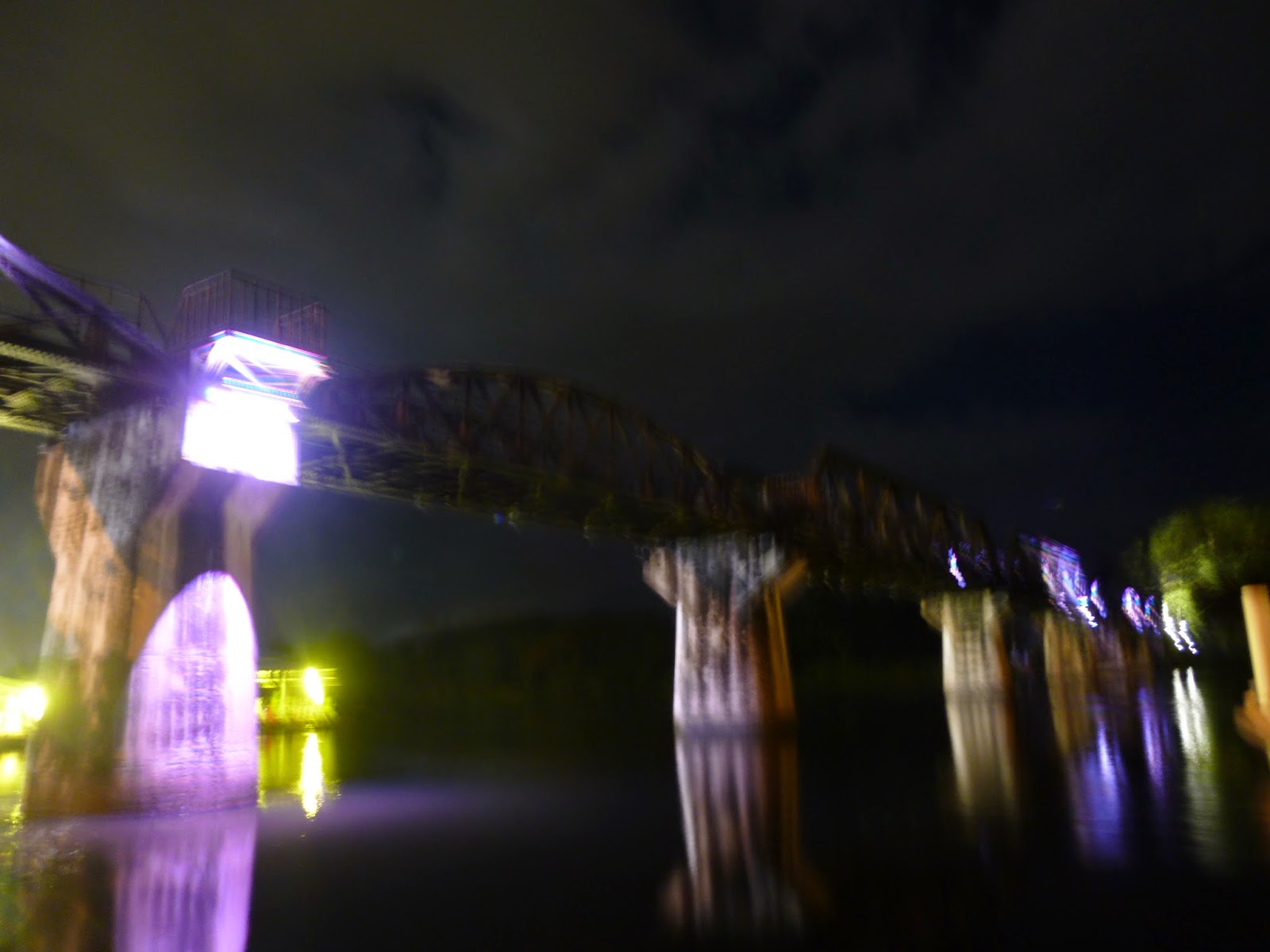
Bridge over the River Kwai, tonight
This morning I woke up, packed, and took a motorcycle taxi to the pier with my big backpack.  Took the boat to stop eleven, the Thonburi stop, and then a sohngtaeou to the train station.  Bought a ticket to Kanchanaburi, and here I am, writing in blue pen, speeding west, towards jungle and mountains and a border.  All of the steps I have rehearsed so long in my head carried out, exactly as anticipated, made flesh.

Banana and palm trees and rice fields line the track.  White and grey egrets by the dozen fly up from swamp as we pass.  We cross rivers choked with water plants, above them houses on stilts.  It's mango season, and as we cross roads I see fruit vendors set up at roadsides, with piles of golden fruit.

Ladies walk through the car selling fried chicken and I want some, but I'm embarrassed.  All I had for breakfast was three pieces of watermelon and some half-eaten bones and sticky rice, but the vendors aren't even soliciting me.  Besides, the middle-aged lady to my left has been eying my over-consumptive purchases since I got on, the overpriced peanuts from the Bangladeshi grifter, the iced coffee in a can for 25 baht.  I don't want her to smirk as I get ripped off a third time.  But I really want chicken.

The rice fields are impossibly green, the greenest green you'll ever see.  Brightly painted houses and trucks rest by the dusty tracks.  Drainage ditches are flush with cattails and lurid algae, bony droop-necked flop-eared cattle grazing among them.  Each stop gets me closer to the border.

I think this may be the bravest thing I've ever done.  Not as brave, of course, as many:  Paul Salopek, Rory Stewart (who walked across central Asia), Sarah Marquis (an extreme walker who faced down Mongolian horsemen in her tent), or any of your average everyday foreign correspondents in Afghanistan.  But it's still something.  The Lord has not given me a spirit of fear.  Everything I see with new eyes.

Thursday, May 08, 2014

I have seen them all


Today I went to the Burmese embassy and applied for a visa.  I walked down to the Chao Praya river taxi and took it seventeen stops to the BTC, then a motorcycle taxi to the embassy.  I brought with my passport photographs and that’s about it, so I had to buy a copy of my passport and a blue pen, since the one I’d remembered (my last live one from the States), is red.  So tonight my passport rests with the Republic of Myanmar, and I hope that my application for visa is successful.

If it is, then I may really make it to Burma, or Myanmar, as the United Nations calls it and the Democratic Voice of Burma does not.  Maybe that’s all I’ll say about that.  As with previous online entries, I am forever fearful of jinxing things by talking about them before they are certain.  I still have a long way to go before that border crossing.

Nevertheless, this means that today I woke up at eight AM and ate coconut bread with the sunshine.  I experienced that peculiar aloneness that accompanies the solo traveler on public transportation.  That anonymity in the middle of the crowd, what I loved about living in Chicago.  Proximity to physical bodies with none of that annoying communication stuff.

By the time I made it into the office I was dripping with sweat.  Not metaphorically.  I forgot what it was like to be drenched with fluid coming from my own body.  I forgot about how in May the moisture just hangs in the hyper-heated April hot season air, now filled with condensation from all the water below and all the monsoon clouds hanging above.

Monday, May 05, 2014

Among the lumberjacks


Waiting for the bus in Bangkok
Still at Bluefin and now alone.  I read “Gentleman in the Parlor,” a book by Somerset Maugham, while journeying through Southeast Asia, saving the introduction by Paul Theroux till the end.  It turns out that while Maugham was jaunting about—almost dying of malaria in a Bangkok hotel, trekking by mule from Burma—he really had his much younger male confidante and lover along with him.  “A drunkard and something of a rogue,” Paul Theroux called Gerald Haxton, Maugham’s companion.

So when Maugham wanted to be left by himself in his hotel room, to be introverted and write, his partner dragged him out to party with locals.  Hence, the book.

And now here I am, for real, no K. to drag me out among locals.  He flew out last week, back to work on the boat, and I insisted on staying.  I wanted to study Thai, or travel by myself—to do something truly adventurous.  Alone.

I am well and truly in the thick of it.  Theroux adds:  “There is no shame in this, though it makes the actual solitary wanderers, such as Doughty on camel back in the Empty Quarter of Arabia Deserta, seem almost heroic.”

I’ve written at times in the past as if I were alone, as Maugham does in his book.  And of course anything that “we” could do “I” could do just as well.  Do we go to the market?  Or do I go to the market?  In Thai it is irrelevant, no pronoun necessary.  Simply “go to market.”  But almost always I am going with someone.  I began hiking the Appalachian Trail without a companion, and traveled from France to Poland.  But those adventures are years behind me.  Even my solo camping trips from Chattanooga days seem far behind.

There’s something about being alone.  About the way it stimulates your creativity, or just gives you an urge to hide away.  The way it changes your interactions with other people.  Opens you up or closes you off.  Gives you the ability to make your own decisions, to make your own failures and successes dependent on yourself alone.  Forbids the blaming of another individual.

People who write about the ability of couples to make it over the long-term stress the advantage of these kinds of separations from one another.  One must always feel the pull of the partner against the other.  It’s not just I-Thou but I-Thou-Them.  We go away from each other so that we can come back together stronger and braver.

As Donne wrote:
Our two souls therefore, which are one,
    Though I must go, endure not yet
A breach, but an expansion,
    Like gold to airy thinness beat.
And still I cherish this time by myself, wrap it around my heart like a blanket, even as already I feel guilt for all the things I’m not doing, all of the things I’d resolved to do.  It turns out that doing this without a six-foot-tall partner holding me by the hand I’m a lot more timid.  I hide out.  I feel like Marilynne Robinson, she who said:
I’m kind of a solitary. This would not satisfy everyone’s hopes, but for me it’s a lovely thing. I recognize the satisfactions of a more socially enmeshed existence than I cultivate, but I go days without hearing another human voice and never notice it. I never fear it. The only thing I fear is the intensity of my attachment to it.
I remember those solitary months in Aroostook where I could dive into myself, into my time at my desk, my time in the woods, not missing the sound of another human being’s voice.  How did I think I could pressure myself out of my cozy-desked room into the roiling mass of Bangkok?  Although when I do, every time is rewarding.  A mini-date with myself or random Thai strangers.  Last night, over sehn yai moo daeng, I met an entire Thai family and conversed with them, practicing my Thai as I’m intended to be doing.

Maybe one day I’ll start visiting all of the museums and temples and famed street stalls I’m supposed to. Maybe I’ll yet screw my courage to the sticking place.  If nothing else, I’m going to need to, because I have to do another visa run.  Soon.  As a solitary wanderer.

Saturday, April 19, 2014

Bangkok, Thailand

Chatuchak Market from above
Back home again.  Bangkok still feels like home.  Today we took the Bus 3 to the Chatuchak Market, the Weekend Market, which is supposed to take you three days to explore.  In doing so we went past Phahayoltin Rd, the Rd my family used to live on.  I winked at the Victory Monument as I went by, I think.  It seemed smaller.

We’re staying at the Bluefin Guesthouse, where we’ve stayed for two other weeks throughout the course of this adventure, and has begun to feel like home.  We know the other residents, they have a storage unit where some left-behind gear was stored, and we have our favorite noodle vendors out front.  Last night a big group of us went to the barbecue restaurant where we’ve gone twice before, Thai-style with a charcoal grill set up in the center of the table.  You pick up meat and poach or grill it at the table, making a broth with seafood and vegetables and tofu or whatever else you find at the buffet.  I try not to think about what my travel doctor would say about all that room-temperature chicken.

Here internet is fast, fast enough for video, so we’re plunged back into the realm of YouTube videos.  But I love Bangkok.  Whenever we met travelers who had spent a significant amount of time in Thailand, they said their favorite place was Bangkok.  Cheapest?  Also Bangkok, Khrung Thep, the City of Angels.

We buy fruit from the trustworthy vendors and use the kitchen—ice in the freezer and in our glasses.  The table out front feels like the front step.  I keep thinking this time in Bangkok we’ll visit all the temples we’re supposed to, see all the sights, troll the neighborhoods.  Somehow we’ll be able to evade Bluefin’s gravitational pull.

Friday, April 18, 2014

Nong Khai, Thailand

Mekong River
12 April - 18 April

Nong Khai reminds me of Newburyport, a city built along the edge of a river.  Nong Khai nestles along the Mekong, which is wide and swift and deep.  It feels almost like a beach town without all that decadence.  Just barges laid out in the river as restaurants and bars, lights glimmering in reflection morning coffee on terraces looking out on slow-moving water.

All the good things about the beach minus the sand.  Here we hit songkran full blast and it bowled us over.  People who don’t understand songkran, the Thai water festival at the time of the lunar New Year, somehow don’t think it’s possible.  You go around with a super soaker and it’s okay to shoot cops and old ladies.  Cops and old ladies dump buckets of ice-cold water on your head in return.  You are soaked from head to toe, all the way to the inside of your underclothes.  You wander the streets and borrow buckets of water from families to heave at pickup trucks, their backs filled with entire families.  Thai families offer you food from their roadside dinners as you walk.

It’s a mind-bending experience, a beautiful celebration of the hottest point of the year, when all you want is to have water heaved at you.  After it was over, we walked past a lady watering her garden from her driveway.  I wish it was still songkran, I said.  Then I’d be able to be splashed by water every day.  We celebrated in and around the Mutmee Guesthouse, with a vibrant group of expatriates, a surprise in what I thought would be a backwater town—German-Turks and Filipinas and Brits and Guinea-Portugese travelers or “work vacationers” as they call themselves, people who had lived there for years sometimes, teaching or doing development work.

Here I watch, for the first time, the Buddha procession, where people splash Buddha statues and priests with flower-scented water.  Yes, even them.  Statue after statue parades down the street, some hundreds of years old, on the backs of pickup trucks or strapped to the tops of cars, decorated with flowers and garlands, with laughing prepubescent priests alongside, throwing water down on us as if it were rain.

Friday, April 11, 2014

Vientiane, Laos


Lao bus station
In Vientiane, the streets are white hot.  In all of Laos the streets are white hot.  On the tuk-tuk going to the bus someone splashes me with a bucket of water—my first songkran blessing.

We find at least a couple of street food stands with sohm tam—which in Lao is tam sohm—and we cower against the sun.  The hotel room we settle on is on the third floor and rising upwards is like going into Dante’s innermost pit of hell.  They have free water refills on the ground floor, which, comparatively, was all garden and cool tile.  But I rise with the heat, up one floor, and then the next, and then to our little box with open windows facing the sun.

The market is along the Mekong, mainly Lao clothes vendors and Lao teenagers holding hands.  I find one shirt I almost buy and should have, in retrospect.  It says BOSTON MBSESTCHBTETSS or something like that.  I would have rocked that shirt.

The hotel room is intolerable so we only spend one night and take another tuk-tuk to another bus station and ride it back across the Thai border, thus squandering our thirty-day $35 Lao travel visa.  Thais came across for the day just to buy big bags of baguette.  Lao bakers know how to bake real French baguette, Thailand barely sells bread.  Another effortless border crossing, although my heart always does clench a little as I meet the officer’s eyes.

Thursday, April 10, 2014

Luang Prabang, Laos

The cool park at the top of the hill
Baguette in the white-hot sun.  Traipsing down the main street past French cafes and tour agents and elephant posters, trying to get to the temple or the museum or the cool park up the hill.  Food is horrifically overpriced, but the baguette stalls way down the gauntlet of pavement reflecting 120 degrees up at our faces, the sun beating a burnt patch on our faces and the top of our heads, are cheap.  I buy a hat to dodge the heat.  It’s only farangs out in this madness, girls in bikini tops and shirtless boys on motorbikes.

We have to buy eight bottles of water a day in order to stay hydrated, and they cost $1 apiece, and there’s no way to refill them.  Our budget goes down, my plastic guilt goes up.  We fill up an entire corner of our room with plastic bottles.  It’s also impossible not to buy them, as we’re sweating out the equivalent amount and often more—sometimes, often, I am dehydrated anyway.

Nevertheless:  drinks above the Mekong.  Climbing to the top of the hill and surveying the town from above, all the French red-clay roofs.  Walking one night way down to the tip of the peninsula and realize that it’s for really, really rich people, like $1000 a night rich people.  They can afford the water.  We can’t.

Our guesthouse has a terrace and we can sit out there at five pm and watch the monks begin to play music, a drum gonging the welcome and then everyone thronging to take their turn on instruments.  Priests in Luang Prabang are somehow more photogenic than the rest of Southeast Asia, teenaged boys from the provinces with black umbrellas and mismatched robes, chattering as they walk down the street together.  I understand why people try to take so many pictures of them, and I cannot bring myself to.  I try, nerveless, from behind.

Saturday, April 05, 2014

Luang Prabang, Laos


Main street in Luang Prabang
So there’s this other thing that I’ve been thinking about, traveling in a foreign country, and that is money.  Maybe it makes sense that it’s what I’d start to think about, traveling through one of the world’s twentieth poorest countries.  A country that is the most bombed per capita in the world.  By the United States of America, my own government, in a “secret war” against communists.  The one on which Apocalypse Now was really based.

Or maybe I’m thinking about money because at our guesthouse room in Nan the other day, on satellite television, played a very faithful movie adaptation of the Ayn Rand classic, Atlas Shrugged.  A book that I last read when I was in these latitudes.  A book that kept me from believing in the concept of love until I was 22.

If you don’t know Atlas Shrugged, consider that Ron Paul named his son Rand after its author.  It’s a paean to capitalism, an exaltation of self-involved greed as the highest good for society.  Here’s the speech that I flipped to the movie, on my all-English-movie satellite station:
‘Oh, so you think money is the root of all evil?  Have you ever asked yourself what’s the root of money?  Money’s a tool that allows us to trade with one another.  Your goods for mine.  Your efforts for mine.  The keystone of civilization.  Having money is not the measure of a man.  What matters is how he got it.  If he produced it by creating value, then his money is a token of honor.  But if he’s taken it from those who produce, then there is no honor, and you’re simply a looter…’
    ‘Señor D’Anconia, we all know that money is made by the strong at the expense of the weak.’
    ‘What kind of strength are you talking about?  The power to create value, or the ability to manipulate?  To extort money in backroom deals, to exercise pull?  When money ceases to be the tool by which men deal with one another, then men become the tools of men.  Blood, whips, chains, or dollars, take your choice.  There is no other.’
This speech entranced me, before I realized what movie it came from, exactly the way Atlas Shrugged entranced me 28 years ago.  It’s a beautiful idea, and true, I think.  If money is produced by creating value, then it is honorable, with no moral pollution.  In the speech, he’s speaking to crony capitalists and government flunkies—comparing them unfavorably to himself (the scion of a copper mining family) and another dude that mines coal.  They’re both good guys, escaping an evil communist empire.

The problem comes, of course, when one realizes that creating value does not equal looting land.  Why do all of these brilliant creators have so much land anyway?  How is it valuable to take stuff out from beneath the ground?  How did they get this land?  Who does land belong to?  Who does its resources belong to?

Who knows, in the fictional universe of Ayn Rand.  But here, on this earth, I know.  The land belonged to Indians, who didn’t believe that land could be owned.  The idea when the invaders managed to make it understood, was obscene to them.  They believed it belonged to everyone, that is was sacred.

“The Inuit language has no difference between he or she, or between mankind and animal,” she adds. “They’re all equal.” —American Nations, Colin Woodard

But the Indians were killed at rates of ninety percent, a mass extinction event.  A genocide.  Then us, their successors, systematically stripped the land, above and below, of all its “value.”  We turned the value into money.  We created nothing except waste.

Even today, the reason certain people own vast stretches of land is that their fathers were wealthy, and their great-grandfather before them.  That their families have been wealthy for so long that they had original land grants.  My family and my family's family are the inheritors of all of the wealth of the New World--all that fur and wood and coal.  It’s the reason that I can still afford to pay someone to clean my bathroom here, as I stay in guesthouse after guesthouse.  I watch the housemothers sweep the floor, and I think about somehow our histories being different, that this is the exchange of resources between us.

Laotians, according to sources in Luang Prabang, also have no word for mine and yours.  The words are the same.  They believe, shockingly, that everything in their land belongs to everyone.  It’s a communist country, still.  Ha!  The Randians say.  And see how little value they create!  See how poor they are!

And then we realize that no.  They’re poor because of ten years of illegal, illicit, secret, and relentless bombing by the United States of America.  They’re poor because of the following twenty years of futile embargoes.  They’re poor because of the refuse of colonialism. And still their land is being used by those with money—Chinese building massive smog-shrouded power plants that we drove by. 

Which brings me, of course, to climate change.  The last two brilliant Atlas Shrugged capitalists are a train builder and a metal smelter, who builds the high-tech rails for the train tracks.  The original screeners of the movie, for the American Heritage foundation, had as their major criticism that trains as an effective method of transportation are unrealistic.  Never mind that Hank Rearden (one of characters who could be designated an actual value creator) has invented an ultralight ultra-strong super-metal.  Never mind that gas costs $42 a gallon (as it should).  Never mind that we already have the technology for mag-lev TGV (ultra-high-speed) trains that go 400 mph with virtually no friction, no drag on the rails, and a fraction of the energy that it takes us to drive anywhere.

So the movie treats a coal-miner as a hero and gas at $42 as an outrage.  But then also treats scientists and inventors as saviors.  Never mind the irony of the brilliant scientist working in his public university lab, the sole genius creator, funded by government grants. But those who hold to Ayn Rand’s doctrine (Rand Paul, for one) refuse to believe what scientists are clearly saying, and refuse to listen to the inventions that could save us.  They refuse to use the free market and entrepreneurial spirit, the best tools at our disposal, to solve the problem they don’t even admit exists.

I don’t know to explain it clearly, without using incendiary propaganda myself.  I want it laid out stark.  Carbon dioxide is a waste product from burning things that contain carbon.  It is causing climate to change, in ways that could murder billions of people, in ways that could cause a mass-extinction event, in ways that endanger civilization.  A free market only works if people are asked to pay the true price for things.  It is crony capitalism if a certain producer, a certain company, or a class of companies, do not have to pay for the disposal of their own waste.  For the results of their waste.  If we do not have to pay the true cost for what it costs for us to burn carbon.

If one is able to dump lead in a river, or avoid the expense of a septic system by shitting on a neighbor’s front lawn, that is not a free market.  That is a system where manipulation, chiefly of people’s minds through doubt and misdirection, is in power.  Not liberty.  Not creators of value.  Not even the all-powerful market.

The book itself is seductive propaganda.  It’s so beautiful to believe in a world where all anyone has to do is make money, and the poor magically disappear, taking care of themselves.  It’s like believing in Santa Claus. 

I read Ayn Rand’s books, and I read my grandfather’s book, The Labor of Love, back to back.  His, by a Greek self-published exegete, analyzing the epistles of Paul.  Hers with their seductive vision of pure humanism, desire for money.

But the truth is that humans are much more complex.  Desire for money is simply a twentieth century concept.

I met a bitcoin capitalist in Chiang Mai, a libertarian, a defender of “liberty.”  A denier of climate change, who believes the whole thing exists to siphon money from poor to rich.  And it will do that.  Everything does that.  But that doesn’t mean it won’t happen anyway, unless someone, poor or rich, decides to do something, from the best power within them.  He doesn’t down the evil of Monsanto, though—not the GMO crops themselves, which are fine—but the things they can now spray them with.  But what should we do about it, if Monsanto has the liberty to spray what it will?  If doing otherwise would inhibit its brilliant capitalist entrepreneurialism?

Liberty has many definitions.  American Nations, a book I read last year, continues to haunt me, in its argument that
"from the very start the country was divided by the northern states’ Germanic idea of “Freiheit” and the southern states’ Latin idea of “libertas.”  "Essentially, Freiheit (“freedom”) holds that all people are born free and equal before the law, that they all possess at least certain minimal rights that have to be mutually respected, and that they are capable of self-governance.  Conversely, libertas (“liberty”) holds that people are born into bondage, that liberties are granted as a privilege, that most people are not capable of self-governance, and that only a very few, governing elite can or should enjoy the full blessings of liberty."  --Daily Kos
Another Colin Woodard find is this quote, from Virginian John Randolph decades after the American Revolution. “I am an aristocrat.  I love liberty; I hate equality.”

I keep thinking that what I am is a communitarian like the Yankees in American Nations, whose governments built schools, churches, community centers, courthouses, grange halls. As if living in a Massachusetts town, a Commonwealth, was a place where the wealth was common—where if something would benefit everyone, it’s cost should be shared.  They believed in collective good.  They wrote laws to protect us from other people, from them murdering or raping or torturing us.  Those laws stand today.

Simply put, one does not have “liberty” to dump someone’s garbage in a place where it does other people harm.  As Benjamin Franklin said, my freedom stops at the end of somebody else’s nose.  And murder can be more subtle, if it comes as an invisible gas.  The example I use is piles of shit on a sidewalk.  In an ideal Massachusetts town they’d build a sewage treatment plant, pool their resources to clean it up.  But what if the shit weren’t brown but invisible?  What if it were floating all around us in the air?

Andrew Guzman says:  
If you push on someone who doesn't want to take action on climate change, the place they end up, if they're reasonable people, is exactly the question: why should we spend money now to solve this problem, instead of either spending money later when we're going to be richer, assuming economic growth continues, or just living with it later? So there are a lot of answers to that. The answer the human being makes is that the economic gains from this pollution—which is what it is, the greenhouse gas that we're putting in the atmosphere—are falling to us. We're getting the benefits.

The economically well-understood principle is that the cost of the thing should be tied to its use. That is, we will get better allocation of resources if the person who uses a resource has to pay for it, for its full cost. In this case, including this pollution. That suggests that we should have to pay for it when we use it.
But even money isn’t the root of all evil, according to the Bible.  The love of money is.  That’s what gospel said.  That’s what Christ said.

Ayn Rand addresses this too, in her own work, not in the shortened screenplay speech:
Did you say it’s the love of money that’s the root of all evil? To love a thing is to know and love its nature. To love money is to know and love the fact that money is the creation of the best power within you, and your passkey to trade your effort for the effort of the best among men. It’s the person who would sell his soul for a nickel, who is loudest in proclaiming his hatred of money–and he has good reason to hate it. The lovers of money are willing to work for it. They know they are able to deserve it.
But I disagree.  I can love the best power within me without loving money.  My work comes from that best power inside of me no matter what our culture chooses to financially reward.  Never mind that even loving the best power within me, even love maybe, is a kind of desire.
There are two novels that can change a bookish fourteen-year old’s life: The Lord of the Rings and Atlas Shrugged. One is a childish fantasy that often engenders a lifelong obsession with its unbelievable heroes, leading to an emotionally stunted, socially crippled adulthood, unable to deal with the real world. The other, of course, involves orcs.  —John Rogers, Kung Fu Monkey
Or science tells us, in a recent Ted talk, that money as a motivational tool is a myth.  For factory work—repetitive, endless labor—money can work.  But for any kind of creativity monetary rewards actually depress performance.  And what are 21st-century problems if not problems that demand creativity?  Do these brilliant capitalists wanting us all to work from the “best power” within us want us to have factory jobs?  Or sweep floors?

Watch it if you don’t believe me.  Human beings aren’t driven by money after all.  We’re driven by autonomy, mastery, and purpose.  We do worse with a profit motive.

Dan Pink:  Puzzle of Motivation

“Blood, whips, chains, or dollars, take your choice.” said D’Anconia.  “There is no other.”  But of course there’s another choice.  There's love, as an operating principle.  Autonomy, mastery, and purpose—all kinds of love:  of self, craft, calling.

We stood at the mouth of a Buddha cave in Luang Prabang today.  I crept inside, alone.  I didn’t want to bring my (10,000 kip) coffee inside, in its plastic bag, so I waited till I could leave it outside with K. and headed in alone.  Ever the revenant I am but still there’s this feeling of terror in heading inwards alone, this sense of going into a sacred space, into the holy of holies.  It’s terrifying.

I wrote this in my journal when I passed my first temple on this trip, on Kho Phayam: I had that same feeling of power from the statues, or silence, or quietness, or peace, or brooding strength--the feeling that made me panic as a teenager.  It's odd and unexpected.

But I can write about it now on a computer worth a piece of land in Laos.  This is one of the twentieth poorest countries in the world.  And still to hike to the top of the mountain cost us 20,000 kip.  And then there’s the amount of how much food costs, and how much my daily income corresponds to a person here and a person can go crazy.  Our water budget here is insane.  How much to just keep myself in water.

Still I feel poor here.  I am poor here.  Laos is bleeding us dry.

Buddha teaches us about money in that he teaches about suffering.  Do not desire money, is what he would say, as you should grasp after nothing.

The gatekeepers at the temple give us evil eyes to make sure we pay our $3.  At the top of the mountain is a simple stupa.  We go down into white-hot heat and dust.

What Buddha said doesn’t seem enough to me.  It’s not enough to desire nothing. I also need the Holy Ghost inside me.  Meditation and mindfulness are good for focusing on where the Holy Ghost needs me to be.  Yoga helps too.   My father preached a sermon in Maecherim about Jacob meeting the angel and wrestling him, about wrestling with that Spirit for your own name, for your own answers.  Money does not help me in that fight.  Nor does desire. 

I love money.  Help thou my love of money.  I try not to love money, but I do.  And I try not to desire, as Gautama taught, anything other than what is.  Lord I believe.  Help thou my unbelief.

I remember the prayer given to me every time I take the rail at St. Anne’s in Mars Hill:  This is my body, given for you.  I begin to take that literally.  This body, that I’m living in, is His body.  It’s given for me, my self.  A gift.

As is grace, as is forgiveness, as impossible as I find it to live inside of that place.  I love him, I love my partner, I love my self, and I love this broken world, and I try to make my way around it in love.  I love the life I’m living through.  Can’t I love it more than money?

Even today, though, the guy glares at us as he sweeps our room.  He’s the teenaged son, sent upstairs by his mother, in a spotless starched shirt and carefully ripped jeans.  He has to sweep our room of my hair, the room we stayed in for a week.  Somehow I have exchanged my money for this service, the ability to have him clean up for me.  I exchange the result of my best labor for his, and I hope he can work from the best power within him, too.

Friday, April 04, 2014

Hong Sa, Laos


Hazy skies above the Mekong in Luang Prabang
Nan, Thailand:  1 April - 2 April
Muang Ngoen, Laos:  3 April
Hong Sa, Laos:  4 April

I’m trying to write sixteen-sentence prose sonnets about the cities we’ve visited, as it seems to be all I can manage:

A Chinese power company town.  We drive through in a minivan, from one the border town to this middle-of-nowhere place, and asphalt roads and ATMS sprout up from nothing.  Off the main road are chickens and ducks and dust, ladies in patongs and bamboo.  But in Hong Sa are giant cooling towers looming above the road, a sky perpetually coated in haze.

I want to write about my experience of the place before doing my research.  Somehow I hope against hope that it is a good power plant, and not a bad one, but I fear.  Is it wrong of me to quantify power in that way?  If it were hydroelectric, or geothermal, or solar, or wind.  Even if it were nuclear, which I have come around to.  But somehow I think it is putting more carbon dioxide in the air.

I have this new idea to carry around an Onset Computers data logger and log the carbon dioxide everywhere.  Yes, it’s 400 ppm in Hawaii, until they lose their funding.  But what is it here?  In Laos in summer when they’re burning the trees?  As we go among the countryside the sky is gray, but I also see fires burning everywhere, smoke heading towards the sky.

Sunday, March 30, 2014

Maecharim, Thailand

Home
Chiang Mai, Thailand:  19 March - 26 March
Nan, Thailand:  27 March
Maecharim, Thailand:  28 March - 30 March

On the move again, after a full week in Chiang Mai.  Despite its full-on tourist-town status, it did have gorgeous gilded temples and spectacular night markets.  As much as I despise these tourist-track stops (the banana pancake trail, after Alex Garland and Lonely Planet) they draw us in.  I think the elephant-pants trail would be a better name.  All the backpackers where elephant pants, and everyone sells them.  I looked for a pair for a while, and then stopped when I was unable to find a single design that did not incorporate elephants.  It’s difficult to feel cavalier about elephants as decor when I know about the pajaan.

Nevertheless, some things are easier if we’re not the only farangs in town.  We shopped, ate farang food as a break—my halfway marker.

But now we head back in the wild.  Almost everyone (that we have met and I have read about) heads north from here, through Chiang Rai and the Golden Triangle and onto Huay Xai—or by bus direct to Luang Prabang, the next backpacker stop.  But we head east instead, into Nan province, the northern district that remains one of the least frequently visited areas of Thailand.  My parents are running a weeklong English camp at the school there, the school their time in Thailand helped build.

Although my visa soon expires, so we’ll only be able to stay a couple of days, I still wanted to see them and help in any way I can.  If I’m honest, though, I also had a selfish reason for wanting to come.  It’s been my failed intention all along to visit the sites where I lived as a child, and this is the first real chance I’ve had.  The apartments and complexes where I lived in Bangkok are being razed.

This house, though, is where we spent two quiet summers.  Living in a concrete house on mission grounds, bathing from the collected water dip bucket in the concrete bathroom with the drain on the floor, no electric after dark—where I read all of Sherlock Holmes.  Twice.

I feel like those precious summers meant more to me in some way, than other chunks of my childhood—inspiring me to live sustainably and ultralight as much as possible.  To cast off:  money, desire, other people’s expectations.  There, at this house, I collected an egg from a chicken in our backyard, and fried it, still warm.  Thence comes my love of farming as an avocation, my love of seeing where food comes from.

Also, maybe, my continued love of fried eggs.

So in coming here, to the mountains of Nan district, I want to come home.  Sometimes I’m this desperate wandering child, clutching any scrap of home around myself for warmth.  Maybe this is the closest thing I have to a home, the only building where I lived as a child that still exists.  A home where I still don’t belong.

The house is bedraggled and cobwebbed and padlocked, but it looks exactly right.  Smaller, maybe, as people always say on going back.  The backyard doesn’t possibly look big enough for chickens.

One night there Dad drives us up the rutted dirt road to the refugee camp that used to be here.  Lao refugees from the communists across the border.  My whole childhood I thought the people we moved here for were Cambodians, refugees from Pol Pot, but I never asked.  Most of the people here were Hmong, fighting with Americans against Lao guerrillas.  Many of them emigrated to the States.

The forest is hazy and brown, from all of the burning.  In hot season, the farmers burn the undergrowth.  I used to call this slash-and-burn agriculture, but there’s not so much slashing.  It just seems like a carbon-intensive and old-fashioned way to make biochar.

We see a bamboo hut, and speculate on its rental costs.  This is really the middle of nowhere.  No elephants in sight.

A photograph by Ron Jude -- read his interview here:  Set the woods on fire