Today I flew into Grand Rapids. To get here, from Aroostook County, I started at six o’clock this morning, and caught three successive buses—the first to Bangor, thence Portland, thence Boston. Then a plane to Chicago, and finally, at 10:25 pm, Grand Rapids. I drove straight to the nursing home with my brother to see my grandmother.
She is actively dying. She and my grandfather were married for 64 years, and although I can’t quite accept it, I believe that she held onto her cancer-ridden body just long enough to see her husband through the gate. Now she’s choosing to follow him. She’s always been known for her quiet, forceful strength. If anyone could will herself to life, and now to death, it’s her.
This process has been so long, and we’ve been grieving their passing for so long, but I still wasn't prepared. I can’t stop thinking about two summers ago, August 2009, when my grandmother fed me from her own garden for the last time. I couldn’t believe then, I still can’t believe now, that it really was the last time. I can’t believe that if I pull into her driveway, open the door to her house, that there won’t be chocolate cake waiting for me. I can’t believe that I’ll never again walk through her hallway and smell beef roasting, hear the table being set.
No matter when death comes, we’re not ready. It’s the nature of death. My grandmother, at least, follows her husband. As she did in life, so in death.

Friday, April 29, 2011


Wednesday, April 27, 2011
She’s a rebel
 Picking rhubarb, last summer, at the old homestead
My grandfather died this morning, so on Friday I’m headed back to Grand Rapids to be with my family. Just when the snow is off the ground and the mosquitoes beginning to buzz above the pond. Just when the horse manure is shoveled in the garden. Just when I’m beginning to feel like I’ve come home.
But it’s all right. My grandfather was 92, and I find myself thinking of him more and more, the more deeply I get my hands dug into the earth. He was the one who woke up every morning at four to milk the cows in the Michigan winter, the one who took his award-winning smooth-skinned potatoes to the agricultural fair in Chicago, the one who always had the biggest tomatoes from his garden. He retired young, and spent the last years of his life pouring himself into carpentry, the Bible, and the half-acre of dirt behind his home.
My grandfather and grandmother are lions in my memory, inspirations. We would tell stories about them, shaking our heads in simultaneous awe and disgust. How they didn’t have garbage pickup for forty years, how even meat scraps went in the compost, so my grandpa had to keep away the raccoons with a .22. But every summer we ate up the rhubarb pies, the raspberries on vanilla ice cream.
My dad tells a story of how my grandfather would eat an entire row of lettuce in one sitting. Cut the whole thing, put it in a big bowl, sprinkle it with some vinegar and salt, and wolf it. I find myself thinking of all these questions I wish I could ask him now—what kind of lettuce? How did he start his seeds? Is it okay to plant when it’s wet out? What dirt did he use? What tools?
Why is it that we never think of the important questions to ask until too late? I want my own lettuce, some year when I can spend May digging my hands into my own dirt.
Sunday, April 24, 2011
Hallelujah
It finally felt like spring today. I made quiche and listened to the entire Handel's Messiah and watched the resident blue heron wander around snapping up little frogs from the edge of the beaver pond. The garden is tilled, ready for my leeks and lettuce. Today I feel like it's truly Easter, in the old sense of the world--the dead god had arisen from his winter slumber. He is risen indeed.
Saturday, April 23, 2011
Me as the eagle
 Bean sprouts
On the boat, I had some of the same struggles that I’m having here in Aroostook County. There are some odd similarities between eking out an existence in the frozen north and on a deserted beach. The temperature is different, but in many ways, the landscape is the same. I even had a dream about it when I first arrived, imagining a windswept beach, with sand the color of snow.
One thing is the difficult of eating healthily without fresh things. It’s one of these ironies of our modern existence. All we seem to be able to talk about is health and wellness, and the way we can maintain the strength and youth of our bodies, at the same time as the health of the earth. But what if those things are mutually incompatible? Isn’t Earth Day today? I’m realizing how incompatible our desire for fresh fruit and vegetables is with any kind of connection to the earth’s natural rhythm.
I’m Greek by descent, and the so-called Mediterranean diet is my favorite—there’s little better in the world than sun-warmed tomatoes, fresh basil, and sliced feta drizzled with olive oil. Up here, far from the equatorial sun, you’re lucky if you can get kale to grow by July. So what do you eat in the winter? Potatoes. Moose. More potatoes. All of the things the television tells me are no longer “healthy.”
The produce department gets by only with the help of massive amounts of fossil fuels. When we talk about the developing world wanting the luxuries that we have, what they want are salads, grapes, strawberries. I don’t think it’s a conundrum we can solve. I’m trying to find that balance between what will bring my human body health and what will bring the earth health, and I don’t think it’s to be found in organic sprouted-wheat bread shipped from Australia, nor found in endless quantities of deer jerky.
My lettuce seedlings are nascent in the glass room/greenhouse, and I’m learning to sprout beans and sunflower seeds, to at least get some freshness in my diet. But I can’t resist the romaine lettuce or the mealy hothouse tomatoes at the grocery store, either. Nor can the rest of America, which is the reason for the climate fix we’re in now. Eat more foraged fungi, people. I suppose it’s the best we can do.
Thursday, April 21, 2011
You want me, my love
 Full moon behind clouds
When I was in college, I was one of those girls that liked “every kind of music but country,” but now it’s pretty much my favorite music. Townes Van Zandt, John Prine, Johnny Cash, Steve Earle, Gillian Welch, Lucinda Williams—they’ve all got to be top ten. That’s six out of the top ten slots, if I were to geek out all High Fidelity-style.
Not to mention Hank Williams, he of the honky tonk blues. Stories about Hank Williams abound. My favorite is the one where he went into a record producer’s office and promising him he could turn in a song by the next day on any topic the producer could name. The producer looked out the window and saw the hills surrounding Nashville. “A big house on a hill,” he said. The next morning, Hank showed up with “Mansion on the Hill,” one of his greatest classics.
He and his drifting cowboys summed up an essential part of what it is to be an American. A country singer is always getting into trouble because of drinking and partying in the woods, but loves his ma and his sweetheart just as much as he loves Jesus. I used to hear legends that Hank's song “I Saw the Light” was included in old Baptist hymnals. I’ve searched pew after pew, though, and haven’t found it.
And his yodel! A friend of mine on the PCT (shout-out to Solid) claimed that humanity’s two greatest artistic triumphs were break-dancing and the yodel, and I’m inclined to agree. Something about the way a human voice can jump from one register to another in a guttural slide echoes our saddest hearts, just like it does for aboriginal Australians or lederhosed Swiss. Those backwoods southern Scotch-Irish knew their way around sadness.
Hank's songs about heartbreak are his best. He’s a master of tragedy. “You only build me up to let me down,” he croons. His greatest song, “I’m So Lonesome I Could Cry,” never mentions his lost love at all. It hovers around the things in his landscape, the lonesome whippoorwill and the sad moon all reflecting his own loneliness. The world outside echoes his internal world, and tells the only story he needs to tell.
Hank Williams died at 29, partly of spina bifida that plagued him, but mainly of hard living. There has to be a special level in heaven for great artists that die in the prime of their youth--Hank Williams and John Keats and Elliott Smith and Kurt Cobain. He left a legacy of heartbreak on vinyl, a record in song that’s perhaps America’s greatest.
Sunday, April 17, 2011
Question authority?
 Mind mapping. Maybe too much information if you zoom in.
A piece below I'm submitting to The Sun, on the topic of Authority. More mind-mapping this weekend... I hope it's all taking me somewhere important... And on the plus side, although my toes are numb right now, it is beginning to feel like spring here.
The first garden plot is finally half-free of snow, and Crockett says we can put peas into the ground April 20! Woo-woo!
**
James Dean is the rebel, his stodgy father is the authority. Lyra is the rebel, and The Authority is dying in a bombed-out popemobile. The dorm girls who listen to The Cure and wear black eyeliner are the rebels, my dorm dad, Uncle Art, is the authority.
I’ve never claimed or respected any authority. I’ve always placed myself on the other side of that line. The introverted girl on the sidelines, or the sneering teenager, leaning against a figurative motorcycle, or the twenty-year-old blowing smoke into a cop’s face. Questioning everything appeals more than having authority.
Like James Dean, I chose to question authority. I attended a boarding school for the children of missionaries in Manila, and my dorm dad took issue with any questioning. Especially of him. It didn’t matter how logical my question, how well-thought-out a position. Questioning authority itself was to be condemned, a punishable offense.
In my dreams, to this day, I’m chased by mysterious “administration officials” out to get me. I’m haunted by the administration as a symbol of the unforgiving God of my childhood, the God that mimics Lyra’s Authority, a heartless, cold, controlling bastard.
Authority isn’t cool. As I wave at thirty zooming by, I realize I’m at the age past which Bob Dylan, the apostle of cool himself, says I can’t be trusted. As I age, I find myself changing my opinion about authority, too. The jaded aura of cool that used to mean so much to me means less as my years pass. Instead, I realize that it’s always easier to stand against something than it is to stand for something.
Maybe it wouldn’t be so bad to be an authority on something. “Author” is hidden inside of the word neatly. What I most want is to author my own reality, to shape my future. I want my questions have the same value that Uncle Art’s answers did. I want to possess moral authority, for my opinion to have weight, and substance.
Part of that moral authority, and part of the answers to those questions, is coming to terms with the God of my childhood. I’ve come to understand that I can stand for something, but I can also submit to the will of a higher power. That the true author doesn’t mind questions—welcomes them, in fact. And that as much as I try to create my own reality, I’m not the Creator.
Maybe the essence of authority is knowing when to stand for something, and knowing when to let go. I’m still the rebel. The Creator has the authority.
Saturday, April 16, 2011

Friday, April 15, 2011
We know that day will come
Reading the Sojourners blog the other day, I came across this interview with Rob Bell. In it comes the quote: “I’ve never felt more loved than when I realized I was doing exactly what I was created to do.”
Today I drew a mind-map for one of my characters. I taped a 18”x12” sheet of drawing paper to the cantina, and took two colors of pens, and drew a picture of what I knew. I’m not sure that I came up with anything, but it’s something I’ve always wanted to do.
I woke up late this morning, because I was up playing motorcycle-racing games at the neighbor’s bus until one o’clock in the morning. Then a midnight snack of bean sprouts and rice (K’s first successful attempt to sprout mung beans!) and this morning I woke up to dirty laundry and a blank page. So I spent two hours mind-mapping.
I went for a walk, which I could do without snowshoes, because it was 32 degrees. If it’s under 35 degrees the snow is crunchy enough to walk on top of. I took photographs of the moon.
After coming home, I put cedar in the wood stove and burned my hand. My second serious burn in less than a week. A Vitamin E capsule broken open and rubbed into it works wonders. Then a dinner of chili in the crock pot, an episode of Fringe, some Buena Vista Social Club. It’s 11:47. I’m doing some child’s pose and going to bed.
Today I drew a mind-map for one of my characters. I taped a 18”x12” sheet of drawing paper to the cantina, and took two colors of pens, and drew a picture of what I knew. I’m not sure that I came up with anything, but it’s something I’ve always wanted to do.
I woke up late this morning, because I was up playing motorcycle-racing games at the neighbor’s bus until one o’clock in the morning. Then a midnight snack of bean sprouts and rice (K’s first successful attempt to sprout mung beans!) and this morning I woke up to dirty laundry and a blank page. So I spent two hours mind-mapping.
I went for a walk, which I could do without snowshoes, because it was 32 degrees. If it’s under 35 degrees the snow is crunchy enough to walk on top of. I took photographs of the moon.
After coming home, I put cedar in the wood stove and burned my hand. My second serious burn in less than a week. A Vitamin E capsule broken open and rubbed into it works wonders. Then a dinner of chili in the crock pot, an episode of Fringe, some Buena Vista Social Club. It’s 11:47. I’m doing some child’s pose and going to bed.
Wednesday, April 13, 2011
California-style, I found myself singin'
 Little house at the edge of the woods
I wanted to post these Lessons from 10 Days of Self-Help. When I was in Chicago with my sister, we gave each other a yoga retreat, right in the apartment, while the girls were napping. We’d talk about life, where we were, and we came to the conclusions below.
I finally feel like I’m anchored here, like I can remember what happiness feels like. I don’t think you ever really know when you’re happy, but you know afterward. Every day I wake up, and think: was I happy yesterday? And I answer: yes.
It’s mainly because I’ve been following the path my sister and I talked about.
1. If you can't do it from a place of love, don't do it.
2. There are only ever really two options: do the dishes or don't them. (See below.)
3. Let it go.
4. No regrets.
5. Tell people how you really feel. Don't try to small talk if you can't.
6. If you don't have anything to say, just ask how others are doing and really listen.
7. Nobody is bad at yoga. Just like nobody is bad at anything else in life. Someone just may not have practiced a pose enough yet.
8. Practice makes perfect, or however that famous Buddhist guy says it. [“Practice, and all is coming.” Sri Pattabhi Jois]
9. Get rid of useless stuff that just drags you down in life. Each thing you own is one more thing to worry about.
10. Take care of yourself. Treat yourself kindly. Do not harm yourself.
11. Don't be scared to try the next difficult step, in yoga, and in life. You can't fail.
12. Quiet your thoughts. Let them drift by.
13. Don't try to do a million things at once and fit as many activities and achievements into a period of time (be it five minutes or a lifetime) as possible. Meditating, even amid the chaos, is just as important as getting stuff done. Often it is more important, because it allows you to know what must be done.
14. Peel off the band-aid. Admit you have a mouse problem. Or a rat problem. Or a lice problem. Or an alcohol problem.
15. Procrastination is fear.
16. Don't agonize about loading the dishwasher, doing the laundry, sweeping the floor. Do it or don't do it. Then you can do yoga.
Here’s the “do the dishes or don’t do the dishes” story, courtesy of festivus.net. (Click for the original post.)
I read another story that I’ve been trying to keep in mind when I get crazy angry about all the unfair things. The story was about a woman whose husband no longer drank, but was still what they call a “dry drunk” — still exhibiting all the symptoms of alcoholism, just no longer drunk while doing it. And she began to exhibit the symptoms of a dry drunk’s wife, still trying to control him, make him behave the way she wanted, believing it was his behavior that caused their unhappiness, and if she could change it, everything would be better.
She decided that things would be better if he took more responsibility for household chores, so informed him that he would now be doing the dishes from now on (this is called: setting yourself up for disappointment). The first night he was supposed to do the dishes, he just got up and left the house after dinner. She called an Al-Anon friend in a rage, explained the situation. “And so now if I do the dishes, he’ll think he doesn’t have to!” she said. “So don’t do the dishes,” her friend said. “But then the dishes won’t be done!” “So do the dishes,” her friend said. “But then he won’t!” “So don’t do the dishes.” “But they have to get done!” “So do them!”
Eventually she realized that these were truly her only two options. Should they be the only two options? Were they fair options? Those questions don’t really matter, because they don’t change the fact that those are the only two options. The third option, “Fix my husband,” doesn’t actually exist, but putting all your energy into it provides a great distraction from reality, and a great scapegoat for your problems. “If only he would do the dishes,” instead of, “If only I would stop trying to force him to change in order to fix my unhappiness.”
I think about that story a lot, whenever I get into a rage. I try to simplify my options. My co-worker, for example. Goddamn, I hate her. I hate that she asks me questions. I hate that she does her job wrong. I hate that I have to clean up after her… hey, wait a second. I don’t have to clean up after her. But if I don’t, then the work won’t get done! Then clean up after her. But if I do clean up after her, then she just keeps getting away with it. Then don’t clean up after her.
Monday, April 11, 2011
It’s a hard rain
 Aroostook County clouds
Today I’m listening to Neil Young’s “Harvest Moon”, one of the albums my sister gave me in Chicago. I have a consistent weakness for 1970s singer-songwriters. In his song “From Hank to Hendrix,” he says: “the same thing that makes you live can kill you in the end.” What are those things that make you live but kill you in the end? Maine could be one of those things. It’s a tough life up here, a tough winter, and I’m beginning to understand why Mainers are so tough.
I saw the outdoor thermometer hit sixty today, for the first time. I still snowshoed across to the beaver pond. The snow is more and more swampy by the day, but clinging on. At least two feet in the front yard. Maybe rain tomorrow, maybe another layer carried away, so I can plant my peas.
I find myself thinking a lot about weather up here. Even though I’m one of those people bored by weather, typically. I have a hard time making choices based on weather. But living in Aroostook County, it’s almost as important as it was on the boat. I have to watch the fronts move through, watch them closely and pay attention.
I’m consciously choosing a life where things aren’t easy. As the snow melts down, up comes the mud. I saw the season’s first flies today, too. I’m doing it because:
“The only way to know the truth [about a character] is to witness her make choices under pressure.” --Robert McKee, by way of Donald Miller (A Million Miles in a Thousand Years)
Adventure makes you live. Beauty makes you live. Challenging relationships force us to define ourselves in opposition to other people. I’m walking a path where I experience greater extremes, both of joy and of pain. I’m choosing to live more courageously. Some days, as Neil Young says:
“Sometimes the beauty of love just comes ringing through. New glass in the window. New leaf on the tree. New distance between us, you and me. Can we get it together, can we still walk side by side?"
And as Ezekiel says: “When I open your graves, and bring you up from your graves, O my people, I will put my spirit within you, and you shall live. I will place you on your own soil; then you shall know that I, the Lord, have spoken and will act.”
Today’s lectionary. An apt metaphor for spring, as we approach Easter. As we watch for the natural world to wake.
Wednesday, April 06, 2011
It had to die
 Global warming? Not here.
My life here in northern Maine means a number of things, one of which is that I have time to catch up on all the New Yorkers I’ve avoided reading over the last two years. I’m reading the issue of January 4, 2010, right now, which has an article in it about Vincent Van Gogh. You know, he of the Don McLean song. “This world was never made for one as beautiful as you.”
Van Gogh, though is a central type of the modern artist. He doesn’t sell anything while he lives. He goes crazy. He kills himself.
It’s so cliched now as to be almost boring. But the point of the article is that he’s more than that. Gopnik says, “The real community is not that of charmed artists living like monks but the distant dependencies of isolated artists and equally isolated viewers, who together make the one kind of community that modernity allows.”
And then, “On the outer edge of art there is madness to pity, meanness to deplore, and courage to admire, and we can’t ever quite keep them from each other.”
Maybe the article means so much to me because I’ve retreated into my own Yellow House, to spend time in an isolated rural community, to devote myself to a calling. How many Van Goghs were there? “We all make our wagers, and the cumulative lottery builds museums and lecture halls and revisionist biographies. But the artist does more. He bets his life.”
I’m betting my life. I’m going all-in, throwing the dice, and betting it all on one throw.
Friday, April 01, 2011
Never knowing who to cling to
 April Fools!
On Wednesday I wrote about faith being a full system of being, a thought that I have continued to mull over these last few snow-haunted days. I’ve written before about the challenge of mutually incompatible systems of belief. Maybe it comes from having parents that are missionaries, parents that are evangelists in the true sense of that word. They make it their life's work to change people’s systems of belief, from one thing to another.
The thing is, in our culture, we don’t believe that any system should impose itself on anyone else. That’s what we mean when we talk about “moral relativism.” I don’t want Aroostook County to impose its system on me, or vice versa. But certain systems of being cannot exist in the same world, mine and Osama bin Laden’s, as an example.
He can’t live in a world where women like me are allowed to live legitimate, solo, lives with purpose. According to him, my life should come only from my family, either from my father or my husband. It’s hard for me to believe that any religious text could completely support the suppression of half of the human race, but many Muslims interpret their religious scripture as saying exactly that. There are also Islamic feminists who have an avant-garde, progressive, feminist interpretations of the Koran, who interpret Islam in a cultural context, who support the equivalent of liberation theology.
That’s neither here nor there. My point is that I do attempt to convince other people that my system of being is the right one. That it’s correct for me to be out here in the woods, separate from the world, devoting my days and nights to the written word. I want other people to find the joy that I find in art, in the outdoors, in a life of withdrawal from our consumer addictions. I am an evangelist in my own right.
But if everyone were to live the way I do, our economy would fall apart.
Thoughts on a snowy April evening, alone, with the wood stove burning. A foot of snow falls tonight, as I write, on the first of April. Heavy, dense, wet snow, forecast to bring down power lines, according to the weatherman. I’m trying not to get discouraged. I’m trying to muster the courage to plant my little radish seedlings, to look through seed catalogs, to build a cold frame, to believe that spring is really, really right around the corner. It is, right? April is the cruelest month, indeed. It won’t be breeding any lilacs out of the dead ground up here.
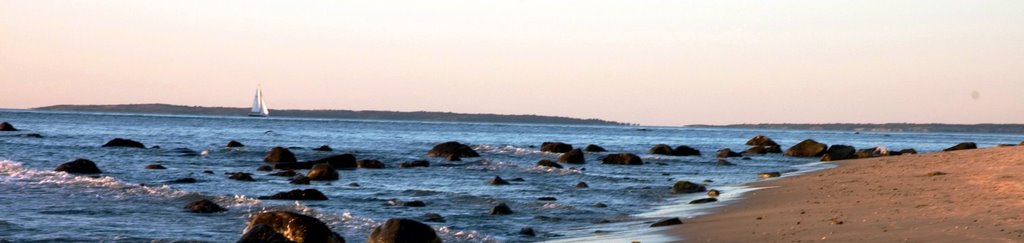
It makes me remember my old masthead, the sailing vessel of the coast of New England, and all of the hope and freedom it conveyed to me, the blues and the purples. Things are different up here. Photographs, even. They're all black and white.
Wednesday, March 30, 2011
Islamic scientists predicted the computer chips
 My hosts
When every Sunday rolls around, I ask myself why I'm not making it to church. I ask myself that question almost every single Sunday, and have for years. Since college, actually. I read John Updike's lauded article about faith, and he mentions slipping into a pew each week, almost despite himself, and I wished I could get that far.
What's hard for me about church is the same thing that's hard for me about living in a rural area—community. It's difficult to break into any community, especially to find a place where I belong among people of faith. What I loved most about living in a major urban center was the complete anonymity. No one knew who I was. No one knew what I was buying at the grocery store.
Here, people do. I feel judged for my choices—the tomatoes in the dead of winter, the bedraggled package of blue cheese shipped from who-knows-where, the day-old bakery wheat bread, unsliced. It's not so much judged as observed. As someone accustomed to anonymity, observation feels like judgment. I worry the same thing about church here, that my choices--of clothes, boots, peripatetic lifestyle—will be judged.
As Immortal Technique says so eloquently, it makes me want to "dead 'em all then escape in green Chevy." If only I had a green Chevy.
I wish I could just accept myself enough to make the choice to belong, no matter my differences. I keep thinking about this xerox-copied anti-Muslim treatise someone distributed at the YMCA before I left Chattanooga. It said that Islam wasn't a religion, but a full, 100-percent, total system of being, in its truest sense. I keep thinking about it, because that's the way I want to live my life.
A total system of being--that's what being a person of faith means. Faith is the most fundamental part of my existence. No matter what I have faith in, that's how I determine how I live my life. Some people believe in capitalism. Some people believe in status, prestige. Some people believe in mere matter in motion, in science, in hedonism, in just having a good time.
The first thing is what we believe. Everything else comes afterward. We're not all that different after all, the gentle citizens of Aroostook County and I. "Y'all are my sons like Ibrahim and Ishak," says Immortal Technique. Maybe so.
Friday, March 25, 2011
The creatures of Prometheus
People ask me why I blog sometimes, and besides blogging being a calling card for me as a writer, I do think of it as a literal web log, similar to the logbook I kept on my boat. Then I tracked the variance of the weather, my location, my mood, and Secret’s mood. When I go back and read posts from the past, they carry me right back to that moment in time, and I’m glad that I kept that record, if only for myself.
Some posts become touchstones, as this one did. I wrote it on the train, when we were home for the holidays from the boat. One of the great things about being back in Maine is that I have access to my old library, including that book, The Spell of the Sensuous, which has continued to be influential in my thought, even as I’ve been away from it for the last several years. My quotes from my last posts were epigraphs from it, and I’ve been rereading excerpts, especially thinking about it in the context of land.
I consistently think about the way he explains the way aboriginal Australians view the earth, as profoundly differently than we do, not as mere matter, but as the literal bones and blood of their ancestors. Their spiritual life takes place in something called “Dreamtime” when, “The earth itself was still in a malleable, half-awake state, and as Kangaroo Dreaming Man and innumerable other Ancestors wandered, singing, across its surface, they shaped that surface by their actions, forming plains where they lay down, creeks or waterholes where they urinated, forests where they kicked up dust, and so on. Eventually, having found an appropriate location, or simply exhausted from the work of world-shaping, each of the Ancestors went ‘back in,’ transforming himself (or herself) into some physical aspect of the land.
“Each Ancestor thus leaves in his wake a meandering trail of geographic sites, perceivable features in the land that are the result of particular events and encounters in that ancestor’s journey, culminating in that place where the Ancestor went ‘back in,’ metamorphosing entirely into some aspect of the world we now experience.”
I find myself wondering as I traverse this landscape, walk across the spine of this land, about the native people who lived here. Who were they? I don’t even know what tribe lived here, how they survived. I can’t imagine living outside during the winter here, yet people must have found ways to cope. That knowledge is completely lost. They must have told each other stories about this landscape, known what people are buried here.
My floundering for a place to belong becomes a larger cultural struggle. My blood is mixed. My grandfather Zodhiates came from a Greek island off the coast of Cyprus, Zodhia. Zodhiates means “of Zodhia.” My great-grandfather Douglas was of the Douglas clan of Scotland, so much so that my great-uncle was named Douglas. My name, Jenks, is Welsh. But I belong to none of those places. They no longer own me. I don’t know their stories, I don’t know the bones hidden in their land.
I’m realizing that being homeless is a larger American symptom, and maybe even a larger global symptom. Here’s the question David Abram asks:
“How did Western civilization become so estranged from nonhuman nature, so oblivious to the presence of other animals and the earth, that our current lifestyles and activities contribute daily to the destruction of whole ecosystems—whole forests, river valleys, oceans—and to the extinction of countless species? …How did civilization break out of the participatory mode of experience known to all native, place-based cultures?”
Place-based cultures. The alternative that we’ve chosen is homelessness. We are a homeless people, who have stolen our land. Maybe my hunt for a place to belong echoes a larger one, our larger hunt as a culture for a place that we belong. Because only when we can find that, when we can begin to look at the land as a living, breathing entity, can we begin to find our way across it as a civilization.
Some posts become touchstones, as this one did. I wrote it on the train, when we were home for the holidays from the boat. One of the great things about being back in Maine is that I have access to my old library, including that book, The Spell of the Sensuous, which has continued to be influential in my thought, even as I’ve been away from it for the last several years. My quotes from my last posts were epigraphs from it, and I’ve been rereading excerpts, especially thinking about it in the context of land.
I consistently think about the way he explains the way aboriginal Australians view the earth, as profoundly differently than we do, not as mere matter, but as the literal bones and blood of their ancestors. Their spiritual life takes place in something called “Dreamtime” when, “The earth itself was still in a malleable, half-awake state, and as Kangaroo Dreaming Man and innumerable other Ancestors wandered, singing, across its surface, they shaped that surface by their actions, forming plains where they lay down, creeks or waterholes where they urinated, forests where they kicked up dust, and so on. Eventually, having found an appropriate location, or simply exhausted from the work of world-shaping, each of the Ancestors went ‘back in,’ transforming himself (or herself) into some physical aspect of the land.
“Each Ancestor thus leaves in his wake a meandering trail of geographic sites, perceivable features in the land that are the result of particular events and encounters in that ancestor’s journey, culminating in that place where the Ancestor went ‘back in,’ metamorphosing entirely into some aspect of the world we now experience.”
I find myself wondering as I traverse this landscape, walk across the spine of this land, about the native people who lived here. Who were they? I don’t even know what tribe lived here, how they survived. I can’t imagine living outside during the winter here, yet people must have found ways to cope. That knowledge is completely lost. They must have told each other stories about this landscape, known what people are buried here.
My floundering for a place to belong becomes a larger cultural struggle. My blood is mixed. My grandfather Zodhiates came from a Greek island off the coast of Cyprus, Zodhia. Zodhiates means “of Zodhia.” My great-grandfather Douglas was of the Douglas clan of Scotland, so much so that my great-uncle was named Douglas. My name, Jenks, is Welsh. But I belong to none of those places. They no longer own me. I don’t know their stories, I don’t know the bones hidden in their land.
I’m realizing that being homeless is a larger American symptom, and maybe even a larger global symptom. Here’s the question David Abram asks:
“How did Western civilization become so estranged from nonhuman nature, so oblivious to the presence of other animals and the earth, that our current lifestyles and activities contribute daily to the destruction of whole ecosystems—whole forests, river valleys, oceans—and to the extinction of countless species? …How did civilization break out of the participatory mode of experience known to all native, place-based cultures?”
Place-based cultures. The alternative that we’ve chosen is homelessness. We are a homeless people, who have stolen our land. Maybe my hunt for a place to belong echoes a larger one, our larger hunt as a culture for a place that we belong. Because only when we can find that, when we can begin to look at the land as a living, breathing entity, can we begin to find our way across it as a civilization.
Monday, March 21, 2011
Bridgewater, Maine
 Branches in winter
I’ve been following the curve of the road back to the end of the land every day, except Sunday. Some days, when it’s above 40, the snow is damp and soft and I sink through up to my thigh in some places. Some days, when it’s closer to 30, like today, I can walk across the icy crust of the snow and head to places unknown.
I’ve been visiting this piece of land for seven years now, and I know it pretty well—where it arcs and curves north above the gravel pit to the beaver pond, where it opens up into the big wide field they call Strawberry Field, where the hill rises behind the washout, and how it looks on the other side. I feel like I know it.
“We must stand apart from the conventions of history, even while using the record of the past, for the idea of history is itself a western invention whose central theme is the rejection of habitat.” --Paul Shepard
“I wonder if the Ground has anything to say? I wonder if the ground is listening to what is said?” –Young Chief of the Cayuses tribe, upon signing over their lands in 1855
I know I don’t truly know this land, or have any possession of it. But if I continue to follow its lines, every day, don’t I love it better than anyone else? It’s almost like the only dignity is to be found in treating the land itself with compassion and love, to listen to it, to be mindful of it.
Thursday, March 17, 2011
Aroostook County, Maine
On the bus yesterday, I rode eight hours up from Boston, watching the snow accumulate along the sides of the road. Piles and piles of it, growing along the highway. Here, in Aroostook County, the biggest county east of the Mississippi and the northernmost county of the continental United States, spring is a long way away. I went for a walk today, trying to balance my body on the crust of ice atop the four feet of snow. When I postholed, breaking through the crust to the soft stuff underneath, the snow came above my knee.
It’s beautiful up here. Today, as I walked the sky turned lavender as the wind changed. Even a quarter of a mile into the woods, I could be hundreds of thousands of miles away from the nearest civilization. It feels like I am. I’m writing in a little office, a view out the window of the snow and the pines, but with no idea how I’m going to connect this to the internet. I’m hoping to set up a dial-up internet connection. (If I’m posting it, it’s because I have.) Doing it old school. Cause that’s just how I roll.
This was the point of coming up here. Among the points. Solitude and silence are a writer’s lifeblood. I’m hopeful, given enough time and silence, that I’ll be able to accomplish something extraordinary.
One of things I’ve been reading, or was reading before I came up to the frozen north, was the biographies of Nobel Prize winners on the internet. It’s an odd thing to do, I know. I’ve always been a compulsive prize follower. I back-check Original Screenplay Academy Awards every year the Oscars roll around. When he found me poring over my encylopedia’s list of the Pulitzer Prizes for fiction, my dad said I should rethink my degree in chemical engineering.
There have been only four women writing fiction in English to win the award: Pearl Buck, Nadine Gordimer, Toni Morrison, and Doris Lessing. Shockingly, all of them were products of two cultures, the marriage creating a third culture, its own. Pearl Buck was the child of missionaries in China, thrown out by the Boxer Rebellion, and she spent her life writing novels about China and the intersection of Asian culture with the west. Nadine Gordimer and Doris Lessing were both raised in countries that were not their own—Gordimer in South Africa and Lessing in Iran. They both spent their adult lives wandering, hunting for a home, and interpreting their experiences through their fiction.
Morrison inhabited her own space as an African-American writer, finding that space on either end of the hyphen in the divided word. It’s bold of me to claim that she inherits the assignation of a third culture, but more and more as I read my favorite African-American writers they find that same space where Morrison lives, balancing the demands of their home culture and the alien culture in which they live. That’s the tension that occupies her as a writer. “I don’t belong here,” she says. “I don’t belong anywhere else, so I have to stay here. You can’t tell me this home is mine.”
It’s encouraging for me to look at these writers, and have a moment of recognition. They were successful as writers and as women precisely because they didn’t belong. Precisely because they occupied that place of homelessness. They found that tension and they lived inside of it and they used it to create art. Instead of fighting against the feelings of loneliness, of loss at leaving a place I loved, I can use those feelings to inform my work. The point is to transform the woundedness, to come through it, and to end up on the other side in great joy.
As Toni Morrison herself so eloquently said, "My project rises from delight, not disappointment."
It’s beautiful up here. Today, as I walked the sky turned lavender as the wind changed. Even a quarter of a mile into the woods, I could be hundreds of thousands of miles away from the nearest civilization. It feels like I am. I’m writing in a little office, a view out the window of the snow and the pines, but with no idea how I’m going to connect this to the internet. I’m hoping to set up a dial-up internet connection. (If I’m posting it, it’s because I have.) Doing it old school. Cause that’s just how I roll.
This was the point of coming up here. Among the points. Solitude and silence are a writer’s lifeblood. I’m hopeful, given enough time and silence, that I’ll be able to accomplish something extraordinary.
One of things I’ve been reading, or was reading before I came up to the frozen north, was the biographies of Nobel Prize winners on the internet. It’s an odd thing to do, I know. I’ve always been a compulsive prize follower. I back-check Original Screenplay Academy Awards every year the Oscars roll around. When he found me poring over my encylopedia’s list of the Pulitzer Prizes for fiction, my dad said I should rethink my degree in chemical engineering.
There have been only four women writing fiction in English to win the award: Pearl Buck, Nadine Gordimer, Toni Morrison, and Doris Lessing. Shockingly, all of them were products of two cultures, the marriage creating a third culture, its own. Pearl Buck was the child of missionaries in China, thrown out by the Boxer Rebellion, and she spent her life writing novels about China and the intersection of Asian culture with the west. Nadine Gordimer and Doris Lessing were both raised in countries that were not their own—Gordimer in South Africa and Lessing in Iran. They both spent their adult lives wandering, hunting for a home, and interpreting their experiences through their fiction.
Morrison inhabited her own space as an African-American writer, finding that space on either end of the hyphen in the divided word. It’s bold of me to claim that she inherits the assignation of a third culture, but more and more as I read my favorite African-American writers they find that same space where Morrison lives, balancing the demands of their home culture and the alien culture in which they live. That’s the tension that occupies her as a writer. “I don’t belong here,” she says. “I don’t belong anywhere else, so I have to stay here. You can’t tell me this home is mine.”
It’s encouraging for me to look at these writers, and have a moment of recognition. They were successful as writers and as women precisely because they didn’t belong. Precisely because they occupied that place of homelessness. They found that tension and they lived inside of it and they used it to create art. Instead of fighting against the feelings of loneliness, of loss at leaving a place I loved, I can use those feelings to inform my work. The point is to transform the woundedness, to come through it, and to end up on the other side in great joy.
As Toni Morrison herself so eloquently said, "My project rises from delight, not disappointment."
Sunday, March 13, 2011
Ann Arbor, Michigan
When I arrived in Ann Arbor yesterday, I thought that the rejection letter I had received from the University of Michigan graduate school was already behind me. After all, I knew from the definitive MFA blog that people who were accepted received their letters on February 22. I knew that only 22 out of 1000 applicants were accepted last year, and only half of those in fiction. Generally, 70 percent of applications are for fiction rather than poetry. Those are long odds—11 out of 700. “Don't take it personally,” my professor from Tennessee said. It seemed good advice. I thought I had made my peace.
Tonight, though, as my friend Sonia and I wandered the streets and coffee shops of downtown Ann Arbor, it began to irk me. We sipped lattes and Thai iced tea, and I eyed the bespectacled and bescarfed students that surrounded me. Which of them were already MFA students? Which were professors? Had any seen my work? Had they roughed up my precious manuscript? Read three lines and scoffed?
Sonia and I also went to our first Bikram yoga class today, the original hot yoga. First impression: a carpeted room, heated to 105 degrees, filled with close-packed bodies sweating for 90-minute classes, six times a day, is extremely stinky. The first goal of a Bikram practice is just to acclimatize, to condition oneself to actually spend 90 minutes without leaving the room. It’s one of those limitations that can end up bringing freedom—I had to let go and just experience the heat, experience the feeling of being present in those conditions. Let it go, I kept telling myself. Let it go. Let your expectations for your body (and olfactory organs) go.
Which is what I need to do for graduate school, too. Let it go. I’ve put off applying for so long because I was afraid of this exact scenario. If they said no, what would that mean to me? Would it mean I’m not good enough? Would it mean I should give up? Of course now I know it doesn’t. It just means that it’s not the path for me now, at this time. It means I’m not ready yet, or that there’s a different opportunity around the corner. I need to let this program at this time go, to throw it like a stone into the river and let the water to flow by. “We step and do not step into the same river,” Heraclitus said. “We are and are not."
Everything flows, he also said. Nothing remains still. Let it go. Practice, as Patthabi Jois said, and all is coming.
Tonight, though, as my friend Sonia and I wandered the streets and coffee shops of downtown Ann Arbor, it began to irk me. We sipped lattes and Thai iced tea, and I eyed the bespectacled and bescarfed students that surrounded me. Which of them were already MFA students? Which were professors? Had any seen my work? Had they roughed up my precious manuscript? Read three lines and scoffed?
Sonia and I also went to our first Bikram yoga class today, the original hot yoga. First impression: a carpeted room, heated to 105 degrees, filled with close-packed bodies sweating for 90-minute classes, six times a day, is extremely stinky. The first goal of a Bikram practice is just to acclimatize, to condition oneself to actually spend 90 minutes without leaving the room. It’s one of those limitations that can end up bringing freedom—I had to let go and just experience the heat, experience the feeling of being present in those conditions. Let it go, I kept telling myself. Let it go. Let your expectations for your body (and olfactory organs) go.
Which is what I need to do for graduate school, too. Let it go. I’ve put off applying for so long because I was afraid of this exact scenario. If they said no, what would that mean to me? Would it mean I’m not good enough? Would it mean I should give up? Of course now I know it doesn’t. It just means that it’s not the path for me now, at this time. It means I’m not ready yet, or that there’s a different opportunity around the corner. I need to let this program at this time go, to throw it like a stone into the river and let the water to flow by. “We step and do not step into the same river,” Heraclitus said. “We are and are not."
Everything flows, he also said. Nothing remains still. Let it go. Practice, as Patthabi Jois said, and all is coming.
Friday, March 11, 2011
Grand Rapids, Michigan

Grandma in her garden (my sister's photograph)
My grandmother sleeps this evening a floor above me, in my aunt’s day room, hooked up to oxygen and a catheter. She’s on three kinds of morphine, but still sometimes grimaces with pain in her sleep, when she feels the tumor pressing against the tender tissue of her lung. Last night, I made her boneless skinless chicken breast and potatoes for dinner. She looked up at me, smiled, and asked, “Is this one of your gourmet meals?” She ate every bite. Food has always been her favorite thing, and she’s keeping that joy till the end.
Tonight my grandfather sleeps five miles away, in the special care unit of a nursing home. He’s hale as a horse at 92, but his mind is slipping. Today, as I joined him for his lunch, he repeated the story of the flight he’s scheduled to make to California tomorrow, to speak to first the entire country, and then the entire world. He shook his head at the difficulty of it. “I just don’t think I’m qualified,” he said. “I don’t want to embarrass the president. I don’t want to make a fool of myself.”
The irony did not escape me. He was so concerend with not embarassing himself, as he was revealing his most vulnerable side to me, his granddaughter. I drew him back around to topics I knew he could manage—his garden of forty years, the farmstead where he grew up, stories from the boat. He asked me why I wasn’t married yet. “I’m an independent woman, Grandpa,” I said.
They’re both fading. I’m mentally preparing for this trip to be the last time I see both of them. I could be wrong—I hope so—but in some ways I know they’re preparing for their departure. My grandma asks her pastor why it’s taking so long, and I understand that, too. I don’t want her to end her life of faithfulness with excruciating suffering.
I’m glad to be communing with them at the end of their lives, but I prefer to remember them the last time I saw them at their own house. Grandma cooked a vast feast for a group of us, me, cousins, and assorted children—wilted chard, zucchini bread, sliced raw tomatoes, and blanched green beans with butter. Along with, of course, a ham and scalloped potatoes. An everyday meal in her house. Four ingredients from her own garden, and this was only two years ago. The cancer was already growing in her body.
Grandpa has a picture of that garden, from that year, on the wall in his nursing home. He stands, with a straw hat, between the cabbage and tomatoes. Maybe someday, when I’m eighty, someone will take a photograph of me, standing between my rows of cabbage and tomatoes. And I hope that at the moment that photograph is taken, I remember both of my grandparents, and this day.
Wednesday, March 09, 2011
The rain drops
En route from Chicago, Illinois, to Grand Rapids, Michigan
186 statute miles
Traveling today on the Amtrak, I was able to review some of my old emails, including one that forwarded to me this review of an essay I wrote for the House Studio. Bizarre, to see my deeply felt and carefully constructed article disposed of like so much garbage. And oddly encouraging, in that I don't feel the criticism as deeply as I would have even a year ago. It doesn’t bother me as much as various other rejections, like the one I also received yesterday from the graduate school at the University of Michigan.
One of the books that I read while “adventuring” on Secret was Silence, by Japanese author Shusako Endo. In the novel, a Portugese priest named Father Rodrigues travels halfway across the world in order to evangelize the Japanese. Instead of being nourished by the rich food of faith upon arrival, he finds discouragement, disappointment, and filth. He reviles the Japanese he is supposed to be serving. He flirts with, dancing ever closer to, the seductive poison of apostasy.
Eventually he is imprisoned by the Japanese authorities, to whom any kind of proselytism is illegal. As he sits in prison, images of the face of Jesus and the face of Judas Iscariot flash before his eyes, and he tries to decide whether or not he will walk on the face of Christ when it is presented to him. Thematically, the novel explores the silence of God in the face of his believers’ persecution. Does God accompany followers experiencing adversity, or does he abandon them? And do we abandon him in turn?
That’s apostasy. While I am sympathetic to the priest’s struggle, I refuse to admit that questioning the literal inerrancy of Scripture equates me with him. I am willing to admit that my last post was borne more of that kind of doubt and fear than out of a true spirit of faith. In college, I was taught the concept of the hermeneutical circle, a circle of faith inside which a person is completely alone, forced to make the decisions of life by herself. An atheist, inside of the circle, decides that all of life is purely matter in motion. A Jungian decides that the endless layers of synchronicity he encounters mean something deeply significant about archetypes and the subconscious. A Christian stakes her life on the death and resurrection of the person of Jesus Christ, the Messiah, simply and solely that.
The biblical prayer is: “Lord, I believe. Help Thou my unbelief.” I struggle to find my own faith inside of my doubt. I have no other choice. All of us step out in faith, insulated inside the bubble of our own hermeneutical circle. All of us who sit in condemnation are solely responsible for our own choices, our own belief system.
I continue to doubt, walking away from my life as it was. Walking into the unknown, as Father Rodrigues did, forces me to doubt, forces me to throw myself on the goodness and grace of God. The choices I’m making also mean that I’m again walking away from people I care about and love, and walking a path that my family and many of my friends don’t always approve of. That’s difficult. A cognitive tension that I don’t think will ease with the passage of time. I’m trying to walk that line.
186 statute miles
Traveling today on the Amtrak, I was able to review some of my old emails, including one that forwarded to me this review of an essay I wrote for the House Studio. Bizarre, to see my deeply felt and carefully constructed article disposed of like so much garbage. And oddly encouraging, in that I don't feel the criticism as deeply as I would have even a year ago. It doesn’t bother me as much as various other rejections, like the one I also received yesterday from the graduate school at the University of Michigan.
One of the books that I read while “adventuring” on Secret was Silence, by Japanese author Shusako Endo. In the novel, a Portugese priest named Father Rodrigues travels halfway across the world in order to evangelize the Japanese. Instead of being nourished by the rich food of faith upon arrival, he finds discouragement, disappointment, and filth. He reviles the Japanese he is supposed to be serving. He flirts with, dancing ever closer to, the seductive poison of apostasy.
Eventually he is imprisoned by the Japanese authorities, to whom any kind of proselytism is illegal. As he sits in prison, images of the face of Jesus and the face of Judas Iscariot flash before his eyes, and he tries to decide whether or not he will walk on the face of Christ when it is presented to him. Thematically, the novel explores the silence of God in the face of his believers’ persecution. Does God accompany followers experiencing adversity, or does he abandon them? And do we abandon him in turn?
That’s apostasy. While I am sympathetic to the priest’s struggle, I refuse to admit that questioning the literal inerrancy of Scripture equates me with him. I am willing to admit that my last post was borne more of that kind of doubt and fear than out of a true spirit of faith. In college, I was taught the concept of the hermeneutical circle, a circle of faith inside which a person is completely alone, forced to make the decisions of life by herself. An atheist, inside of the circle, decides that all of life is purely matter in motion. A Jungian decides that the endless layers of synchronicity he encounters mean something deeply significant about archetypes and the subconscious. A Christian stakes her life on the death and resurrection of the person of Jesus Christ, the Messiah, simply and solely that.
The biblical prayer is: “Lord, I believe. Help Thou my unbelief.” I struggle to find my own faith inside of my doubt. I have no other choice. All of us step out in faith, insulated inside the bubble of our own hermeneutical circle. All of us who sit in condemnation are solely responsible for our own choices, our own belief system.
I continue to doubt, walking away from my life as it was. Walking into the unknown, as Father Rodrigues did, forces me to doubt, forces me to throw myself on the goodness and grace of God. The choices I’m making also mean that I’m again walking away from people I care about and love, and walking a path that my family and many of my friends don’t always approve of. That’s difficult. A cognitive tension that I don’t think will ease with the passage of time. I’m trying to walk that line.
Sunday, March 06, 2011
Don’t you want to feel your skin on my skin?
I feel alone right now, and broken. I walked away from my Chattanooga life a week ago and already I feel like I have made a bad choice. I walked away from my life there, and for what? For faith and a vague promise of redemption?
God said: all things work together for good for them that love Him and are called according to his purpose. He said: worship in Spirit and in truth. But I feel lost. I’m letting go of things, and it’s almost as if I’m letting go of too many things and now I’m left alone, driftless. I have cast off, and now I am being cast off myself.
How can I go through life alone? I see my sister’s life, her challenges and the things she has given up, the compromises she has been forced to make, but at least she has a life partner that she can count on, children who receive her love willingly. What do I have? Only the language and not the kiss.
“The fear I've known, that I might reap the praise of strangers, and end up on my own.”
It’s this constant fear that somehow there’s something wrong with me, that I came out wrong. I have to be in some way twisted, if I’m forced to drive away everyone who ever loved me, to pursue some high-minded ideal that isn’t real the way people are real. I feel abandoned, even though I’m the one changing, shifting my life, my boundaries, my space. Conflict about my life choices, from people in my life whom I love, makes me question Christ’s plan for my life. How can I believe that God loves me if the people He brings into my life don’t treat me with love?
I guess it’s a matter of letting go of the people who don’t treat me with love and drawing close to my heart those who do. God brings people into my life who care about me, but sometimes it’s difficult to pay attention to those people, to let go of those whose approval I desperately crave, whose approval I will never get. I have to have faith in Christ, that He is bringing change into my life for a reason, even if I have to journey alone. I also have to have faith that the things that happened in the past happened for a reason.
Clearly, I had an intense experience of surrender at my sister’s church this morning. I’m trying desperately to hold my life with an open hand, to hold it open to God’s will, but I keep wanting to close my fists.
It just hurts so bad. Change is brutal. Painful. Like I’m shedding another layer of skin.
God said: all things work together for good for them that love Him and are called according to his purpose. He said: worship in Spirit and in truth. But I feel lost. I’m letting go of things, and it’s almost as if I’m letting go of too many things and now I’m left alone, driftless. I have cast off, and now I am being cast off myself.
How can I go through life alone? I see my sister’s life, her challenges and the things she has given up, the compromises she has been forced to make, but at least she has a life partner that she can count on, children who receive her love willingly. What do I have? Only the language and not the kiss.
“The fear I've known, that I might reap the praise of strangers, and end up on my own.”
It’s this constant fear that somehow there’s something wrong with me, that I came out wrong. I have to be in some way twisted, if I’m forced to drive away everyone who ever loved me, to pursue some high-minded ideal that isn’t real the way people are real. I feel abandoned, even though I’m the one changing, shifting my life, my boundaries, my space. Conflict about my life choices, from people in my life whom I love, makes me question Christ’s plan for my life. How can I believe that God loves me if the people He brings into my life don’t treat me with love?
I guess it’s a matter of letting go of the people who don’t treat me with love and drawing close to my heart those who do. God brings people into my life who care about me, but sometimes it’s difficult to pay attention to those people, to let go of those whose approval I desperately crave, whose approval I will never get. I have to have faith in Christ, that He is bringing change into my life for a reason, even if I have to journey alone. I also have to have faith that the things that happened in the past happened for a reason.
Clearly, I had an intense experience of surrender at my sister’s church this morning. I’m trying desperately to hold my life with an open hand, to hold it open to God’s will, but I keep wanting to close my fists.
It just hurts so bad. Change is brutal. Painful. Like I’m shedding another layer of skin.
Subscribe to:
Posts (Atom)