Wednesday, August 22, 2012

Well you can ride, ride, ride


Wandering around in Camden. Here for two days helping my friend Carol.  Some photographs from the day:

Trees

Edna St. Vincent Millay achieved her literary debut bare yards from where I nest on a bleached duvet, in the Whitehall Inn music room.  We're here visiting our friend the chef, who works in the kitchen.  Tomorrow morning I am hoping for house-made hollandaise on his own English muffins.  Possibly the world's most perfect food.  In fact, the whole day has been like a food tour.

Eating is an agricultural act.
Big County
 There it is way up there in the tip--Cold River potatoes and 22 Vodka.  Home sweet home.

Libations

Delectable Hendrick's gin cocktails.  If I were a good food blogger, I'd know what restaurant we were at.  I just follow where I'm led and drink gin.

Best crab cakes of my life.  With iceberg wedge.
How do they get them so flaky, but crispy?  It's that conjunction of textures, plus being served piping hot.  Or maybe it's the crab.  I am yearning for lobster, but none so far.  I want to get one that's $3 a pound around here and find a pot and eat it in someone's backyard.  Despite having lived in Maine for eight years now, very off and on, I have yet to eat a Maine lobster.  I eat them in Mass, where K.'s family has the local hookup.  I am told, by Mainers, that Cape Cod lobsters have nothing on the babies up here.  They have to say that.

I finally get a picture of a moose!  Also:  I heart jugs.
At the local, where we finished the evening with piles of french fries, steak salad, and a haddock reuben.  I've never even heard of such a thing before, but it was exquisite.  The mild flavor of the swiss goes astonishingly well with haddock.  Again, if I were a good food blogger, I would actually have a camera that could take photographs in low light.

The walk back to the inn

Tuesday, August 14, 2012

Nobody knows, nobody sees

Writing tonight with only my left hand.  Even so, I want to type up this passage from Jane Eyre.  Typing left-handed with my right shoulder in a sling is fun.
I know poetry is not dead, nor genius lost; nor has Mammon gained power over either, to bind or slay:  they will both assert their existence, their presence, their liberty, and strength again one day.  Powerful angels, safe in heaven! they smile when sordid souls triumph, and feeble ones weep over their destruction.  Poetry destroyed?  Genius banished?  No!  No;  they not only live, but reign, and redeem.
So there all you doomsdayers about the current state of literature and publishing.

Wednesday, August 08, 2012

Come down from this cloud


I went to bed the other night with a slight twinge in my right shoulder blade, a common problem for me. I use it as a barometer, sometimes, of my activity level. If I start feeling pain in my shoulder from my old backpacking injury, it means I'm sitting in front of too many screens. Time to take a walk, time to get moving.

But the next morning I woke up with a jabbing pain behind my right shoulder blade, a constant throb that feels like it connects to both my spine and my neck, looping around my shoulder joint in the meantime. I've always been one of those people who (as much as I try not to) look down on those who let pain stop them. It's one of the reasons yoga has been so helpful to me, but even then, I think: they must not have been listening to their bodies enough. With some Protestant work ethic and some good Calvinist stick-to-it-iveness, they could snap out of it. No complaining. Work through the pain—push harder, soldier on.

Admittedly these are things I did not know I believed until I started experiencing constant stabbing pain for going on five days, pain that makes it impossible to sleep or to sit or to stand still. I'm on my second day of ice, but I worry increasingly that I won't make it to 2014 and Obamacare before I need to see the inside of an MRI machine.

I also begin to search for what I'm doing that is causing God to punish me, as I do whenever I experience suffering, another firmly held belief contradicted by my stated conscious beliefs. For someone who is supposed to believe in ultimate grace, I believe a whole hell of a lot in karma. What unknown sin have I committed? Is it because I have gained weight this year?

Because of course that's immediately where my mind goes, what I blame everything on. If only I was a svelte 00 nothing on my body would hurt. Babies have starved to death while I have padded fat molecules with egg rolls, ranch dressing, ice cream.

Or is it the sin of pride? For having the audacity to teach a new yoga class when I am a year out of practice? For braving the role of teacher when my own practice, thanks to angst and loneliness, has been dying on the vine?

Is it because of yoga itself, because I've deemed it an acceptable choice of exercise, disagreeing thereby with the orthodoxy of the Southern Baptist convention? Because I disagree that yoga is of Hindu descent and thus of the devil? Is it God's way of telling me that yoga is merely Satanism disguising itself as aerobics class?

Once upon a time a 26-year-old girl walked 3000 miles in two years, while carrying all she needed for life on her back. Her walk was a pilgrimage, a rebellion from the broad path, a way for her to discover her inner callings and gifts. She failed to defend herself against injury. She continues to fail to listen to her own body, the gift that yoga gives her that she continues to deny. She injured ligaments, sprained tendons, tore muscle fibers, built scar tissue—in her shoulder lives the memory of that journey.

Can I blame her? Is it punishment? Or is it merely consequence?

Sunday, August 05, 2012

Talking about


K. made us BLTs for lunch today. His obsession with bacon annoys me, to the point where the smell or taste of bacon grease begins to turn my stomach, but he can still do wonders with the meat nuggets themselves. The sandwich was a slice of storebought Canadian greenhouse tomato, a sprinkling of bacon nuggets from breakfast, and piles and piles of lettuce I cut in the garden. Last night was Thai-style tom yum (shout out to my brother, who bought us the tom yum paste) with kohlrabi leaves and cilantro from the garden.

So, see, it's not a complete disaster. That's the thing. I'm constantly panicking about the state of some vegetable or another, when really the thing to do is just to eat it. Even if it's beginning to bolt. The sandwich was exquisite, maybe the platonic ideal of a BLT, something worth sacrificing swine for. Who knew a BLT was designed to be a salad on a bun, with a sprinkling of meat bits?

It's interesting to me how my expectations for myself and for the world moderate. I'm even becoming less of a purist about local food. Of course, the world would be better off if many more people would grow a much higher percentage of their own food. I'm proof that it's easy enough, and it wouldn't be bad to have some chickens scratching around for eggs and meat or a swine in the shed, either. But my tomatoes from Canada I will not give up and I refuse to feel guilty about.

There are all sorts of ways to build and design a more healthy society, but I think there's room for luxury, too. We're only human. We need things like melons in winter shipped from Mexico, like greenhouse-grown tomatoes for all months except this one, and then our tomatoes are still weeks away. The sooner begin to turn our minds around to how we can power this global village in a way that doesn't corrupt our atmosphere any more than it's already been corrupted the better.

Saturday, August 04, 2012

I remember the days


Empty beaver pond, dory lawn art, and garden--basil, peas, tomatoes, and turnip barely visible
Missing my grandparents as we head into August. I'm so glad K. had the opportunity to eat dinner at their house in their last year there, to see the breezeway and the garden, to taste my grandmother's food. I know I've written about it before, but August is when it comes back to me—the zucchini bread, the sliced tomatoes, the swiss chard. Especially because I cut my first swiss chard today.

Ridiculous, I know. We could have been eating it a month ago. A friend stopped by this afternoon, a fellow farmer who mainly farms his wood lot, selling what wood he culls in excess of what his family needs, after cutting it himself. Not clear cutting, as the neighbor is doing. I imagine doing the same, trekking out to chainsaw into hunks the trees that have fallen or will soon, dragging out the logs with my team of Belgians. But that'll have to wait until I figure out how to eat the vegetables in my garden.

I mention it, though, because he said what he learned from an old potato farmer: there's no such thing as 100 percent.

Isn't that great? How many times do we hear that on the news—at least I gave it 100 percent. But it's not true. None of us can give that much. None of us have that much to give. We all fail, all the time, we all fall short, we all stumble.

Especially in this business of getting things to grow. The two of us could eat chard every meal, three meals a day, until the frost, and the leaves would just grow back in time for us to make the cycle again. You doubt it, but it's true. Last year we cut them down to their nubbins before the first hard frost to blanch and freeze—frozen chard is a spectacular addition to spaghetti sauce during the winter—and a week later, after it warmed up a bit, the nubs were putting out new tender green leaves. So eating it all is an endless, impossible task.

My grandparents taught me not to waste—not money, not time, not food. But I'm realizing implicit in the enterprise of growing is sacrificing some of the harvest to the whims of fate, whether it's my own laziness or beetles or frost or rot. Moths and rust destroy here. It's a relief, though. When I give up doing justice to the massive quantities of vegetables out in the lawn right now, when I just accept that many of them will be lost, I can enjoy the five leaves of chard I snipped this morning and scrambled into my eggs.

Wednesday, August 01, 2012

Come on girl

Inspiration for today:

Kelly McGonigal on the Neuroscience of Change

Some of this blows my mind.  Like the idea that compassion for yourself actually changes your brain chemistry, whereas self-criticism provokes addictive behaviors.

Some quotes:
...There was a recent set of studies that tracked people over time who had set specific goals. Some were trying to lose weight, some were trying to become better musicians, some were trying to finish an academic degree. So they followed these people over time, and they also tracked how self-critical they were. And there was a direct relationship between self-criticism and success over time. The people who were harder on themselves succeeded less—and not just by self-report. It’s not like they were saying, “Oh, I’m so hard on myself. I don’t feel like I did a good job.” It was objective outcomes, like pounds lost.
...There is abundant evidence from every type of challenge you can think about in the addiction literature with dealing with anxiety and depression that the harder you are on yourself for having the problem in the first place and for being unable to fix it immediately, the more likely you are to spiral back deeper into the problem. To turn back to a drink to kind of soothe your feelings for how guilty and ashamed you are about having to drink or to food when you’re feeling ashamed about overeating or being overweight.
...There are a lot of people who are swayed by evidence, sometimes just showing a picture of the brain—say, “This is what it looks like when you’re being self-critical and why it’s not helpful”—it’s not like we didn’t know it wasn’t helpful, but just to see it somehow can help us recognize that there isn’t something fundamentally broken with us, that all human beings have these experiences. I feel like that’s what the science adds for most people.
Maybe these are things that everyone else knows--Olympic athletes, for instance, who must have a firm belief in their own powers to accomplish what they do.  But not us depressives, who hulk in the Maine wilderness and chastise themselves for eating insufficient quantities of homegrown lettuce.  Maybe it's just the protestant work ethic that gets us all down, an inefficient ethic, as it turns out.  It's turned us into a nation of over-medicated over-fed addicts, always full of hatred for ourselves for our multiple failings.

I just keep thinking that this Buddhist, or perhaps scientific, understanding of self-compassion is what Jesus was talking about when he talked about grace.  It's grace He gives us.  Grace to forgive ourselves for our mistakes, grace that washes us as white as snow.  If only I could believe it.

Sunday, July 29, 2012

We don't really want a monster

A canker in the heart of the heart of the country
Lately, with the beaver pond going dry in the front yard, after, the rumor is--our neighbor shot sixteen beavers and finally got the last one maintaining the dam and it washed out in the middle of the night-- after the endless apocalypse of wood clear-cut on the back side of the house, and the parasites destroying wholesale all the young poplar in the back woods, I feel surrounded on all sides by destruction.  Perhaps that's because I'm surrounded on all sides by destruction.  Our world is fringed by death, nibbled at its corners by desolation.  No one can find a whole leaf in the forest, untouched by parasite, mold, blight, worm.

Now I walk on the edge of wasteland.  It's an interesting job, the job of a farmer, of bringing life out of all that death.  A front-row seat to nature, red in tooth and claw.  Even a grouse, a stupid one, that kept fluttering beside me as I walked, only a mouthful of feathers in the trail yesterday.

It's becoming almost obscene to me this year--maybe it's the heat--the worms clustered on the undersides of leaves, ripe with decay, their overwhelming fecundity, the sheer quantity of them.  As inexorable as sin.  Every day more of them, more trees red with autumn in July.  All the poplar will disappear, I don't doubt.  The tiny cold stand I make against them is inadequate.

Even us--the germs that twist in our gut, the mites that burrow in our skin, the bugs that drink our blood.  We're at their mercy, at the mercy of whatever grace allows us to keep on living.  I try to coax a few small things to life.  My pot of basil.  Our frilled carrots, leafing ever more bravely to the sky.

Saturday, July 28, 2012

Nothing good is kept for later


Something is eating the alder 
The first time I saw a pile of entrails was on a farm in Amish Indiana. I was there for Thanksgiving, my first year of college in the States, my parents in Thailand. I went home with a Mennonite friend from high school, one of my roommates whose parents had been missionaries in the southern islands of the Philippines. Her parents had followed her to the States, and she took me and the three others back for the break, next door to the Amish.

We walked over, and they'd just finished slaughtering a cow. The Amish boys stood awkwardly on one side of the pile, and we missionaries hovered on the other. The older men talked of cows and harvest and slaughter, and I stared at the pile. How could a cow's liver be that big? How could there be that many loops of kinked intestine?

In my memory, the cow's head rested on top of the pile, all bug-eyed and monstrous. My friend James Yeo, whose family was also still on the field, kicked the pile with his skate shoe, absently, as a way of avoiding conversation. The head came tumbling down, landing at my feet. But that can't have happened, can it?

I dreamed recently of a heap of entrails, housed behind glass, before a black-eyed witch trying to take home away. One can turn all pragmatist, and insist on the randomness of dreams.  But I can't.

What does it mean?

Wednesday, July 25, 2012

Transport is arranged

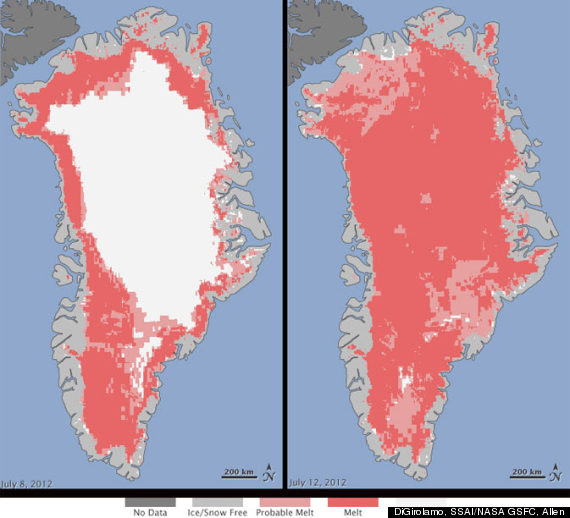
Greenland glaciers melting

There are things that terrify me. These are among them:

A Huffington Post article that explores the consequences of global warming, after the US experiences its hottest twelve-month period in recorded history: Climate Change Effects

Unprecedented amounts of ice are melting in Greenland. See above picture, and the following article:

My vote for the best short story of the last year: Diary of an InterestingYear

This interview with activist Stewart Brand, of the Whole Earth Catalog:  Environmental Heretic

He says:
We have thirty years before we face disaster: Europe, North America, and China becoming unable to grow food, mega wildfires, melting glaciers. Reversing current problems before something catastrophic happens will probably require buying time with climate-engineering approaches, such as putting sulfur dioxide into the stratosphere the way volcanoes do, to reflect more sunlight back into space. We’ve still got to get the carbon-dioxide levels down — along with methane, nitrous oxide, and the rest of it — but that will take a long time, because there’s so much industrial and political momentum to overcome. Many climatologists who were originally opposed to direct intervention in the climate are now saying we may have to do some form of “global dimming” to buy time.
He says that climate change has become a partisan issue in the US. True dat. He thinks environmentalists have to drop their resistance to nuclear energy and genetically-engineered foods, as those two things are going to be among our only ways out of the coming crisis.  In his interview, he defends and defines science in much better ways than I can, and says:
I’m trying to convince the conservatives and the environmentalists to follow the science right across the board, not just where it’s convenient or supports their ideology. And the science itself needs to move forward quickly. We do not have enough data, especially in terms of how the oceans affect the climate. We don’t have climate models that can predict what will happen or even understand some things that are already happening, such as the melting of Arctic ice.
He's also featured in the documentary Earth Days, which I heartily recommend.

Last, but not least, ShawnLawrence Otto, author of the book Fool Me Twice: Fighting the Assault on Science in America who says:
All those dire (alarmist!) warnings from climate scientists 30 years ago? They’re coming true, one after another–and faster than supercomputer models predicted. Data shows 37 years in a row of above-average temperatures, worldwide. My state has warmed by at least three degrees Fahrenheit.
Apologies for enjoying it in Maine, where we've hit ninety degrees pretty much every day of the last month, but my question is what are we doing about it? And why are so few of us discussing it?

Sunday, July 22, 2012

Closer than

Some photos of the garden for today:

Chard, ready to eat
Garlic, and its scapes

Kohlrabi, only about golfball-sized

Friday, July 20, 2012

Fate

The beaver pond mysteriously drained itself two days ago in the middle of the night.  Turns out there were trout in it.

I wrote about fate recently, this quote, about moira. I've been thinking, among other things, that may be the best name for a boat, ever.

The Sun ran an interview with the late James Hillman in its July issue, a meaty conversation with an iconoclast, and points he made continue to nourish me. Hillman:
...believed each individual has a purpose or calling in life that reveals itself in childhood and reappears, often as a set of so-called symptoms, until it is heeded. Harnessing this potential is what he considered the great mortal, and moral, challenge. He once said our duty is not to rise above life but to “grow down into it.”
He spoke about something called “acorn theory,” saying:
...it's more of a myth than a theory. It's Plato's myth: that you come into the world with a destiny, although he uses the word paradigm instead of destiny. The acorn theory says that there is an individual image that belongs to your soul.

The same myth can be found in the kabala. The Mormons have it. The West Africans have it. The Hindus and the Buddhists have it in different ways. They tie it more to reincarnatioan and karma, but you come into the world with a particular destiny. Native Americans have it very strongly. So all these cultures all over the world have this basic understanding of human existence. Only American psychology doesn't have it.... Calling can refer not only to ways of doing—meaning work—but also to ways of being. Take being a friend. Goethe said that his friend Eckermann was born for friendship.
And one last quote:
To show one's face is part of having the courage to show who one is. And coming to terms with your own face takes a lifetime. Just think how, when you were twelve or sixteen, you wished you looked different. And that's true for everyone; even the most perfect, beautiful boy or girl is dissatisfied. So why is that? It can't just be that you don't look like the model on the magazine cover. It's something else. You haven't yet accepted your fate, who you are.
Everything uncovering itself to me lately has been about destiny. Like this Ted lecture:


I love that idea, that there's a germ inside of each of us, waiting to sprout if we but feed it correctly.

This year, for the first time, I was able to start seeds. I can really tell you how to do it, in one of these how-to posts I never do. Use six-packs. Fill them with a blend of garden soil, peat moss, and potting mix (any soil from the dollar or hardware store will do). Plant two seeds in each section of the six-pack and barely cover them with dirt. Place them in old cookie trays filled with water (or old plastic trays of any kind). Stretch clear plastic on top so the soil is kept moist (you'll know it's moist because the water will condense on the underside of the plastic). As soon as you see green sprouts, pull the clear plastic off and keep the plants watered as if they're house plants.

It was almost painfully easy this year, so much so that everything was over-planted, and we have two gardens full of plants, plus two ploughed and unenriched sections planted with cucumbers and squash, and the glass room is still full of plants

So what if my destiny is the same? If all it needs is the right kind of moisture and light, and if I figure it out, I'll burst chlorophyll-fueled growth?

Wednesday, July 18, 2012

Seen people blessed

Salad 
I found this blog this week, another Maine farming family, but one that doesn't seem to share the angst and anxiety, the sturm and drang, I thwart myself with all summer.  I said to two separate friends last week that gardening/farming is an act of wrestling with constant failure, and so easily I forget about all the anxiety from last year, all the failures--the cucumber beetles and hail and blight--and now when I look back on photographs, they seem to be taken from a lush tropical rainforest that magically produced vegetables.

Nevertheless, I made my first salad all from garden vegetables this week, and it feels like a huge accomplishment.  Arugula, red and green oak leaf lettuces, snap peas, green onions.  Tomatoes from the store, a fresh radish pickle as garnish.  It was possibly the most delicious greenery I've ever eaten.

I'm not going to lie about the effort it required--sometimes the harvesting feels like the most difficult part.  Getting out of the house with a pair of scissors and a bowl when I'm hungry and just want a snack, and trimming around the base of the lettuce plants and dumping the slug-infested leaves into the compost and finding good ones and filling the bowl up.  Cleaning dirt from the onions, worm-eaten spots from the radishes.  Convincing myself to put it all together into something delicious.

I, too, have things coming up from the ground that came from last year's plantings, most notably echinacea (cornflower) and Jerusalem artichoke, which has hit the big time as "sunchoke," so called by Gordon Ramsey.  And four or five volunteer tomatoes, all sprung up at the end of a row of leeks.  It's all very exciting, these little gifts that the universe bestows.  But the garden I have is never the garden of my dreams, or even the lush paradise I remember from the past.

Tonight I caught another PBS documentary--why are they all so good?--about harlequin romance novels.  It filmed various women, one in Japan, another in India, all hooked on the genre, juxtaposed with a male model who poses for covers and a British romance novelist.  The surprising thing, the beautiful thing, was watching these people, all so different, all searching for love in their own way.  And those who, after spending all their time longing for the romance they read about in books, realize that the love they're looking for has been there all along.  In their own home, with their own husbands or lovers.  That love, too, can only be found in the moment.

I'm trying to realize that this summer.  Failing most of the time, just as with the garden, but trying anyway.
Send us now into the world in peace, and grant us strength and courage, to love you, and serve you, with gladness and singleness of heart.
That's what I pray in the liturgy.  That's the reminder.  If only I can remember to grow my vegetables with gladness, and singleness of heart.

Sunday, July 15, 2012

Bound to

Today lightning storms and flash flood warnings and electricity out for most of the afternoon.  It's also the mid-point in July, which means any plants that go in the ground have to be for fall weather, capable of withstanding frost.  The joke, around here, is after the fair in August you bank the house, but I'm not making jokes about winter yet.  Not when it's still ninety degrees during the day.

Not when heat and humidity break with heavy rain, pounding down around the eaves like thunder, and lightning cracks over the next ridge.  It reminds me of home--how in Thailand, during the monsoon, we'd have heavy humidity all day and then a rush of rain like a dam bursting in the afternoon, and then a few blessed hours of coolness in the evening.  Here I relish every drop of sweat, hold it close to my heart, knowing how fleeting these days of warmth are.  How soon I'll have to put back on sweaters and socks.  How few months before the wood stove cranks up again.

What it says about our weather patterns that July in northern Maine now resemble tropical southeast Asia are something else entirely.  Something that perhaps I shouldn't go into now, although I'm sick of no one talking about it.  Sick of everyone discuss cavalier plans for building pipelines and fracking when we're not dealing with the larger problem.  All of us know that the ground is shifting under our feet, that there's an elephant in the room no one mentions.  Because it's too hard.  Because we know how much change will cost.

Is it bad, then, that I can be so gleeful on these tropically hot weeks in Aroostook County?  How I pray every day for the heat to hold?  I stand outside, under the bare inches of eave, and let the rain crash around me.  Listen to the thunder.  Thrill to the light.

Friday, July 13, 2012

Everything in this world


What we think of as magic and what we think of as science are close to the same thing. What once was magic is now science, and what now is magic may soon be science. Take time travel. It's one of the things in the Brian Greene documentary on PBS, which—I repeat—everyone must watch. Time travel, according to most scientists, including Brian Greene, so mainstream as to be disdained by the Big Bang Theory, is something that quiet possibly may come to be. Even Stephen Hawking, in his book, The Grand Design, says that time travel should be possible.


Or synchronicity. It was Carl Jung who named it that, this feeling we have of things ordaining themselves around us as we ordain our actions. That a goodness follows our intention. A divine purpose to our ends.  As Hamlet put it:  Divinity shapes our ends, rough-hew them how we will.

As Wikipedia explains so professionally, there is a tendency to interpret these data as necessary, once they've already come to be. “Confirmation bias is a tendency to search for or interpret new information in a way that confirms one's preconceptions.” In other words, it's all in our heads. It's a debate, whether the extraordinary chain of necessary coincidences that shapes our now is really something we only see after we've passed it. Whether all we are doing is falling back into the abyss of time, that each breath we take has already been written.

These are things that abstract mathematicians currently study. Does, time, in fact, exist like a bread loaf? With each moment merely a cross-section, a slice of toast? Math and physics answer these questions.

I'm reminded of Orson Scott Card, my favorite contemporary science-fiction novelist (dude, I come out of the closet as sci-fi dork and the floods break loose], who says, in his novel Xenocide, that god is not in the gaps. A girl, Han Qing-Jao, part of a fundamentalist sect, is tasked with discovering where a fleet of spaceships disappeared to. Despairing, she comes to her father and says: “I can think of no other explanation. God must have made them disappear.”

He says: “Of course God did it! Our job is to figure out how.”

Exactly what a scientist must do. There's a mistrust of science in American culture these days, or maybe just a misunderstanding of what science does. It deals in evidence—cold, hard facts. If we measure this statistic, for thirty years, what changes? What does that prove? Why? Matter in motion is all science cares about. Did you know that when Einstein came out with his Theory of Relativity (note: theory. What science does not do is prove things) people claimed that it was “Jewish” science, and that it would bring about mass moral failings? That support of relativity was divided along partisan lines?

The book the Tao of Physics explains much. That theoretical math has repeatedly echoed the beliefs of eastern mysticism—this should come as no surprise. And also as no threat to Christians, since Christ himself was an eastern mystic. There's a chi, a prana, a Spirit in us. Its name is electricity, and it vibrates in astonishing ways, deep below the surface of our atoms, even in the centers of electrons that make up our corpus and blood. We are, in a scientific sense, spiritual beings.

And with that thought I leave you.  If you don't care about science, here's an alternate blog post to read for today: You Are Here.

Wednesday, July 11, 2012

Seen people cursed

I worry sometimes that I'm becoming too esoteric of a person, too random as a person. I love exploring ideas, but I also just want to be a normal person sometimes, with a normal voice. I want to say things like: it's driving me crazy that the arugula is blooming all of the time instead of producing leaves, but I know I should have planted it earlier, so it's all my own fault. Like how sad I am that I left my windows cracked through the last monsoon and now I have mold growing on the floor of my car. That even though I bought a non-locally produced watermelon for the Fourth of July, I have yet to complete cutting it up. Like we're watching the final episode of Battlestar Galactica tonight, and I'm so excited I could puke. Like I've always been a sci-fi dork, from back one I was a freshman and I read the entire five-book Foundation series, in order, as well as all of the anthologies of pulp sci-fi short stories from the fifties before anyone had landed on the moon.


So. That's what I'm doing today. Above is the sky from my walk with Shadow yesterday, back to the washout. I go to church on Wednesday nights in the summer, and today was the first night I made it in a month (a month of Sundays!) and it feels good to have been there on a night when the reading was David dancing in front of the ark of the covenant.

Beyond Battlestar Galactica, everyone should Google/Netflix/Tivo "The Fabric of Space" on PBS. Theoretical physics as show. A must-see.

Tuesday, July 10, 2012

Seven to eight years old

Arugula, beets, lettuce, peapods, and in the back little patches of chard and spinach.  I feel bad posting these photographs because it is clear how bad my weeding and soil enrichment are.  But the lettuce is pretty.
I'm sitting in my office, at my desk, my mind maps to my right and the orange Burton snowboard that is my wall art in front. To my left is K., on the push lawnmower, decorating the grass with patterns of lawn art in the cloverfield. It's been a good day of work, for both of us—me here and he there.

We're all thieves,” he said today, as we stood out by the garden, talking to our friends, also K., and A. and R. K., the second K.--became a father thirty days ago. A.'s eldest turns two on Thursday. They were talking about the trucks they'd rolled, things they'd stolen in their misspent youth.

Lift and let lift,” Brian Doyle says. 


[And this link also.]

It made me think about theft, about Bob Dylan, and what it mean to steal things. This is one of these topics that I keep dancing around because I want to talk about it seriously some day, like doctoral thesis seriously. Bob Dylan is our greatest songwriter, and what he did was steal.

My central thesis is that Bob Dylan stole every line of “'Love & Theft.'” Every single line. I understand the impulse. It somehow seems a prod to creativity to turn to another piece of art and feed from it. Allow it to nourish us and respond. But is it exactly fair? I can't decide.

Dylan says: “But to live outside the law you must be honest.”

That could have relevance, perhaps, to us trying to live after the law, after the prophets. Under grace.
Living in the land of Nod
Trusting their fate to the hands of God
They pass by so silently
Tweedle-dee Dum and Tweedle-dee Dee
        [also Dylan]
So what things have I stolen today?  Food from the ground.  Light from the sun.  Time from my future.

Friday, July 06, 2012

Everybody held their breath

It's daisy season 

Today I woke up early and came to my desk early, as I do most days. Late for other people, early for me. Sometimes I regret my vampiric ways, that even in the high noon of summer I'm unable to rise and set with the sun. I insist on late nights, staying up till 1:30, 2, 2:30 every day. “Early to bed and early to rise,” etc. Is it true? Should I fight my nature? It's the debate all of us have, perhaps, with our natural tendencies. Even the bodies, the faces we were born with.
A quote, from Richard Hillman:
The Greek idea of fate is moira, which means “portion.” Fate rules a portion of your life. But there is more to life than just fate. There is also genetics, environment, economics, and so on. So it’s not all written in the book before you get here, such that you don’t have to do anything. That’s fatalism.
I've been thinking a lot about failure, as it connects to fate, as my destiny seems to be to consistently fall short at the things I aim to accomplish. For instance, last year the farm/garden, the farden, had an exotic newness to it. By that I mean that the hard work it required had adventure attached to it. This year, it feels more just like hard work. Which means that less has been done, or more has been done in specific areas (perennials), but in other areas I am far behind where I was last year.
That makes me feel bad about myself. The guilt I refer to frequently, as a necessary connector to my faith, almost a phantom limb. This years garden feels like a failure, and the more so as time passes. I experienced this last year, also: the challenge with farming/gardening is always being on the brink of failure. Any malevolent weather could wipe everything out. Any ravenous bug. Any time, here in the arctic north, that you miss the magic week of planting, the magic week of harvest. The awareness of time passing is like a roller coaster plunging.

Thursday, July 05, 2012

Independence Day

Sprinkler

My faith is situated some place between early-church mystic and holy-roller Pentacostalism on the chart, an odd place to be for an ex-Baptist who attends an Anglican church. Sometimes I flirt with Dostoevsky-style eastern orthodoxy or Cardinal Newman Catholicism, too. So what does it mean to be an early-church mystic? It means that the Spirit infuses all things, present in each moment, more present, immanent, than we can conceive. That God is present all around us, numinous, in the world.

It's funny how the Baptist evangelicalism I was raised with was so uncomfortable with the acts of the Spirit. Hysterical. We believed, yes, that He/It was one of the three parts of the triumvurate Trinity, the triune God, but were were much more comfortable with God the Father, the God of vengeance and the law, or blue-eyed Christ Jesus. The Holy Ghost made us think of the wild-eyed New Agers I was warned against in filmstrips. Really, the Spirit is the one that Christ leaves with us, the God that lives inside.

As I begin to find a place as a farmer, it feels like the Spirit is closer than ever. “The force that through the green fuse drives the flower,” as Dylan Thomas puts it, is not that the Spirit of God? That force which aligns coincidence and our archetypal subconscious, which speaks to us in dream, which uses signs and wonders to keep our attention—is not that the Spirit of God? “God's invisible qualities—his eternal power and divine nature” those that “since the creation of the world... have been clearly seen, being understood from what has been made, so that men are without excuse...” Are those invisible qualities not the Spirit of God? All we can see of God in the world—is not that his Spirit?

Maybe it's just the wildflowers springing out after the rain reminding me of the lilies of the field. Buttercups, daisies, pale purple clover, little off-white bells that remind me of purses. “They do not labor or spin. Yet I tell you that not even Solomon in all his splendor was dressed like one of these. If that is how God clothes the grass of the field, which is here today and tomorrow is throw into the fire, will he not much more clothe you, O you of little faith?”

That's me. She of little faith. A friend of mine suggests trusting that the force that drives the green fuse through the flower will drive it through me, too. But he's braver than I am.

And the skunk, our brave miniature skunk, came back too. We're going to try to convince him to become our pet. I may be taking baths in milk and tomato juice any day now.

Sunday, July 01, 2012

I will sing to you of greater things

A baby skunk came to visit
He was about half the size of a kitten, and possibly the cutest thing I've ever seen. My sister's had an obsession with baby animals for a long time, and seeing a miniature skunk waddling around the front lawn, turning on us with the camera and spreading his front legs into an aggressive stance, although he had to have been too small for his stink glands to be active--it made me understand the obsession.

Friday, June 29, 2012

When you go out to play

Dill patch, so far unsuccessful.  Jerusalem artichoke, horseradish, rhubarb, echinacea--in clockwise from bottom right.
Then this paragraph from Raymond Carver:
He pulled a chair out and sat down at the kitchen table in front of the big ashtray. He closed his eyes and opened them. He moved the curtain aside and looked out at the backyard. He saw a bicycle without a front wheel standing upside down. He saw weeds growing along the redwood fence.
That paragraph is perfect.

Wednesday, June 27, 2012

Do the things we choose


Didn't work as well as I'd hoped. Maybe my ribbon is dying, in addition to crumpling and ripping through. Physically decaying as I type. As far as I know it hasn't been changed since my grandmother's time, so it's not a big surprise. That's the next step--find a ribbon, buy some anti-corrosion oil, figure out why I can't get a justified left margin or a single space when I hit the space bar. Still. This was fun. I'm absolutely addicted to my Hermes Rocket. Some photos:

My desk--basil, Burroway, siblings, coffee, typewriter
Crumpling ribbon driving me crazy.  One does understand Jack Kerouac better than previously.

Sunday, June 24, 2012

Check one, check two

All the seedlings should be in the garden already.  They're not.  The flowering plant, however, was brought back from beyond the grave. 
What I really want to be writing about, most of the time, is food. How since food is the only thing I need in life, other than art, it behooves me to learn how to grow it. Or maybe it's just Grandpa Jenks in my DNA, speaking down through the century. Those dairy and potato farms understood the value of pulling things up out of the earth.

Maybe it's why I've chosen farming as my avocation, although calling what we do here, on a plot barely bigger than a garden, is by no means farming. Maybe I just want to reclaim that word, and the idea that one can be a farmer simply by stating that intention, to create something of value for my own body by cultivating the soil and the things that grow from that soil. Recently I asked our cooperative extension representative at what point a garden stops being a garden and starts becoming a farm and even she didn't have an answer.

Why have all of us suddenly returned to a goal of being able to provide our own food for ourselves? It seems a good sign. Today was documentary Sunday on Maine public television, maybe my favorite television day of the week, and the best one was about Bhutan, whose benevolent philosopher-king has instituted a policy of “gross domestic happiness.” GDH is founded on environmental responsibility, economic development, good governance, and a strong connection to a unique culture.

Watching the interviews of families of sustenance farmers in the countryside, families collected together in hot springs, laughing together in the steam, or cultivating their rice fields in the mountains—it seemed the idyllic version of reality I so often envision. Government officials emphasizing the importance of leisure time for the families, and chances to pursue individual spiritual practice. Everyone seemed engaged in art as well as farming—people played native guitars, or sang, or danced, or designed elaborate costumes or masks, or practiced archery. Most of the country folk hadn't even heard of the national policy on happiness. But the happiness itself glowed from their faces and was present in their words. They spoke of the debilitating effects of advertising, now that electricity and television are reaching the farthest flung areas. Advertising creates desire, and desire creates suffering. No wonder so many Americans are so miserable.

“Money?” they ask, almost to a person. “What good is money? If I had money I'd just be afraid of losing it. Happiness comes from inside, and no one can take that away.”

They say it better. Perhaps because they know it better than I ever will.

Friday, June 22, 2012

Solstice

Mark and his wife in their Pittsburgh farm

One Father God
One Mother Earth
One life to live
For what that's worth
Everyone born
Is bound to die
Let us love now
And not ask why
For we are all God's children, oh
We are all God's children, yeah
We are all God's children
Here

--Mark Williams, “All God's Children”
 I'd like to officially stage an online barter, as a child of the internet.  My acquaintance Mark Williams, husband of my sister's best friend, is an artist, a singer-songwriter.  I stole his album long ago, and have benefited from it for many years.  I'd like to trade a review for the album, work for work.  As the essays I've been paid for most frequently are music reviews, I'd hope it's a fair trade.

The album is Borrowed and Blue, a suite of songs recorded for his wedding, and released only as a party favor, unfortunately unavailable on iTunes and Amazon.  Maybe if you send him ten bucks he'll burn you a copy.  The songs are incandescent, joyful.  Every time my iTunes shuffle gives them to me, on the wings of amor fatie, I accept them, love them more, weep silently at my desk.

As a songwriter, Mark finds a balance between the grand faith of hymns and the intimacy of a prayer.  It's so rare to find artists with this level of optimism in their lyrics, optimism but not an ounce of sentimentality.  His lyrics soar, admitting the reality of death and fear and brokenness but denying evil its power, proving, by the richness of his voice and the dense furry breadth of his guitar, the truth of his lyrics.

Williams is a deep thinker and a careful poet, a theologian and a mystic.  It's a constant surprise to me that he's never received fame, although whether he'd look at such a fate as a gift remains uncertain.

He'd probably take it as he takes most things:  with hope, and faith, and music.  His voice has a raspy immediacy that makes me these raw recordings feel like he's singing to his closest friends, as, in fact, he is.  Like Nick Drake's basement recordings or Bruce Springsteen's Nebraska, the music has a fearless honesty underlining his earnestness.  This is someone who believes that Jesus can save us.  Who believes that the only way to meet our greatest doubts is with art.

Each song on the album feels inspired.  “Walkin' Down the Road” colors his world with the reality of darkness.  “I've been mean, I've been cold / I've done things I've never told,” he sings, and all of us are there with him.  “I have lied and I have bled,” as have we all.  “I Shall Not Fear” brings an interpretation of a biblical song, the 23rd psalm, continuing the ongoing metaphor of life as a road we walk down, one heavy foot in front of another.  “Every traveler on this road / Is forced to bear a heavy load.”  But--
When the cold winds blows
And I'm all alone
When I'm tired and lost and all alone
I'll speak the truth with every breath
And walk this road, yea, unto death

And I shall not fear
I shall not fear
The one that gets me every time is "More (Give It All Away)." So much of American culture is about always needing more, wanting more--it's in every commercial, every heart.  We want more money, more cheap plastic crap, more of everything.  But Williams subverts that concept, makes “more” mean so much more, making it into something different.  More is our siren call, but God Himself gives us more.
I am less than I desire to be
And there's no question that the fire in me
Wants more, more

Then I offer on my own
Wander off too far from home
To return
Then he soars into the bridge:
For we must
Give it all away
Give it all away
Give it all away
Give it all away
To return
That's honest, unabashed Christianity. It's an anthem.  He admits to pain and brokenness, but is honest about the things that Christ actually said, the way Christ asked us to live, to follow his “Way,” the path he followed.

Or this line, again from “Walkin' Down the Road”:
Jesus Christ, I am afraid
That you've seen the mess I've made
All along I've been ashamed
Such exquisite honesty. It's the best kind of gospel music, in the sense that he's telling us good news.

For those who think “Christian music” is an oxymoron, for those doubtful of a spiritual realm, for “every boy and girl dying to be free,” Borrowed and Blue is a profound work of art.  Williams said in this recent interview that he considers his songs “modern field music.”  Although for many of us the fields where we work have changed, the need for a call and response that creates unity among our many voices remains.  That's what this album is, and each song here is a masterpiece.

Williams is a farmer and an artist.  His day job is running an urban farm in the city of Pittsburgh, a program that had its funding slashed by government austerity measures this year.  But Mark keeps walking down his road, blazing a path for the rest of us who want to plant gardens and make art.  I can only aspire to be like him to build community by growing food, by walking down my own road.

Erica Jenks Henry, my sister, called me out in her interview, for the half-thieving magpie way I have of assembling music, a guilty obsession I've tried to justify publicly on these pages.  But I hope by writing these words that not only can I justify my theft, but also  can prove that it's been for a greater purpose, because more people need to hear Mark's music.

He ends the album with one last song, “Hallelujah.”
This world got a hold on me
Breaking my bones
Tying me down
Lord knows I want to be free
On my own I don't know how
I don't know how

So I sing hallelujah
Hallelujah
The chorus echoes with of its own hallelujah chorus, a mournful harmonica underlining the truth of our own pain.  It's that way for all of us.  Call and response.  Hope and despair.  One imagines the hymn ringing out in the voices of those growing our fields, building the new life that all of us can imagine, if we build it together.  On our own, we don't know how.  But if we have artists like Mark Williams leading the way, maybe we'll find our way to the home he imagines.
Love the Lord
With all your heart
Love your neighbor
And there's a start
For we are all God's children
We are all God's children

In this life there's no guarantee
Tomorrow's a day we'll never see
I don't care about yesterday
All I want to know is who you're going to love today

We are all God's children, oh
We are all God's children
Here

Saturday, June 16, 2012

Loch raven

June sky
The sky today was low and lean, the shade of purple it only gets this time of June. I forget how lucky we are, in these long, long days. The sun only hits at this angle this far in the north. Only here do we get this quality of light. Praise be to God.

Tuesday, June 12, 2012

I will not give up on you

Clippings from the lettuce (and radish!!) as apertif


This weekend, at the tractor pull, I met a new Aroostookrat—a disc-golf enthusiast who lived for a year on Cape Cod. We talked about belonging, how I'll never belong in a place as thoroughly as he does in the County.

He said, “Yeah. But there's all kinds of belonging."

And it's so true, how he can belong here and not, not the way his brother or his cousin do, his brother who runs the grader at the pull and his cousin the heavy-equipment mechanic for John Deere.

So. To belong and not to belong. How everything I do is an action towards home, when home is nothing but belonging.

I'm reminded of Animal Dreams. Two sisters: both sojourners—but one carries home with her wherever she goes, and the other constantly hungers, yearns after it, and never finds it. I want home.

Or some other of the characters from “Boogie Nights,” Don Cheadle and Melora Walters, who fall in love: one's black, one's white. Maybe that doesn't matter, or shouldn't matter, but is it wrong to love the experiment Anderson performs with the concept of race, by pairing those two up, without ever mentioning race, or interracial romance, or miscegenation, or the horror of the fight for civil rights, or any of the other Faulkner-esque topics perhaps only fraught with significance for those who spent formative years in the American south?

It's beautiful, almost a party trick, the way their bodies crowd together in every shot, the contrast in their pigment merely a thing of aesthetic beauty.

A digression. But maybe not. Because they, too, find home with each other. They belong nestled together, on the screen and in our consciousness, finding happiness in a mirror image, like a photo's negative.

Tuesday, June 05, 2012

Tell the rose not to bloom

Full moon behind clouds

Today the first radishes, spread at their cut slices with butter and salt. And the greens, chopped in pasta sauce. Yet it doesn't feel like summer, yet. I guess it isn't—every year I forget how late the season comes.

I've been thinking a lot about the prodigal son. Here's the painting:


I love how Rembrandt echoes Jesus in his telling. Henri Nouwen wrote a whole book about it, The Return of the Prodigal Son , telling the story of the the painting as one of homecoming. How the parable teaches us that even though one son runs off to spend his inheritance on whiskey and women, and the other stays at home to farm, that both have merely the challenge of loving, and being loved. When the prodigal son returns, after being forced to eat pig slop, his father welcomes him. With an embrace, and a celebration. With no condemnation. With nothing but love. All of us are asked to be all three of those people. This, at least, is according to my brother, who's been encouraging me to read it.

I see it in the painting, though. The surrender of the prodigal. The constant love of the father. The qualms of the brother.

How much of my faith is tied into feelings of constant guilt? Perhaps it's being raised a Baptist, or an American evangelical, descended from the Puritans, or just my own familial culture. But I am tormented by guilt.

I feel guilty for not planting kale and carrots and radishes earlier. I feel guilty for not being able to thin my little precious baby seedlings, but then I feel guilty if I thin them. I feel guilty for eating too much, for not doing yoga enough, for failing as a farmer and a writer and a woman and a human being.

I'm not exaggerating. Is it ridiculous? Yes. Am I aware of that now? More. Maybe. Yes. But it doesn't change that I do this whole farming thing, and the business of living, with fear and trembling.

I'm fighting it now, a lot more than I ever did before. And you know what that parable says? That no matter what you do, no matter who you are, no matter how far you run, no matter the ways you fail, you'll always be welcomed by the father.

I watched the movie “Boogie Nights” the other week for the first time. At the end, the young porn star Dirk Diggler, after running away from the family he's created for himself, has lost himself in drugs and has spent all of his earning. He comes back, finally, to the only family he knows. He comes in and says:
DIRK: Can you please help me?

HOLD.

CUT TO:
INT. JACK'S OFFICE - DAY - MOMENTS LATER

Dirk has broken down in Jack's arms. Jack hugs him and pets his head. AMBER
enters, brings Dirk a glass of water and sits next to them on the couch.
CAMERA DOLLIES IN SLOW.

JACK: It's alright, boy. It's alright.
It's another of these sacramental moments, when I realize just how big love can be, just how big it has to be. Dirk Diggler is exactly the prodigal son, as, I suppose are all of us. Or me, certainly. Maybe only me. And everything is forgiven.

Saturday, June 02, 2012

I know that you would take my hand

Asparagus roots

When putting asparagus plants in the ground, one digs a trench twelve inches deep. As the asparagus grows, one fills in the trench around it. It spreads out a network of roots that eventually shoot up in the spring, at which point one cuts down the asparagus. Sort of like fiddleheads, the one wild-foraged vegetable around here that really seems worth it.

We gathered probably two pounds of fiddleheads, the immature fronts of nascent ferns, last weekend, for omelets and stir-fry, and they were delicious. So I've finally eaten fiddleheads from right here, and maybe, in a couple of years, I'll eat asparagus, too. Those are the actual roots in the photograph up there. Real roots.

I'm digging in real roots. It's actually the first time that I've invested money in something that I then put in the ground to be there, like, really, forever. Or not. Twenty years is average for an asparagus, but Crockett, of whom I am a garden disciple, says he saw a plant in Kew Gardens that had been producing spears for 118 years.

So, theoretically, those wispy roots could be pumping out asparagus when I am long dead. It's a sobering feeling. I write a lot about home, about what it really means, but maybe that's it. Digging things in the dirt that will last a long time. Making plans to stay in a place for a while. It's so alien to me, and yet, already, in my second year, I'm happy to be able to identify the wildflowers.