Today lightning storms and flash flood warnings and electricity out for most of the afternoon. It's also the mid-point in July, which means any plants that go in the ground have to be for fall weather, capable of withstanding frost. The joke, around here, is after the fair in August you bank the house, but I'm not making jokes about winter yet. Not when it's still ninety degrees during the day.
Not when heat and humidity break with heavy rain, pounding down around the eaves like thunder, and lightning cracks over the next ridge. It reminds me of home--how in Thailand, during the monsoon, we'd have heavy humidity all day and then a rush of rain like a dam bursting in the afternoon, and then a few blessed hours of coolness in the evening. Here I relish every drop of sweat, hold it close to my heart, knowing how fleeting these days of warmth are. How soon I'll have to put back on sweaters and socks. How few months before the wood stove cranks up again.
What it says about our weather patterns that July in northern Maine now resemble tropical southeast Asia are something else entirely. Something that perhaps I shouldn't go into now, although I'm sick of no one talking about it. Sick of everyone discuss cavalier plans for building pipelines and fracking when we're not dealing with the larger problem. All of us know that the ground is shifting under our feet, that there's an elephant in the room no one mentions. Because it's too hard. Because we know how much change will cost.
Is it bad, then, that I can be so gleeful on these tropically hot weeks in Aroostook County? How I pray every day for the heat to hold? I stand outside, under the bare inches of eave, and let the rain crash around me. Listen to the thunder. Thrill to the light.

Sunday, July 15, 2012


Friday, July 13, 2012
Everything in this world
What we think of as magic and what we think of as science are close to the same thing. What once was magic is now science, and what now is magic may soon be science. Take time travel. It's one of the things in the Brian Greene documentary on PBS, which—I repeat—everyone must watch. Time travel, according to most scientists, including Brian Greene, so mainstream as to be disdained by the Big Bang Theory, is something that quiet possibly may come to be. Even Stephen Hawking, in his book, The Grand Design, says that time travel should be possible.
Or
synchronicity. It was Carl Jung who named it that, this feeling we
have of things ordaining themselves around us as we ordain our
actions. That a goodness follows our intention. A divine purpose to
our ends. As Hamlet put it: Divinity shapes our ends, rough-hew them how we will.
As Wikipedia explains so professionally,
there
is a tendency to interpret these data as necessary, once they've
already come to be. “Confirmation
bias is a tendency to search for or interpret new information in
a way that confirms one's preconceptions.” In other words, it's
all in our heads. It's a debate, whether the extraordinary chain of
necessary coincidences that shapes our now is really something we
only see after we've passed it. Whether all we are doing is falling
back into the abyss of time, that each breath we take has already
been written.
These are things that
abstract mathematicians currently study. Does, time, in fact, exist
like a bread loaf? With each moment merely a cross-section, a slice
of toast? Math and physics answer these questions.
I'm reminded of Orson Scott
Card, my favorite contemporary science-fiction novelist (dude, I come
out of the closet as sci-fi dork and the floods break loose], who
says, in his novel Xenocide,
that god is not in the gaps. A girl, Han Qing-Jao, part of a
fundamentalist sect, is tasked with discovering where a fleet of
spaceships disappeared to. Despairing, she comes to her father and
says: “I can think of no other explanation. God must have made
them disappear.”
He
says: “Of course God did it! Our job is to figure out how.”
Exactly
what a scientist must do. There's a mistrust of science in American
culture these days, or maybe just a misunderstanding of what science
does. It deals in evidence—cold, hard facts. If we measure this
statistic, for thirty years, what changes? What does that prove?
Why? Matter in motion is all science cares about. Did you know that
when Einstein came out with his Theory of Relativity (note: theory.
What science does not do is prove things) people claimed that it
was “Jewish” science, and that it would bring about mass moral
failings? That support of relativity was divided along partisan
lines?
The book
the Tao of Physics explains much. That theoretical math has
repeatedly echoed the beliefs of eastern mysticism—this should come
as no surprise. And also as no threat to Christians, since Christ
himself was an eastern mystic. There's a chi, a prana, a Spirit in
us. Its name is electricity, and it vibrates in astonishing ways,
deep below the surface of our atoms, even in the centers of electrons
that make up our corpus and blood. We are, in a scientific sense,
spiritual beings.
And with
that thought I leave you. If you don't care about science, here's an alternate blog post to read for today: You Are Here.
Wednesday, July 11, 2012
Seen people cursed

So.
That's what I'm doing today. Above is the sky from my walk with
Shadow yesterday, back to the washout. I go to church on Wednesday
nights in the summer, and today was the first night I made it in a
month (a month of Sundays!) and it feels good to have been there on a
night when the reading was David dancing in front of the ark of the
covenant.
Beyond
Battlestar Galactica, everyone should Google/Netflix/Tivo "The
Fabric of Space" on PBS. Theoretical physics as show. A
must-see.
Tuesday, July 10, 2012
Seven to eight years old
 |
| Arugula, beets, lettuce, peapods, and in the back little patches of chard and spinach. I feel bad posting these photographs because it is clear how bad my weeding and soil enrichment are. But the lettuce is pretty. |
“We're
all thieves,” he said today, as we stood out by the garden, talking
to our friends, also K., and A. and R. K., the second K.--became a
father thirty days ago. A.'s eldest turns two on Thursday. They were
talking about the trucks they'd rolled, things they'd stolen in their
misspent youth.
It made
me think about theft, about Bob Dylan, and what it mean to steal
things. This is one of these topics that I keep dancing around
because I want to talk about it seriously some day, like doctoral
thesis seriously. Bob Dylan is our greatest songwriter, and what he
did was steal.
My
central thesis is that Bob Dylan stole every line of “'Love &
Theft.'” Every single line. I understand the impulse. It somehow
seems a prod to creativity to turn to another piece of art and feed
from it. Allow it to nourish us and respond. But is it exactly fair?
I can't decide.
Dylan
says: “But to live outside the law you must be honest.”
That
could have relevance, perhaps, to us trying to live after the law,
after the prophets. Under grace.
Living in the land of NodTrusting their fate to the hands of GodThey pass by so silentlyTweedle-dee Dum and Tweedle-dee Dee
[also Dylan]
So
what things have I stolen today? Food from the ground.
Light from the sun. Time from my future.
Friday, July 06, 2012
Everybody held their breath
 |
| It's daisy season |
Today I
woke up early and came to my desk early, as I do most days. Late for
other people, early for me. Sometimes I regret my vampiric ways,
that even in the high noon of summer I'm unable to rise and set with
the sun. I insist on late nights, staying up till 1:30, 2, 2:30
every day. “Early to bed and early to rise,” etc. Is it true?
Should I fight my nature? It's the debate all of us have, perhaps,
with our natural tendencies. Even the bodies, the faces we were born
with.
A quote,
from Richard Hillman:
The Greek idea of fate is moira, which means “portion.” Fate rules a portion of your life. But there is more to life than just fate. There is also genetics, environment, economics, and so on. So it’s not all written in the book before you get here, such that you don’t have to do anything. That’s fatalism.
I've
been thinking a lot about failure, as it connects to fate, as my destiny seems to be to consistently fall short at the things I aim to accomplish. For instance, last year the
farm/garden, the farden, had an exotic newness to it. By that I mean
that the hard work it required had adventure attached to it. This
year, it feels more just like hard work. Which means that less has
been done, or more has been done in specific areas (perennials), but
in other areas I am far behind where I was last year.
That
makes me feel bad about myself. The guilt I refer to frequently, as
a necessary connector to my faith, almost a phantom limb. This years
garden feels like a failure, and the more so as time passes. I
experienced this last year, also: the challenge with
farming/gardening is always being on the brink of failure. Any
malevolent weather could wipe everything out. Any ravenous bug. Any
time, here in the arctic north, that you miss the magic week of
planting, the magic week of harvest. The awareness of time passing
is like a roller coaster plunging.
Thursday, July 05, 2012
Independence Day
 |
| Sprinkler |
My faith
is situated some place between early-church mystic and holy-roller
Pentacostalism on the chart, an odd place to be for an ex-Baptist who
attends an Anglican church. Sometimes I flirt with Dostoevsky-style
eastern orthodoxy or Cardinal Newman Catholicism, too. So what does
it mean to be an early-church mystic? It means that the Spirit
infuses all things, present in each moment, more present, immanent,
than we can conceive. That God is present all around us, numinous,
in the world.
It's
funny how the Baptist evangelicalism I was raised with was so
uncomfortable with the acts of the Spirit. Hysterical. We believed,
yes, that He/It was one of the three parts of the triumvurate
Trinity, the triune God, but were were much more comfortable with God
the Father, the God of vengeance and the law, or blue-eyed Christ
Jesus. The Holy Ghost made us think of the wild-eyed New Agers I was
warned against in filmstrips. Really, the Spirit is the one that
Christ leaves with us, the God that lives inside.
As I
begin to find a place as a farmer, it feels like the Spirit is closer
than ever. “The force that through the green fuse drives the
flower,” as Dylan Thomas puts it, is not that the Spirit of God?
That force which aligns coincidence and our archetypal subconscious,
which speaks to us in dream, which uses signs and wonders to keep our
attention—is not that the Spirit of God? “God's invisible
qualities—his eternal power and divine nature” those that “since
the creation of the world... have been clearly seen, being understood
from what has been made, so that men are without excuse...” Are
those invisible qualities not the Spirit of God? All we can see of
God in the world—is not that his Spirit?
Maybe
it's just the wildflowers springing out after the rain reminding me
of the lilies of the field. Buttercups, daisies, pale purple clover,
little off-white bells that remind me of purses. “They do not
labor or spin. Yet I tell you that not even Solomon in all his
splendor was dressed like one of these. If that is how God clothes
the grass of the field, which is here today and tomorrow is throw
into the fire, will he not much more clothe you, O you of little
faith?”
That's
me. She of little faith. A friend of mine suggests trusting that
the force that drives the green fuse through the flower will drive it
through me, too. But he's braver than I am.
And the
skunk, our brave miniature skunk, came back too. We're going to try
to convince him to become our pet. I may be taking baths in milk and
tomato juice any day now.
Sunday, July 01, 2012
I will sing to you of greater things
 |
| A baby skunk came to visit |
Friday, June 29, 2012
When you go out to play
 |
| Dill patch, so far unsuccessful. Jerusalem artichoke, horseradish, rhubarb, echinacea--in clockwise from bottom right. |
He pulled a chair out and sat down at the kitchen table in front of the big ashtray. He closed his eyes and opened them. He moved the curtain aside and looked out at the backyard. He saw a bicycle without a front wheel standing upside down. He saw weeds growing along the redwood fence.That paragraph is perfect.
Wednesday, June 27, 2012
Do the things we choose

Didn't work as well as I'd hoped. Maybe my ribbon is dying, in addition to crumpling and ripping through. Physically decaying as I type. As far as I know it hasn't been changed since my grandmother's time, so it's not a big surprise. That's the next step--find a ribbon, buy some anti-corrosion oil, figure out why I can't get a justified left margin or a single space when I hit the space bar. Still. This was fun. I'm absolutely addicted to my Hermes Rocket. Some photos:
 |
| My desk--basil, Burroway, siblings, coffee, typewriter |
 |
| Crumpling ribbon driving me crazy. One does understand Jack Kerouac better than previously. |
Sunday, June 24, 2012
Check one, check two
 |
| All the seedlings should be in the garden already. They're not. The flowering plant, however, was brought back from beyond the grave. |
What I
really want to be writing about, most of the time, is food. How
since food is the only thing I need in life, other than art, it
behooves me to learn how to grow it. Or maybe it's just Grandpa
Jenks in my DNA, speaking down through the century. Those dairy and
potato farms understood the value of pulling things up out of the
earth.
Maybe
it's why I've chosen farming as my avocation, although calling what
we do here, on a plot barely bigger than a garden, is by no means
farming. Maybe I just want to reclaim that word, and the idea that
one can be a farmer simply by stating that intention, to create
something of value for my own body by cultivating the soil and the
things that grow from that soil. Recently I asked our cooperative
extension representative at what point a garden stops being a garden
and starts becoming a farm and even she didn't have an answer.
Why have
all of us suddenly returned to a goal of being able to provide our
own food for ourselves? It seems a good sign. Today was documentary
Sunday on Maine public television, maybe my favorite television day
of the week, and the best one was about Bhutan, whose benevolent
philosopher-king has instituted a policy of “gross domestic
happiness.” GDH is founded on environmental responsibility,
economic development, good governance, and a strong connection to a
unique culture.
Watching
the interviews of families of sustenance farmers in the countryside,
families collected together in hot springs, laughing together in the
steam, or cultivating their rice fields in the mountains—it seemed
the idyllic version of reality I so often envision. Government
officials emphasizing the importance of leisure time for the
families, and chances to pursue individual spiritual practice.
Everyone seemed engaged in art as well as farming—people played
native guitars, or sang, or danced, or designed elaborate costumes or
masks, or practiced archery. Most of the country folk hadn't even
heard of the national policy on happiness. But the happiness itself
glowed from their faces and was present in their words. They spoke
of the debilitating effects of advertising, now that electricity and
television are reaching the farthest flung areas. Advertising
creates desire, and desire creates suffering. No wonder so many
Americans are so miserable.
“Money?”
they ask, almost to a person. “What good is money? If I had money
I'd just be afraid of losing it. Happiness comes from inside, and no
one can take that away.”
They say
it better. Perhaps because they know it better than I ever will.
Friday, June 22, 2012
Solstice
 |
| Mark and his wife in their Pittsburgh farm |
One Father GodI'd like to officially stage an online barter, as a child of the internet. My acquaintance Mark Williams, husband of my sister's best friend, is an artist, a singer-songwriter. I stole his album long ago, and have benefited from it for many years. I'd like to trade a review for the album, work for work. As the essays I've been paid for most frequently are music reviews, I'd hope it's a fair trade.
One Mother Earth
One life to live
For what that's worth
Everyone born
Is bound to die
Let us love now
And not ask why
For we are all God's children, oh
We are all God's children, yeah
We are all God's children
Here
--Mark Williams, “All God's Children”
The album is Borrowed and Blue, a suite of songs recorded for his wedding, and released only as a party favor, unfortunately unavailable on iTunes and Amazon. Maybe if you send him ten bucks he'll burn you a copy. The songs are incandescent, joyful. Every time my iTunes shuffle gives them to me, on the wings of amor fatie, I accept them, love them more, weep silently at my desk.
As a songwriter, Mark finds a balance between the grand faith of hymns and the intimacy of a prayer. It's so rare to find artists with this level of optimism in their lyrics, optimism but not an ounce of sentimentality. His lyrics soar, admitting the reality of death and fear and brokenness but denying evil its power, proving, by the richness of his voice and the dense furry breadth of his guitar, the truth of his lyrics.
Williams is a deep thinker and a careful poet, a theologian and a mystic. It's a constant surprise to me that he's never received fame, although whether he'd look at such a fate as a gift remains uncertain.
He'd probably take it as he takes most things: with hope, and faith, and music. His voice has a raspy immediacy that makes me these raw recordings feel like he's singing to his closest friends, as, in fact, he is. Like Nick Drake's basement recordings or Bruce Springsteen's Nebraska, the music has a fearless honesty underlining his earnestness. This is someone who believes that Jesus can save us. Who believes that the only way to meet our greatest doubts is with art.
Each song on the album feels inspired. “Walkin' Down the Road” colors his world with the reality of darkness. “I've been mean, I've been cold / I've done things I've never told,” he sings, and all of us are there with him. “I have lied and I have bled,” as have we all. “I Shall Not Fear” brings an interpretation of a biblical song, the 23rd psalm, continuing the ongoing metaphor of life as a road we walk down, one heavy foot in front of another. “Every traveler on this road / Is forced to bear a heavy load.” But--
When the cold winds blowsThe one that gets me every time is "More (Give It All Away)." So much of American culture is about always needing more, wanting more--it's in every commercial, every heart. We want more money, more cheap plastic crap, more of everything. But Williams subverts that concept, makes “more” mean so much more, making it into something different. More is our siren call, but God Himself gives us more.
And I'm all alone
When I'm tired and lost and all alone
I'll speak the truth with every breath
And walk this road, yea, unto death
And I shall not fear
I shall not fear
I am less than I desire to beThen he soars into the bridge:
And there's no question that the fire in me
Wants more, more
Then I offer on my own
Wander off too far from home
To return
For we mustThat's honest, unabashed Christianity. It's an anthem. He admits to pain and brokenness, but is honest about the things that Christ actually said, the way Christ asked us to live, to follow his “Way,” the path he followed.
Give it all away
Give it all away
Give it all away
Give it all away
To return
Or this line, again from “Walkin' Down the Road”:
Jesus Christ, I am afraidSuch exquisite honesty. It's the best kind of gospel music, in the sense that he's telling us good news.
That you've seen the mess I've made
All along I've been ashamed
For those who think “Christian music” is an oxymoron, for those doubtful of a spiritual realm, for “every boy and girl dying to be free,” Borrowed and Blue is a profound work of art. Williams said in this recent interview that he considers his songs “modern field music.” Although for many of us the fields where we work have changed, the need for a call and response that creates unity among our many voices remains. That's what this album is, and each song here is a masterpiece.
Williams is a farmer and an artist. His day job is running an urban farm in the city of Pittsburgh, a program that had its funding slashed by government austerity measures this year. But Mark keeps walking down his road, blazing a path for the rest of us who want to plant gardens and make art. I can only aspire to be like him to build community by growing food, by walking down my own road.
Erica Jenks Henry, my sister, called me out in her interview, for the half-thieving magpie way I have of assembling music, a guilty obsession I've tried to justify publicly on these pages. But I hope by writing these words that not only can I justify my theft, but also can prove that it's been for a greater purpose, because more people need to hear Mark's music.
He ends the album with one last song, “Hallelujah.”
This world got a hold on meThe chorus echoes with of its own hallelujah chorus, a mournful harmonica underlining the truth of our own pain. It's that way for all of us. Call and response. Hope and despair. One imagines the hymn ringing out in the voices of those growing our fields, building the new life that all of us can imagine, if we build it together. On our own, we don't know how. But if we have artists like Mark Williams leading the way, maybe we'll find our way to the home he imagines.
Breaking my bones
Tying me down
Lord knows I want to be free
On my own I don't know how
I don't know how
So I sing hallelujah
Hallelujah
Love the Lord
With all your heart
Love your neighbor
And there's a start
For we are all God's children
We are all God's children
In this life there's no guarantee
Tomorrow's a day we'll never see
I don't care about yesterday
All I want to know is who you're going to love today
We are all God's children, oh
We are all God's children
We are all God's children
Here
Saturday, June 16, 2012
Loch raven
 |
| June sky |
Tuesday, June 12, 2012
I will not give up on you
 |
| Clippings from the lettuce (and radish!!) as apertif |
This weekend, at the tractor pull, I met a new Aroostookrat—a disc-golf enthusiast who lived for a year on Cape Cod. We talked about belonging, how I'll never belong in a place as thoroughly as he does in the County.
He said, “Yeah. But there's all kinds of belonging."
And it's so true, how he can belong here and not, not the way his brother or his cousin do, his brother who runs the grader at the pull and his cousin the heavy-equipment mechanic for John Deere.
So. To belong and not to belong. How everything I do is an action towards home, when home is nothing but belonging.
I'm reminded of Animal Dreams. Two sisters: both sojourners—but one carries home with her wherever she goes, and the other constantly hungers, yearns after it, and never finds it. I want home.
Or some other of the characters from “Boogie Nights,” Don Cheadle and Melora Walters, who fall in love: one's black, one's white. Maybe that doesn't matter, or shouldn't matter, but is it wrong to love the experiment Anderson performs with the concept of race, by pairing those two up, without ever mentioning race, or interracial romance, or miscegenation, or the horror of the fight for civil rights, or any of the other Faulkner-esque topics perhaps only fraught with significance for those who spent formative years in the American south?
It's beautiful, almost a party trick, the way their bodies crowd together in every shot, the contrast in their pigment merely a thing of aesthetic beauty.
A digression. But maybe not. Because they, too, find home with each other. They belong nestled together, on the screen and in our consciousness, finding happiness in a mirror image, like a photo's negative.
Tuesday, June 05, 2012
Tell the rose not to bloom

Full moon behind clouds
Today the first radishes, spread at their cut slices with butter and salt. And the greens, chopped in pasta sauce. Yet it doesn't feel like summer, yet. I guess it isn't—every year I forget how late the season comes.
I've been thinking a lot about the prodigal son. Here's the painting:

I love how Rembrandt echoes Jesus in his telling. Henri Nouwen wrote a whole book about it, The Return of the Prodigal Son , telling the story of the the painting as one of homecoming. How the parable teaches us that even though one son runs off to spend his inheritance on whiskey and women, and the other stays at home to farm, that both have merely the challenge of loving, and being loved. When the prodigal son returns, after being forced to eat pig slop, his father welcomes him. With an embrace, and a celebration. With no condemnation. With nothing but love. All of us are asked to be all three of those people. This, at least, is according to my brother, who's been encouraging me to read it.
I see it in the painting, though. The surrender of the prodigal. The constant love of the father. The qualms of the brother.
How much of my faith is tied into feelings of constant guilt? Perhaps it's being raised a Baptist, or an American evangelical, descended from the Puritans, or just my own familial culture. But I am tormented by guilt.
I feel guilty for not planting kale and carrots and radishes earlier. I feel guilty for not being able to thin my little precious baby seedlings, but then I feel guilty if I thin them. I feel guilty for eating too much, for not doing yoga enough, for failing as a farmer and a writer and a woman and a human being.
I'm not exaggerating. Is it ridiculous? Yes. Am I aware of that now? More. Maybe. Yes. But it doesn't change that I do this whole farming thing, and the business of living, with fear and trembling.
I'm fighting it now, a lot more than I ever did before. And you know what that parable says? That no matter what you do, no matter who you are, no matter how far you run, no matter the ways you fail, you'll always be welcomed by the father.
I watched the movie “Boogie Nights” the other week for the first time. At the end, the young porn star Dirk Diggler, after running away from the family he's created for himself, has lost himself in drugs and has spent all of his earning. He comes back, finally, to the only family he knows. He comes in and says:
DIRK: Can you please help me?It's another of these sacramental moments, when I realize just how big love can be, just how big it has to be. Dirk Diggler is exactly the prodigal son, as, I suppose are all of us. Or me, certainly. Maybe only me. And everything is forgiven.
HOLD.
CUT TO:
INT. JACK'S OFFICE - DAY - MOMENTS LATER
Dirk has broken down in Jack's arms. Jack hugs him and pets his head. AMBER
enters, brings Dirk a glass of water and sits next to them on the couch.
CAMERA DOLLIES IN SLOW.
JACK: It's alright, boy. It's alright.
Saturday, June 02, 2012
I know that you would take my hand
 Asparagus roots
When putting asparagus plants in the ground, one digs a trench twelve inches deep. As the asparagus grows, one fills in the trench around it. It spreads out a network of roots that eventually shoot up in the spring, at which point one cuts down the asparagus. Sort of like fiddleheads, the one wild-foraged vegetable around here that really seems worth it.
We gathered probably two pounds of fiddleheads, the immature fronts of nascent ferns, last weekend, for omelets and stir-fry, and they were delicious. So I've finally eaten fiddleheads from right here, and maybe, in a couple of years, I'll eat asparagus, too. Those are the actual roots in the photograph up there. Real roots.
I'm digging in real roots. It's actually the first time that I've invested money in something that I then put in the ground to be there, like, really, forever. Or not. Twenty years is average for an asparagus, but Crockett, of whom I am a garden disciple, says he saw a plant in Kew Gardens that had been producing spears for 118 years.
So, theoretically, those wispy roots could be pumping out asparagus when I am long dead. It's a sobering feeling. I write a lot about home, about what it really means, but maybe that's it. Digging things in the dirt that will last a long time. Making plans to stay in a place for a while. It's so alien to me, and yet, already, in my second year, I'm happy to be able to identify the wildflowers.
Wednesday, May 30, 2012
Please, please listen to me children

Memorial Day cat
Mason Jennings continues to speak to me, so much so that I urge you again—go give him some money. If I must use these bytes to make fund-raising pleas for the artists I believe in, then so be it. I'll repeat, as I did in March:
The sun comes up and we start again
The sun comes up and we start again
Be here now
No other place to be
This whole world keeps changing
Come change with me
The whole world does keep changing. Winter metamorphoses into spring, which shifts, subtly, slowly, to summer. Time turns this place into home, despite all of my restlessness. I'm investing in photo frames, hanging pictures on the walls. Investing in blueberry and asparagus plants. Sinking roots into the soil.
Part of that means becoming genuinely part of the community around me, to grow where I'm planted. I resist jealousy when I hear fellow farmers are planting on days when I'm slacking. Farming is like yoga, right? No competition in farming. Just getting things to come up from the ground.
I went out on an all-terrain vehicle for the first time yesterday, along the road they call Deep Woods, a rutted, dusty farm access road. It was a blast—the sky studded with clouds and blue and the fields all around and the wind and dirt in my hair. I loved it. Carbon consequences be damned. Then we went back to R.'s and had a bonfire and barbecued steaks and hot dogs and ate them with mustard pickle from last year's garden.
God's in his heaven and all's right with the world. Be here now. There's no other place to be.
All the doubts that linger
Just set them free
And let good things happen
Let the future come
I'll plant more tomorrow, build more. One more day older. One fewer day to live. And still, only now is given.
Thursday, May 24, 2012
The cotton is high
Photographs from this evening:


Walking to the neighbor's for some cable television

Moths on the screen remind me of Annie Dillard.
K.'s photo.
K.'s photo.

After fourteen months, finally putting up pictures--a lithograph a friend made in college, plus others.
Sunday, May 20, 2012
Friday, May 18, 2012
Could you lie
Tonight a pallet bonfire, the first of the season, burning the old wood that clutters the lawn. We must have five lawnmower cages, and still the yard burns with dandelion blossom. It's the weekend, time to survey the work of the week: cucumber and pepper and squash planted in the glass room, beets at last in the garden. All by the sweat of our brow, as per Genesis.
The first butterflies and mosquitoes and black flies. And the hummingbirds are back, the little jerks. It's a good thing they're so cute, what with spending the winter in Costa Rica. I wish I could fly along with them.
I woke up this morning to find a little goldfinch, its chest as yellow as sunlight, battering itself against my bedroom window. I tried to rescue him, but I don't know if he could be rescued. He wanted to get behind the glass, or at the pretty little goldfinch in the glass itself. His name should have been Narcissus.
The first butterflies and mosquitoes and black flies. And the hummingbirds are back, the little jerks. It's a good thing they're so cute, what with spending the winter in Costa Rica. I wish I could fly along with them.
I woke up this morning to find a little goldfinch, its chest as yellow as sunlight, battering itself against my bedroom window. I tried to rescue him, but I don't know if he could be rescued. He wanted to get behind the glass, or at the pretty little goldfinch in the glass itself. His name should have been Narcissus.
Monday, May 14, 2012
I cannot sit sadly by your side

First trillium
Walking uphill to the neighbor's bus last night, where he has a bonfire most Saturdays of the summer—and although we're still only hitting low fifties during the day, we only have a month until days start shortening again, so as far as I'm concerned, summer is in full swing—I walked between the two beaver ponds, one on each side of the dirt road. The peepers are so loud by now that standing in the midst of them like that almost hurts my ears. I guess summer is in full swing for them, too. I can almost drown in the sound, the sound of warmth, of heat, of long days.
I stand still in the middle for a minute, let the noise wash over me. Wash me clean. Although not so clean, because I'm standing there with a bloody mary in my hand. And that's what it means for me to be a flawed person in a physical world.
It's why I love Jesus, the bloody specificity of his being, of God interceding in human history at one moment in time, to badly paraphrase C.S. Lewis.
I feel like my post from Friday is a coming out of the closet in some ways, a public admittance of my desire to be a being of pure thought, to leave my flawed body behind. No wonder gnosticism was the most dangerous heresy for the early church. Jesus was fully human and fully God. He lived here in this messy, ugly, broken, breathtaking world with the rest of us.
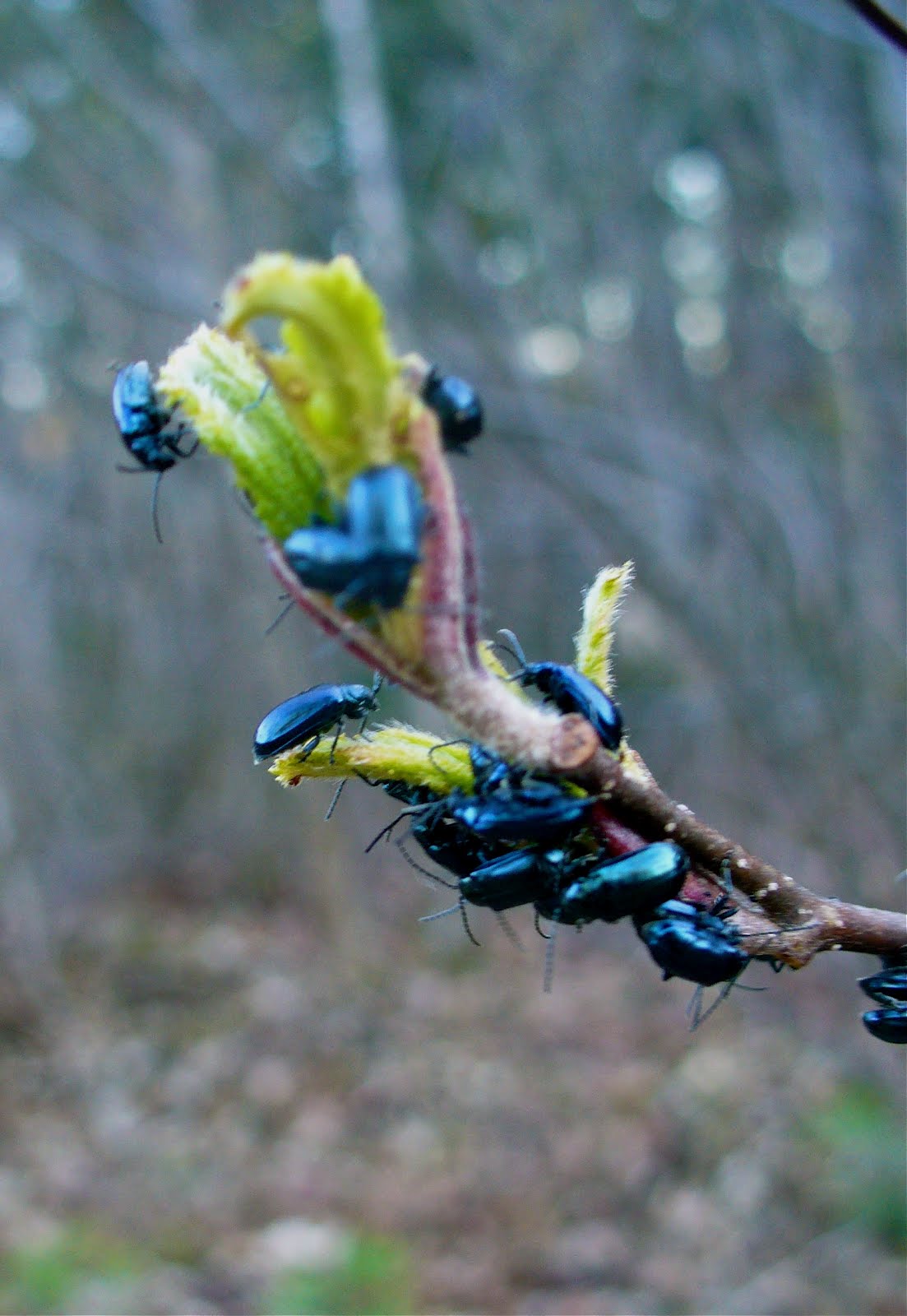
Sometimes I feel convinced I need to start a church of Annie Dillard. We need to exegete Pilgrim at Tinker Creek like it's Scripture. Next rant about American culture and supermodels, just tell me to take a hike. Then I can walk past the bare stumps that soon will succumb to moss, past the alder gnawed by blue beetles, and remember, as Annie Dillard taught me, that beauty and death are two sides of the same coin. The peepers remind me. The trillium reminds me. Even my own aging body reminds me.
Friday, May 11, 2012
Oh lord, big fat woman

Great-great-grandma. We share DNA.
I'm sitting at my desk, listening to Leadbelly croon the above-quoted song, from 1936. Here are some lyrics:
Big fat womanToday we're told that food is bad, that it possesses a moral quantity. We're told to deprive ourselves of food. We're told that food should bring no joy. We're told that the highest good, the most possible value we can have, especially as women, is to look like this photograph:
With her meat hanging on her bone
She was born and raised in old Kentucky home
I love my woman and I tell you what I do
I love my woman and I tell you what I do
I love my woman and I tell the world I do
Oh Lord
She's so good to me just like I do you
I woke up this morning and I found my baby gone
I woke up this morning and I found my baby gone
I was so mistreated
But I wouldn't let on

You can never be too skinny or too rich, say the fashion magazines. She who wins, dies, read the pro-anorexic sites I used to frequent.
The fact is that farm wives look like the first photograph, my great-great grandmother, not like the second. Being a farm wife means spending all winter eating potatoes, and sauerkraut, and sausages made from the nasty bits of the pig you slaughter in the fall. It means spending all winter gathering layers of clothing and fat around yourself, to prepare yourself for the dearth of nutrients you'll suffer through during the cold season. That's what it used to mean. Now it just means self-hatred.
These beliefs are completely dysfunctional, and they drive all of us, those of us on the wrong side of the line, the vast cultural divide that no one who's ever been skinny understands, straight into the arms of the donut. It doesn't help for you to call me disgusting, to roll your eyes, to say: “I don't eat that. I eat healthy food. Do you really need to eat that?”
Another song, from 2008:
I cannot emphasize enough that my bodyPeople have been telling me that I'm fat, or “beefy,” as my mom likes to put it, since I was eight years old. At a certain point, say when I was eight-and-a-half, I started believing it. Even the day I finished the Appalachian Trail, when I was burning 7000 calories a day, I was a full fifteen pounds heavier than the medically approved median weight for my height. What hope does that leave for me with a career as a writer, spent with an ass spreading in a chair made of wood, and a winter spent eating potatoes and shoring my body up against the cold?
Is a badly designed, poorly put together vessel
Harboring these diminishing so called vital organs
Hope my heart goes first, I hope my heart goes first
We are beautiful, we are doomed
--Los Campesinos! [Buy an album.]
And still, even now, people on television tell me how disgusting and repulsive I am. Last night on The Colbert Report, the director of the National Institutes of Health brought in a five-pound chunk of fat and slapped it on the table to show all of us overweight Americans how horrible we are, how much better we need to be doing. As if I don't punish myself enough already. As if I don't know how to punish myself further. It makes me, it makes all of us, want to obliterate ourselves with a pound of ice cream and a shotgun blast to the head.
You don't know how it feels, I want to scream to all of you skinny bastards. You don't know how it feels to know: I'm never going to be a normal person. I'm never going to be able to eat like a normal person. I'm never going to be able to eat when I'm hungry. I can never eat what I'm hungry for. I can never listen to my body and answer it. Not without guilt, without shame, without punishment from the culture at large, condemnation from the people I love, and judgment from numbers on a scale. No. What you want from me, what you've always wanted from me, is for me to starve myself. You want me to be miserable. You want me to suffer.
Childhood obesity is a problem. But I know, from personal experience, what it does to a child to tell her that she's somehow less, by being bigger, than everyone else. We have a giant cultural problem with food, clearly. It's a more dangerous addiction for us than alcohol, drugs, or sex, far more dangerous than any addiction except, perhaps, gasoline or television, but still our culture sandwiches ads for Weight Watchers in between ads for Burger King and ads for heartburn drugs.
It's not a problem of farming, or advertising, or big food companies. It's a problem of psychology. Until you can teach me not to hate myself, not to spend my life trying to be something other than I am, it's a problem for which I have no solution. If I did, I'd be a Victoria's Secret model.
Wednesday, May 09, 2012
I want to reach out
Today is drear, gray, and overcast, the poplars just beginning to be touched by green along Snow Road. The rain is making the loggers take the day off, which means blessed silence, except for the U2 I blare at my desk. Make hay while the sun shines, they say, another adage that has real meaning now that I live on a farm. I should have planted my beets and broccoli this weekend, when I had sun, even if it was Sunday, my Sabbath.
We have a single lettuce that over-wintered in the cold frame, from which I have already eaten several delicate leaves. It's a lettuce I thought was speckled romaine, last year, but which now looks closer to a spotted trout-back, according to Johnny Seed, and which becomes far too bitter to eat by June. So we did get vegetables in May, despite our spring vacation. It's the time of year when there's too much to do, in every area—dirt to be tilled and enriched and sown, new beds to put in, new crops to try—and I don't always feel like doing any of it.
It's days like this one that I'm happy farming is merely my avocation. I'm trying to be more focused, more driven, even more disciplined, dare I use that loathsome word. I loath that word, but it's one people keep chirping at me, as if it's the solution to life, the universe, and everything. Often I believe that's the opposite of being true, that discipline is dust in the mouth, and the true answer is joy, joy in all things.
Life is a daily practice of mindfulness, of coming to my desk, coming to the blank page, coming to the earth, coming to the mat. I know it, and as Bob Dylan says, still I'm learning it these days. How do I become strong? By a daily delight of being in a single place, of being present in time as time moves forward.
We have a single lettuce that over-wintered in the cold frame, from which I have already eaten several delicate leaves. It's a lettuce I thought was speckled romaine, last year, but which now looks closer to a spotted trout-back, according to Johnny Seed, and which becomes far too bitter to eat by June. So we did get vegetables in May, despite our spring vacation. It's the time of year when there's too much to do, in every area—dirt to be tilled and enriched and sown, new beds to put in, new crops to try—and I don't always feel like doing any of it.
It's days like this one that I'm happy farming is merely my avocation. I'm trying to be more focused, more driven, even more disciplined, dare I use that loathsome word. I loath that word, but it's one people keep chirping at me, as if it's the solution to life, the universe, and everything. Often I believe that's the opposite of being true, that discipline is dust in the mouth, and the true answer is joy, joy in all things.
Life is a daily practice of mindfulness, of coming to my desk, coming to the blank page, coming to the earth, coming to the mat. I know it, and as Bob Dylan says, still I'm learning it these days. How do I become strong? By a daily delight of being in a single place, of being present in time as time moves forward.
Sunday, May 06, 2012
Talking to your picture

Stumps
My neighbor is cutting trees: beech and birch and cedar, spruce and tamarack and ash. It's decimated back there. At first I believed in the sustainability of Maine's forestry initiatives, that the state didn't allow clear-cutting on the scale I've seen in Alabama. But as it wears on, day by day, the endless drone of the chainsaw, a crunch like bone as another tree collapses, the whine of the skitter sullying my Aroostook County quiet, I feel like I'm about to collapse, too.
I'm aware of my hypocrisy. I burn cedar all winter in the wood stove, for heat, and I feel especially hypocritical about it now when it's a bare forty degrees outside and there's a full moon—and still I burn the wood. I don't want to burn diesel in the furnace, I don't want to smell petroleum roasting in my house. I also don't want to start a big fire for little ole me.
But I'm cold. I'm still a hothouse flower, a cutting of jasmine from tropical shores. So I burn the wood that my neighbor next door cuts, if only in a figurative sense—I burn the cast-off wood from the lumber mill the next road over. I don't know where he's taking the trees he's cut that border my road, what he's doing with their carcasses, but there's a good chance I'll end up burning their cast-off ends, too.
I believe in well-managed forests, in biomass energy as one of the few solutions to the carbon crisis, but when it's happening right next to me, when the trees that are feet away from my walking path, are turning into nothing but barren, shuddering corpses... I find it difficult to stomach. Not to be melodramatic or anything. My desk is made from wood. My house, table, chairs. It's just the view of it up close that's so painful, that makes me want to swear off the stuff altogether.
Wednesday, May 02, 2012
Tears are in your eyes
I'm working right now in connection with AMG International, the organization my parents were missionaries with when I was a child, on a project driven partly from my desire to better the world, a desire born of my time spent in Bangkok and Manila. I remember driving past “Smokey Mountain,” the towering pile of garbage that housed thousands of families, on my way to the airport in Manila. That was when I was on my way home to Bangkok, home for Christmas or fall break, to spend two or three weeks with my family before coming back to boarding school. My earliest awareness was of being surrounded by constant poverty, fully aware of the presence of suffering in human life.
Clean water is clearly one of world's foremost development problems, and Vestergaard-Frandsen, the organization AMG is partnered with, operates under the principle of profit with a purpose. It's an interesting financial model, one I've worked on before, at Opportunity International, which when I was there was working on a project to open the first for-profit bank aimed at the poor, the Opportunity Microfinance Bank. These are beautiful financial models for those in favor of pure capitalism, that a profit motive doesn't have to be soulless.
It reminds me of this quote I heard (and quoted—it bears repeating) last month from Ana Martino, a New Zealand activist: “We have to reassess the fundamental structure of the modern market, rather than trying to fit all unpaid and informal labor into the existing market parameters. Now the process of reassessing those structures should seek to move the conversation away from classical economic examinations of selfishness, scarcity, competition, and efficiency, and towards examinations of necessity, surplus, consumption, and community.”
I heard a similar idea from Gar Alperovitz, a political economist who wants a new economic paradigm. “There is an emerging 'new economy,'” he says, “which empowers communities and workers, not corporations.” Keep in mind that these communities and workers will still be making money, be for-profit enterprises, but they'll be making that money for themselves. In such models, management would make about five times the average worker's salary, instead of 343 times as much, as at the nation's largest companies, according to CNNMoney.
He speaks of new for-profit community models, where workers take over a specific industry, say, towel-washing for a large hospital, and themselves share the profits for an environmentally sound and locally sourced business model. I can see such things blooming, see rows of attached greenhouses connected to schools, see carpenter's shops and musician's guilds, see the whole medieval village of my dreams, but functional, with each part fitting into the next.
And Lifestraw could be part of that, if only in the largest possible sense, which is of bringing basic services to those whose biggest health concern is diarrhea. My favorite product is LifeStraw Family, which offers water cooler style water for easy access. And if we can fund clean water, using the best practices of capitalism, then why wouldn't we?
Clean water is clearly one of world's foremost development problems, and Vestergaard-Frandsen, the organization AMG is partnered with, operates under the principle of profit with a purpose. It's an interesting financial model, one I've worked on before, at Opportunity International, which when I was there was working on a project to open the first for-profit bank aimed at the poor, the Opportunity Microfinance Bank. These are beautiful financial models for those in favor of pure capitalism, that a profit motive doesn't have to be soulless.
It reminds me of this quote I heard (and quoted—it bears repeating) last month from Ana Martino, a New Zealand activist: “We have to reassess the fundamental structure of the modern market, rather than trying to fit all unpaid and informal labor into the existing market parameters. Now the process of reassessing those structures should seek to move the conversation away from classical economic examinations of selfishness, scarcity, competition, and efficiency, and towards examinations of necessity, surplus, consumption, and community.”
I heard a similar idea from Gar Alperovitz, a political economist who wants a new economic paradigm. “There is an emerging 'new economy,'” he says, “which empowers communities and workers, not corporations.” Keep in mind that these communities and workers will still be making money, be for-profit enterprises, but they'll be making that money for themselves. In such models, management would make about five times the average worker's salary, instead of 343 times as much, as at the nation's largest companies, according to CNNMoney.
He speaks of new for-profit community models, where workers take over a specific industry, say, towel-washing for a large hospital, and themselves share the profits for an environmentally sound and locally sourced business model. I can see such things blooming, see rows of attached greenhouses connected to schools, see carpenter's shops and musician's guilds, see the whole medieval village of my dreams, but functional, with each part fitting into the next.
And Lifestraw could be part of that, if only in the largest possible sense, which is of bringing basic services to those whose biggest health concern is diarrhea. My favorite product is LifeStraw Family, which offers water cooler style water for easy access. And if we can fund clean water, using the best practices of capitalism, then why wouldn't we?
Sunday, April 29, 2012
Bridgewater, Maine
 Only in Maine do we have pink moss
Today is the first full day of my true solitude. K. has left, drifted away with the wind for a stint on the Maine Appalachian Trail. He claims he's getting to the New Hampshire border and turning around, but I know the wiles of the trail. She's an alluring mistress. I know if I was hiking Maine, I'd hear the siren song of Springer, calling from Georgia.
So I'm here alone, here with photographs to nail to the walls, seedlings to start and plants to set, beds to build and compost to stir, fires to stoke and dishes to wash. I do a good impression of a female alone in the wilderness most days, but for the next few weeks it'll be true.
Saturday, April 28, 2012
Aroostook County, Maine

Sky above the clouds
My first seeds are in the ground, although not the real ground, the fake ground that I put into plastic six-packs and keep in the sun in the glass room. Although K.'s been hard at work here, and in the real ground, his real ground—we already have garlic peeping up, planted last fall, and beets and spinach and chard—and a pea sprouting. And one hardy lettuce, the one I used to think was a speckled romaine, wintered over in the cold frame. Believe it or not.
These things are so enjoyable to me, and I always hesitate to speak of them because it feels like bragging but I'm beginning to believe that maybe I'm somewhat good at this. Not really, because even just a generic search of farm and garden blogs makes me realize that I'm way down on the totem pole. There are people out there, in Maine, already eating garden greens. It took us till June last year, and maybe it'll take us that long again.
I called Johnny Seed today and they are out of asparagus and blueberry plants. They run out in January. Who knew? And my never-ending war with the herbs goes on. I persist, but I can't get them to turn into the provencal herb garden of my dreams.
It feels good here, workmanlike. The snow has passed. I forget how much I miss the green earth, the green world, the green tunnel that closes me in on my long walks to the back of the land. It's black and white for six months, and then the green comes back. I battle with place, but this place is drawing me in, claiming me.
Thursday, April 26, 2012
En route from Chicago, Illinois, to Aroostook County, Maine
1385 statute miles
44°F
SW winds 5mph
At the gate now, heading back to the place that's the closest thing to home, I sit beside blonde college students in a purple headband and skinny jeans, reading George RR Martin, across from a middle-aged man in an orange baseball cap, reading The Economist, catty-corner from a younger man with Bose headphones and a Columbia fleece reading on his iPad. On the plane from O'Hare to Hartsfield-Jackson, on my way back from the airplane's head, I counted fully twenty people reading books on paper or LCD, no matter which. Methinks the death of prose has been greatly exaggerated. It's good to reminded of such things after filling my cup to overflowing at the font of literature, good to be reminded that all we do who write is not in vain.
Back to the earth I go now, back to plant lettuce and chard and broccoli, to dig my hands in the soil and walk while I watch the sky. I learned a couple of important things that have stayed with me after the festival, and I want to put them into words before I or anyone else forget them. First: the subconscious. I became aware that writers, in writing, are painting on the cave walls of the subconscious mind of the audience, which is why it's so crucial that writers pay attention to their own subconscious. All art, and I include in this category adventuring, and farming, is not about creation as much as allowing the spirit to flow free. It's about “getting out of the way of the story,” as Marilynne Robinson put it.
Second: specificity. Unexpectedly, this word came from the two essayists of the bunch, writers exploring the quotidiana of their lives. But Robinson spoke of that, too, of “creation being continually addressed to us.” That's a quote from Calvin himself, who believed that all of reality is a gift, each moment of reality a part of a slate wiped clean by God. And only in seeing reality as a gift can we see it as it really is.
Third: stories can only be told after the trauma of experiencing the story is over. This lesson I learned from Kate Braestrup, the only Maine writer at the conference, and the chaplain for the Game Warden Service here. It's a smaller lesson, perhaps, but just as important, and I feel that the link between all three is an emphasis on allowing one's art to flow within the larger flow of the river. “We step into the river. We are and we are not,” says Herodotus. “Time goes slowly when you're lost in a dream,” says Dylan.
It's all cinched together by the homily preached by Marilynne Robinson. Perfect love casts out all fear, says the Bible. Is it really that simple? Don't be afraid, and do what you love. Jesus says our burden is light. It's possible that's all he meant.
44°F
SW winds 5mph
At the gate now, heading back to the place that's the closest thing to home, I sit beside blonde college students in a purple headband and skinny jeans, reading George RR Martin, across from a middle-aged man in an orange baseball cap, reading The Economist, catty-corner from a younger man with Bose headphones and a Columbia fleece reading on his iPad. On the plane from O'Hare to Hartsfield-Jackson, on my way back from the airplane's head, I counted fully twenty people reading books on paper or LCD, no matter which. Methinks the death of prose has been greatly exaggerated. It's good to reminded of such things after filling my cup to overflowing at the font of literature, good to be reminded that all we do who write is not in vain.
Back to the earth I go now, back to plant lettuce and chard and broccoli, to dig my hands in the soil and walk while I watch the sky. I learned a couple of important things that have stayed with me after the festival, and I want to put them into words before I or anyone else forget them. First: the subconscious. I became aware that writers, in writing, are painting on the cave walls of the subconscious mind of the audience, which is why it's so crucial that writers pay attention to their own subconscious. All art, and I include in this category adventuring, and farming, is not about creation as much as allowing the spirit to flow free. It's about “getting out of the way of the story,” as Marilynne Robinson put it.
Second: specificity. Unexpectedly, this word came from the two essayists of the bunch, writers exploring the quotidiana of their lives. But Robinson spoke of that, too, of “creation being continually addressed to us.” That's a quote from Calvin himself, who believed that all of reality is a gift, each moment of reality a part of a slate wiped clean by God. And only in seeing reality as a gift can we see it as it really is.
Third: stories can only be told after the trauma of experiencing the story is over. This lesson I learned from Kate Braestrup, the only Maine writer at the conference, and the chaplain for the Game Warden Service here. It's a smaller lesson, perhaps, but just as important, and I feel that the link between all three is an emphasis on allowing one's art to flow within the larger flow of the river. “We step into the river. We are and we are not,” says Herodotus. “Time goes slowly when you're lost in a dream,” says Dylan.
It's all cinched together by the homily preached by Marilynne Robinson. Perfect love casts out all fear, says the Bible. Is it really that simple? Don't be afraid, and do what you love. Jesus says our burden is light. It's possible that's all he meant.
Friday, April 20, 2012
Grand Rapids, Michigan
Underlying themes thread their way in golden type through these days of feasting, of literary inspiration and intellectual challenge—one, of course, my newly acute awareness of the subconscious. Larry Woiwode, in his proem masquerading as a lecture, spoke of the mirroring pool of metaphor all artists draw from, how drawing detail from that well allows something new to be created between the mind of the writer and the reader. Jonathan Safran Foer said that when he writes the word “tree,” the reader conjures a tree. The writer writes, the tree appears, like magic, on the blank screen of the imagination.
This morning, Brian Doyle and Patrick Madden (yes, I realize all of them are men. Shall I diatribe? No) explored the genre of essay, and I finally realized what I've been doing here all of this time—betwixt all of the food writing and travel writing and spiritual writing and sports writing--I've been writing short, unworked, mostly bad essays. Patrick Madden's website is called quotidiana, and he uses it as an overarching metaphor for his work, the idea that in the essay we draw from the ordinariness of our quotidian lives, finding in them the realization that there is nothing ordinary. We need to sharpen our attentiveness to the daily holiness in each moment. I was given permission, the permission I didn't know I craved, to follow my trail of associations down the rabbit holes they lead me, as they always do.
Yesterday morning, in a bad mood after a panel in which my questions were not answered, intimidated by the participants and fearing my journey might be wasted, I dawdled by an entranceway, waiting for my sister. I heard a girl on her cell phone, her closer shoulder pointing in towards the wall, grinning, face bright with joy, blonde hair curled. She ducked away from me so I couldn't hear, so I couldn't steal her secret. Still, I heard: “I better go. I love you,” she said. I walked away. When I came back, she was still talking, still transcendent with love, maybe first love, newborn. It's been a long time since I've seen it.
New love is a sharp thing, with edges unworn by time and lethargy. I'm still very much in love, but a love aged, by life, experience, pain.
Then, today, a different girl, hair slicked back against her head, intent, focused, her knees knocked together, sitting on the steps outside the student union, a phone clutched to her ear. (Is it any wonder we name these things after a prisoner's cage?) I only caught a fragment--”yes, I know, but when you yell at me, I...” and then the sentence carried away by the rain. How long between those two eternities? How long?
Brian Doyle says I don't need to close here, to tie up my daily meanderings with some hard-won wisdom. I don't need to, in short, preach. I can let those two images hang together in time, drawing up story from the collective pool that rests below all of us.
This morning, Brian Doyle and Patrick Madden (yes, I realize all of them are men. Shall I diatribe? No) explored the genre of essay, and I finally realized what I've been doing here all of this time—betwixt all of the food writing and travel writing and spiritual writing and sports writing--I've been writing short, unworked, mostly bad essays. Patrick Madden's website is called quotidiana, and he uses it as an overarching metaphor for his work, the idea that in the essay we draw from the ordinariness of our quotidian lives, finding in them the realization that there is nothing ordinary. We need to sharpen our attentiveness to the daily holiness in each moment. I was given permission, the permission I didn't know I craved, to follow my trail of associations down the rabbit holes they lead me, as they always do.
Yesterday morning, in a bad mood after a panel in which my questions were not answered, intimidated by the participants and fearing my journey might be wasted, I dawdled by an entranceway, waiting for my sister. I heard a girl on her cell phone, her closer shoulder pointing in towards the wall, grinning, face bright with joy, blonde hair curled. She ducked away from me so I couldn't hear, so I couldn't steal her secret. Still, I heard: “I better go. I love you,” she said. I walked away. When I came back, she was still talking, still transcendent with love, maybe first love, newborn. It's been a long time since I've seen it.
New love is a sharp thing, with edges unworn by time and lethargy. I'm still very much in love, but a love aged, by life, experience, pain.
Then, today, a different girl, hair slicked back against her head, intent, focused, her knees knocked together, sitting on the steps outside the student union, a phone clutched to her ear. (Is it any wonder we name these things after a prisoner's cage?) I only caught a fragment--”yes, I know, but when you yell at me, I...” and then the sentence carried away by the rain. How long between those two eternities? How long?
Brian Doyle says I don't need to close here, to tie up my daily meanderings with some hard-won wisdom. I don't need to, in short, preach. I can let those two images hang together in time, drawing up story from the collective pool that rests below all of us.
Thursday, April 19, 2012
Border five miles from here
Yesterday morning I awoke at 5:30 a.m. to pull on jeans and sweatshirt and drive the four-and-a-half hours to Portland, where I left my car in long-term parking and took two planes and another four-hour car ride to arrive here. I'm in Grand Rapids, home of Calvin College and its Festival of Faith and Writing, and today I heard: Larry Woiwode, Kathryn Erskine, Jonathan Safroen Foer, Amy Frykholm, Gary D. Schmidt, Bethany Pierce and half a dozen more. I heard from Christian writers and Jewish writers and Muslim writers and people who write about sex and the Sabbath and blind typists and eating disorders and from a panel of four—count them, four—Dutch-Canadians.
The night before I left, I dreamed of giving my grandmother's intricate glazed ceramic tea cups away. I gave them away to careless students who broke them as together we drank tea. Breaking my grandmother's tea cups—my subconscious came up with a better metaphor than I ever could have for squandering her inheritance.
But am I, in fact? No. At the end of the first of three thirteen-hour days I am full, replete, overflowing. “Anything worth saying is unsayable,” said Kevin Moffett, quoted in a lecture today, “that's why we tell stories.” I'm in my communitas, people who believe in the power of words skillfully strung to together, who believe on building word atop stubborn word, who believe that all art carries meaning.
This prayer, from another writer, whose name blew away from me as ephemeral as wind: “God, although You needed no help from us, you named us to be namers.”
That's the calling.
The night before I left, I dreamed of giving my grandmother's intricate glazed ceramic tea cups away. I gave them away to careless students who broke them as together we drank tea. Breaking my grandmother's tea cups—my subconscious came up with a better metaphor than I ever could have for squandering her inheritance.
But am I, in fact? No. At the end of the first of three thirteen-hour days I am full, replete, overflowing. “Anything worth saying is unsayable,” said Kevin Moffett, quoted in a lecture today, “that's why we tell stories.” I'm in my communitas, people who believe in the power of words skillfully strung to together, who believe on building word atop stubborn word, who believe that all art carries meaning.
This prayer, from another writer, whose name blew away from me as ephemeral as wind: “God, although You needed no help from us, you named us to be namers.”
That's the calling.
Sunday, April 15, 2012
Aroostook County, Maine

Seraffyn
Tweedle Dee and Tweedle DumThe first lines from Bob Dylan's “Love & Theft” seem to be a jab at violent, capitalistic America and how ridiculous it is. I recently saw for the first time Tim Burton's Alice in Wonderland, and although the film fell into some narrative cliches, it reopened to me the world of Lewis Carroll, one of the original magical realists. I don't know if Carroll meant to poke fun at capitalists with his doddering Tweedle Dee and Tweedle Dum, but Dylan certainly does. What good do they do echoing the words of someone else, parroting each other?
Are throwing knives into the tree
Two big bags of dead man's bones
Got their noses to the grindstone.
What good does it do them to keep their noses to the grindstone? What good does it do us?
These are questions I've been asking myself as I return to my triune vocation: adventurer, writer, and now farmer. Money is an idea that I return to repeatedly as I explore how to survive in that vocation. I keep thinking about money itself, what it is but slips of paper representing obscure and possibly irrelevant concepts. It represents nothing but calcified energy.
In my mailbox when I arrived here was a brochure from a retreat center in the Berkshires, the Rowe Camp, and I noticed that they accept the possibility of barter. The vegetables I grew last season, now briny and spiced in mason jars, are also preserved labor. Why does the work I put into those not have the same value as dollar bills?
These thoughts come to mind especially as I spend my inheritance, the prodigal daughter, on another conference, for the chance at finding an agent for my unpublished book. It's just money, I tell myself, just dollars in the bank. I have to follow these leads if I'm going to believe that I'll achieve success in this field. I want to believe that it's God guiding my steps, that the people I admire most are the ones, like Lin and Larry of Seraffyn (see above), who followed their dreams and didn't let any ostensible obstacles stop them.
But my heart quails.
Saturday, April 14, 2012
En route from Marion, Massachusetts, to Aroostook County, Maine

The day of our departure, we were able to visit a wooden boat yard and see Seraffyn of Victoria herself, an amazing privilege. More photographs later. It certainly wasn't the best thing for a person trying to convince herself to stay put aground.
436 statute miles
38° F
Winds calm
Arrival time: 6:30 am
In the car last night, driving from Buzzards Bay north, around Boston, through the bright lights of the big dig, across the highways that bridge New Hampshire and again into Maine, I kept thinking how I was going home. It felt alien, the feeling foreign to the point of being uncomfortable. But there's part of me that feels that way, even now that I'm here, nesting my knees beneath my desk, my fingers on the keys. Home is merely something I convince myself of.
We towed the new boat behind the Volvo, the new boat whose coat of green paint is bringing out a host of possible names: Pickled. Pistachio. Pequod. Brillig, which has nothing to do with green, but is my personal favorite.
Today, after a five-hour morning nap, I pulled the first couple of rows of rocks from the ground, rocks cleared last fall that frost has heaved up to meet my fingers. Fifty mile-an-hour gusts during one storm while we were away broke a sheet of glass from the cold frame, and now hairline-fractured plate glass paves half of the garden. It's already past time to plant peas and spinach, past time to start beet seedlings. The earth is calling.
And so are the words. After this journey, this conference ostensibly undertaken for other people, I decided to pursue a trip this summer just for me, for the sake of my own art, and now a multitude of possibilities are heaped upon me, and I don't know which I should choose. I've been gone too long. Part of me just wants to hole up, with my desk, my words, to spend mornings with the blank page and afternoons with my fingers in the soil. Is that just fear calling? Or is it home?
Wednesday, April 11, 2012
There she goes

The new boat, at Meadow Island
When Easter rolled around on Sunday, I wanted to write a post about Ishtar, and Isis, and how the Christian year mimics that of the pagans, but how that doesn't make the celebration of Easter, and the blood of the Lamb, the dying God become the risen Lord, any less legitimate. Now it's Wednesday, and my Lenten discipline is over, meaning that I can watch English premiere league soccer (Queens Park versus Swansea) and eat popcorn to my heart's content, without having to worry about posting links to global warming articles or quotes from Moby Dick before midnight. (Actually, it's Moby-Dick. There's a hyphen.)
I didn't do so badly this Lent, other than my failure, most days, to post before midnight. Do these Lenten disciplines make any difference? Make anything better? That's the larger question. If I had to answer it, I'd say Lent is about that cycle of death and rebirth, the eternal circle that all of us celebrate every year, whether we acknowledge it or not.
Because that's what the season of darkness is about, the season of darkness and now the season of light that begins. It's about death and rebirth, and how the green fuse drives the flower back up from the ground, and how we remind ourselves of that by taking things away from ourselves and then giving them back. My sister posted her Thailand pictures today, though, and I'm reminded how I hate the seasons, how I want it to be 95 degrees year-round. Everyone, at least in Maine, uses that as a selling point: we have all four seasons!
But what if I just want one? Endless, never-ending, unchanging summer?
So God dies and is reborn, and crops die and our reborn, and the sun goes away and comes back, and we celebrate that now, during spring, celebrate our own return from the darkness and depression. The passage of the seasons, the cycle of the church calendar, they remind me of the passage of time, how every day that changes is different, and new. Maybe that's why we want to drift from those reminders, into a world separated from the earth, and plants, and the cycle of growing things, how we want to dissolve into a digital world of pixels, of fictional equatorial sun, a place that only exists in the imagination, and, perhaps, at the actual equator. No matter how we separate ourselves from them, the seasons still pass.
Now Lent is over, and spring begins in truth. Nothing for it but to roll on, into the cruelest month.
Sunday, April 08, 2012
Friday, April 06, 2012
There is one knows not what sweet mystery about this sea, whose gently awful stirrings seem to speak of some hidden soul beneath; like those fabled undulations of the Ephesian sod over the buried evangelist, St. John. And meet it is, that over these sea-pastures, wide-rolling, watery prairies and Potters' Fields of all four continents, the waves should rise and fall, and ebb and flow unceasingly; for here, millions of mixed shades and shadows, drowned dreams, somnambulisms, reveries; all that we call lives and souls, lie dreaming, dreaming, still; tossing like slubmerers in their beds; the ever-rolling waves but made so by their restlessness.Sorry to keep quoting our American master, but he strings words together with such aching beauty, such melodious sorrow, enough to sing me to sleep--it seems a tragedy that he spent the last nineteen years of his working life as a customs inspector. I'm glad I didn't read him on the boat, for to read such words of the sea--the ineffable put into words--would have made me despair forever. Heck, it almost makes me despair now. Some writers are just too good. It makes one think the well has dried up.
--Herman Melville, Moby Dick
Read this book: Why Read Moby Dick.
And this one:
Thursday, April 05, 2012
Gotta start feeding our souls

Pavement shadow (not my photograph)
Why are we always cruelest to those we love the most? I know at this point it's almost a cliche, or at least a truism, but it remains true. Maybe we take those closest to us for granted, or maybe we're trying to drive them away. Maybe it's a way to avoid looking at ourselves too closely, to avoid being present in each moment as we love. It's a Christian cliche that love is not a feeling, but an action, but whichever it is we--or at least I--fail to love actively, consistently, kindly.
I made it to a yoga class this evening, for the first time since I've been in Massachusetts, and I was reminded of the first limb of yoga, ahimsa, the principle of non-violence. It's a fundamental tenet that no practice should involve violence to yourself or another, hence no pain, and no competition. Because all competition is a form of violence, the desire to defeat the other, a desire to be better.
It's that ahimsa that perhaps is lacking in our closest relationships as we compete with each other for attention, for regard, over who's working harder or doing things better. We even compete about who's right and who's wrong, who folds tee-shirts or steams vegetables correctly.
Coming back from yoga I glow with the attention I've given myself for the past 75 minutes, the mindfulness I've gained of my own core strength, the power of my own breath, my ability to overcome challenge and discomfort. But only by not competing with myself, by not harming myself, by not causing myself pain. And as long as I beat myself up, I beat up others around me. I've been reviewing by Julia Cameron, and I found this reminder last night:
"If I had more time, I'd have more fun," we like to tell ourselves, but this is seldom the truth. To test the validity of the assertion, ask yourself how much time you allot each week to fun: pure, unadulterated, nonproductive fun?It may seen a non sequitur, but it's not. Fun is the opposite of cruelty. Fun is the food of love and creativity both. Yoga felt like nonproductive play tonight, with no violence, no competition. It's a good reminder to carry that joy around with me, as a weapon against the toxic sludge I can allow to steal my mindfulness.
For most blocked creatives, fun is something they avoid almost as assiduously as their creativity. Why? Fun leads to creativity. It leads to rebellion. It leads to feeling our own power, and that is scary.
Subscribe to:
Posts (Atom)