Friday, September 25, 2009
A baby on motor oil
My childhood had its fair share of trauma, although I usually feel guilty talking about it because so many people had it so much worse. My early years were idyllic. I still can’t conceive of anything better than drinking mango lassis under palm trees for breakfast; treading beneath a sun so hot it makes my breath quiver; spending all day swimming and walking and snorkeling in the sun and then eating crab fried rice and plah sahm roht at an open-air restaurant while an old James Bond movie plays on the VCR; stepping from thick humid air into air-conditioning as cold as the arctic; the blissful final pain of sunburned skin scraping against the sand that always crept beneath my guest-house sheets.
That’s what I remember when I think about my early childhood. Then I went to boarding school, at eleven. I loved that, too, and made friends there that are still my closest, but it was an immense disruption that forced me abruptly into adulthood. It was hard, and it’s where reality began to slowly seep into my consciousness, the reality that life is not an endless string of books and beach vacations.
When I was a thirteen-year-old freshman, three girls in my class were raped in an armed robbery at a neighboring teacher’s house. They were my age, close friends. How our community experienced that violation colored all four years of my experience of high school .
I don’t like to talk about it. I don’t know if I ever have talked about it. I don’t really know why I felt a sudden need to write about it now. Things changed at school afterwards. Barbed wire went up around the campus. The administration hired armed guards to patrol the perimeter. Not that any of that helped, or would have changed anything. My problems with my faith started then, specifically my doubts when it came to the problem of evil.
I didn’t know if I could trust that there was a plan, somewhere, that someday I’d understand why that happened to my friends. I still don’t know if I can trust that.
Can I? There has to be meaning in everything, doesn’t there? Can God have a meaning for even something like that? I don’t know.
Maybe some of my continuing fear comes from that moment in time. I’m more afraid of rape than I am of almost anything else, and that fear always colors my consciousness. I can’t decide if I’m more afraid because of my experience, or if it’s something that every woman fears. Or if men are afraid in the same way, too. It comes back to the same question--do I trust someone in the universe to take care of me? Do I trust this promise: “all things work together for good for those that love Him”? All of the parents of those children stayed on the mission field. Last I heard, some were still in the Philippines. God demanded a sacrifice of them, and they made it.
Not that they even made a sacrifice, other than the one of belief--they were able to believe that god had a purpose behind it, that there was a greater good. They were able to convince themselves that God had a plan. Sometimes, that seems sacrifice enough for me.
I know that I’m not alone, that many women are similarly afraid, and with better reason. That fear infuriates me. So many choices have been taken away from me, and not because of anything I have done. Merely because of how I was born, because of my chromosomes. My anatomy makes me vulnerable, and that vulnerability means that I have to protect myself. “Guard your heart,” my parents and teachers used to say. I hated it, more when I learned it actually came from the Bible, not a self-help book: Proverbs 4:23. “Above all else, guard your heart.”
At the end of the day, it simply comes down to what losses I am willing to accept. I have to be smart, to make good choices, but I can’t live in fear. I have to be able to accept anything that can happen. I always say that, but I still allow fear to control so many of my choices. It reminds me of the great St. Augustine disaster, when so much was lost. Sometimes I wonder if Secret would even be stranded where she is if it wasn’t for that one awful night. She might be worth twice what she’s worth now.
If I believe, then I can’t make decisions based on fear. But I do have to make decisions that are in my own best interest. I have to protect myself. I have to guard my heart.
It’s a balance, as almost everything is. Not living in fear, but living in just enough fear to keep myself safe.
**
A postscript: I’ve been meaning to post this entry for two months now. I’ve dated it July 9. For some reason, I was able to write about this moment in my past now, even though I’ve been trying for two full years. It’s still been overwhelming and difficult to think about posting, but maybe there’s some reason for this now, too.
Friday, July 10, 2009
Come listen, gather 'round
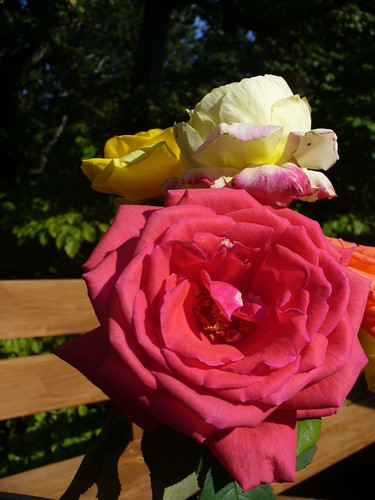
Flowers are not a cliche
On the boat, I kept a little notebook of blog ideas. I've abandoned the practice here, partly because my life ashore seems so gosh-darned boring, but mainly because it's hard work to be constantly alert to those twinges of conscience that say: ah. Here's a story. Follow it.
I'm looking through that little notebook now, remembering how and where my twinges happened, remembering a different life that felt not just sensually rich but also ideologically rich. I know there are as many ideas floating through the air here, but my receptors feel deadened, asleep. Maybe that's why my late posts have been so bombastic and dictatorial. Even though I believe them, I'm annoyed at their tone. Get off your high horse, Melissa, I want to say. Get over yourself. Geez.
So I've been asking myself how I can build that spirit of receptivity into my life here, how can I begin to put out my antennae again. Taking pictures makes me feel alive. Playing Bob Dylan songs on the piano that I couldn't have on the boat. Cooking pad Thai. Growing basil.
Here I am, though, a person who allegedly thrives on adventure, cringing from the thought of it here, even though I know the more adventurous I allow myself to be, the more rich my life feels. David Wilcox, one of my favorite contemporary folk artists is performing tonight here in Chattanooga, of all places, and I'd love to go, but I'm not going to. Why? Because it's too expensive. Because guys assume that girls alone at bars only want one thing. Because I don't have anyone to accompany me.
During the childhood and on the boat, it was my cross-cultural interactions that made me feel alive. In the Bahamas, especially, I came into the culture as an equal. I encountered the middle class, not exclusively the poor, as development workers and missionaries do, or the rich, as we find immigrants in this country to be. I worked alongside Bahamians who had just about as much money as we did, some slightly less, some more. Nappy is still the best non-American friend I've made since boarding school.
Seeing things through other people's eyes makes me feel awake. Here I can get that perspective only through stories, and songs, and art. Maybe I can also begin to find it through adventure again, in small ways. By spending the day at the park or the beach or the library. Which I'm discovering about adventure, though, is that the hard part is doing it alone. The hard part is being alone. That's what's scary.
Sunday, July 05, 2009
All your dreams are on their way
I’ve been thinking a lot about belief lately, maybe because of the response I received to my Lenten blog, which has led to a lot of additional reading. My father also sent me a link to the Evangelical Manifesto, a document produced by a group of evangelicals trying to sort their way out of the political mess they’ve managed to get themselves into during the last eight years. I’m reading Velvet Elvis, by Rob Bell, subtitled “Repainting the Christian Faith,” which I am finding enlightening in all kinds of ways. My favorite quote from today is:
The thing we are searching for is not somewhere else. It is right here. And we can only find it when we give up the search, when we surrender, when we trust. Trust that God is already putting us back together.
I believe that, as you know if you’ve been reading for the last few months. Or I believe some days, not others. Today, I believe, as Paul Simon said so eloquently, all my dreams are on their way. Today I believe that I don’t need to search for what I already have. I can trust that God is ordering my steps, leading me in the way that I should go.
Other people don’t believe, and I see their point, too. It feels ludicrous sometimes. It feels New-Agey, hippie-ish, gullible--or to put not too fine a point on it--stupid. Some days I believe I am nothing but matter in motion. God had nothing to do with that email in my in-box, that day I spent with a friend, those hours on the grass. Those are just moments in time, a quantum mechanical construct. I’m a rat, dying slowly in a cage, and not in a bad way. I’m moving through time, the way an animal moves through time: eating, sleeping, reproducing. Some days that’s all I am.
My whispered prayer, then, is: Lord, I believe--help thou my unbelief.
The thing, though, about belief is that everyone believes what they believe. And they believe it because they believe it, and if they didn’t, they wouldn’t believe it. Whether you believe you’re just a product of your biology and chemistry, or heading on a divinely oriented teleological journey, either way, you believe. At some point, you said, “Here I stand. This I believe.”
My reasoning is beginning to sound circular, because I can’t seem to find a way to put into words the irreducibility of belief. At times like these I take a shortcut, by quoting someone much smarter than I am. Here’s Kierkegaard:
Thus, if someone wants to have faith and reason too, well, let the comedy begin. He wants to have faith, but he wants to assure himself with the aid of objective deliberation. What happens? With the aid of reason, the absurd becomes something else; it becomes probable, it becomes more probable, it may become to a high degree exceedingly probable, even demonstrable. Now he is all set to believe it, and he dares to say of himself that he does not believe as shoemakers and tailors and simple folk do, but only after long and careful deliberation. Now he is all set to believe, but, lo and behold, now it has indeed become impossible to believe. The almost probable, the probable, the to-a-high-degree and exceedingly probable, that he can almost know, or as good as know, to a higher degree and exceedingly almost know — but believe, that cannot be done, for the absurd is precisely the object of faith and only that can be believed with the passion of inwardness.
Beliefs can change, but not because of anything I can do. I don’t believe that anyone really has the ability to change the beliefs of another person. There’s the rub, though: that’s a belief. And beliefs only make sense from the inside.
For an example, let’s consider Osama bin Laden. I’m not a big fan of the guy, but his beliefs have complete internal consistency. He believes that we Americans deserve to die, so he is setting about killing us. It’s rational. It makes sense. I just don’t agree with him. I don’t believe what he believes.
Or that guy who assassinated Dr. George Tiller, the alleged “baby killer” of Kansas. I don’t see why there’s so much confusion about it. It’s not an argument about abortion. It’s simply the just war debate all over again. We don’t think twice about whether or not World War II was a just war--innocent people were being slaughtered, and we needed to stop that. From the perspective of Dr. Tiller’s murderer, his decision was completely rational and justified. It made sense. I just don’t agree with him.
So what do we do with people we disagree with? We can try to convince them that we’re right, but somehow I don’t think anyone’s going to convince bin Laden of the advantages of a secular democracy, and I don’t see many pro-lifers convincing pro-choicers or vice versa.
That’s the thing about belief. The belief and the truth become indistinguishable, even if the believer is dead wrong. That’s one of many reasons that I’ve stopped believing in evangelization, of any stripe. Part of my belief system is humility, that God is in control, and He’ll make happen what He needs to make happen. It’s not my job to tell other people that they’re wrong.
I’ve taken a leap of faith. We all have. And we’re all by ourselves on that cliff, doing the leaping.
Tuesday, June 30, 2009
Remember the nights
(A lot more pictures of my garden are here.)
I’m sitting on a blanket on the grass at my local park. I’ve never been here before, and I don’t know why. There are children playing in the creek with buckets and pails. Why do we bring children to parks to play and never take ourselves? I don’t know if I’ve laid out a blanket on the grass, listened to music, read, and wrote, since I was in college. Why do college students deserve this sensory fulfillment any more than adults do? Why don’t we treat ourselves as well as we do our children?
Maybe this decision is the one I’ve been making since I dropped out of society five years ago to hike the Appalachian Trail. I decided then that I wanted to experience every moment of every day fully, not from inside of a computer in a cubicle. I’d rather suffer with holey clothes and cheap haircuts and a basement apartment than cage myself eight hours a day. It’s a decision that has not been met with great approval by family and friends, nor society at large. I believe in what I’m doing, even if everyone else seems to believe it self-indulgent nonsense.
My next adventure, I’ve more or less decided, is to buy a little piece of land, probably in Alabama. There I’ll build my own house, with my own back and brawn and hands. I have no construction experience and very little aptitude. Still. Would I rather lock myself up from dawn to dusk (at least for six months of the year, when sunlight appears after eight and disappears before five) and pay someone else to do something I can learn to do myself? I’d rather heft the beams in my own arms. Heck, I’d rather pour my own concrete.
I’ve never had a job--paid, at least--where I was rewarded for creating something with my own hands. I envy people who get paid for building things. Marx was right. He said that human beings are fundamentally divided between the proletariat, who see the results of their labor--at the end of the day, the ditch is dug, the stones are in a pile--and the bourgeoisie, who use their minds but are divorced from what they produce. He said, and I concur, that those two halves, intellectual and physical, are only fulfilled in the pursuit of art. Is it any wonder we use the term creativity? Something new is created. Something new takes form.
How many Americans, I wonder--seventy percent? Ninety?--spend their days moving paper from one stack to another? No wonder our economy is destroyed. We don’t make anything. We earn our livings making nothing. Then we spend all the money we earn on cheap plastic nothing we buy at Wal-mart. This cycle is patently insane, and yet we all continue in it. Why? Because we’re ashamed not to. We’re ashamed to say that the emperor has no clothes. And we like our cheap plastic crap, our fried chicken, our garbage bags, our splinter-board furniture.
I learned recently that a coworker of a friend, an executive assistant at a financial company, makes $80,000 a year. She shuffles paper for a living. She has a $300 key-chain. What does that say about us as a nation? As people? As Christians?
I can’t say I won’t give up, that I won’t take one of those jobs eventually. I like fried chicken, too. The battle may exhaust me. I may lose. I may go hungry, at least metaphorically. I may fail. At the end of my life, though, at least I’ll be able to say I had this afternoon on the grass, in the sun, watching ants crawl on clover.
Sunday, May 10, 2009
Everything in its right place
He said: freedom “means being conscious and aware enough to choose what you pay attention to, and to choose how you construct meaning.”
There are so many things I have to say about him and the article: what a gift is to have access to the New Yorker again, to feel like I’m participating in a dialog with the best minds alive today, relishing every exquisite sentence. What a tragedy it is to have lost one of our best novelists. How awful is the continued massacre of artists by their own hands. How I feel required to apologize for his and my own battle with depression, and how I refuse to do so.
What I want to say most, though, is what a brilliant man he was, and how lucky we are that he managed to stave off his fear and doubt enough to create at least two novels. How grateful I am for that. I haven’t read them yet--I’ve only read his shorter work--but I savor their future reading the way kids look forward to dessert. That anticipation in this case is coupled with sadness that his words are so finite. Two is all we get.
Despite his awful death, I believe he grasped in some essential way the core of what it means to be successful in life. His end doesn’t matter as much as the courage he had to make good choices about his own internal life for 47 years, to battle the demons of addiction and depression that stalked him. I find it intolerable that, because he eventually succumbed to those demons, after going off the antidepressants that kept him alive for twenty years, people can invalidate his life’s work.
He sought to find the truth behind experience. He wasn’t willing to accept archness and irony as substitutes for substance. He wasn’t afraid to risk being cheesy. Or he was afraid, terrified, but he was brave enough to confront that fear and overcome it, for a long, long time.
In the book he was working on when he died, a vast exploration of the inner lives of IRS agents, he said:
“Bliss--a second-by-second joy and gratitude at the gift of being alive, conscious--lies on the other side of crushing, crushing boredom. Pay close attention to the most tedious thing you can find (Tax Returns, Televised Golf) and, in waves, a boredom like you’ve never known will wash over you and just about kill you. Ride these out and it’s like stepping from black and white into color. Like water after days in the desert. Instant bliss in every atom.”
So much of his internal struggle echoes mine. I fight those same neuroses, trying to control my inner life. Lately, people, intending to be helpful, have dangled these ghosts in front of me, the specters of the artists who offed themselves serving as cautionary tales. See, you really don’t want to be an artist. Look what happens to them! They’re consumed by despair! They go crazy! They kill themselves!
I refuse to be scared by demons or ghosts. I celebrate the accomplishments of those who spent their whole lives battling mental illness and the war of our culture against those who speak painful truth. I’m so grateful that David Foster Wallace managed to wrest meaning and beauty from his experience. I refuse to invalidate his success.
Friday, May 01, 2009
Account
Flowers are pretty.
Another poem today, this one by Czeslaw Milosz, the Polish national treasure. (I should add that I'm also not the author of the previous poem, as some seem to have assumed. That was John Updike, who died last year.)
The history of my stupidity would fill many volumes.
Some would be devoted to acting against consciousness,
Like the flight of a moth which, had it known,
Would have tended nevertheless toward the candle’s flame.
Others would deal with ways to silence anxiety,
The little whisper which, though it is a warning, is ignored.
I would deal separately with satisfaction and pride,
The time when I was among their adherents
Who strut victoriously, unsuspecting.
But all of them would have one subject, desire,
If only my own—but no, not at all; alas,
I was driven because I wanted to be like others.
I was afraid of what was wild and indecent in me.
The history of my stupidity will not be written.
For one thing, it’s late. And the truth is laborious.
Friday, March 27, 2009
How'd I end up here?
1932-2009Fine Point
December 22, 2008
Why go to Sunday school, though surlily,
and not believe a bit of what was taught?
The desert shepherds in their scratchy robes
undoubtedly existed, and Israel's defeats--
the Temple in its sacredness destroyed
by Babylon and Rome. Yet Jews kept faith
and passed the prayers, the crabbed rites,
from table to table as Christians mocked.
We mocked, but took. The timbrel creed of praise
gives spirit to the daily; blood tinges lips.
The tongue reposes in papyrus pleas,
saying, Surely--magnificent, that "surely"--
goodness and mercy shall follow me all
the days of my life, my life, forever.
December 22, 2008
Why go to Sunday school, though surlily,
and not believe a bit of what was taught?
The desert shepherds in their scratchy robes
undoubtedly existed, and Israel's defeats--
the Temple in its sacredness destroyed
by Babylon and Rome. Yet Jews kept faith
and passed the prayers, the crabbed rites,
from table to table as Christians mocked.
We mocked, but took. The timbrel creed of praise
gives spirit to the daily; blood tinges lips.
The tongue reposes in papyrus pleas,
saying, Surely--magnificent, that "surely"--
goodness and mercy shall follow me all
the days of my life, my life, forever.
Thursday, March 26, 2009
He’ll stop the next war
My current source of stress is an article I’m writing about American perceptions of poverty. I’m having a really hard time with it. I don’t know how much I have to say about poverty. I do believe that after growing up in the vast, dirty necropolises of Bangkok and Manila that I have a better conception of what global poverty really means than the average American. I believe that much of my angst and uncertainty and depression, and that of my brother and sister and fellow missionary kids, is due to having experienced the reality of suffering around the world. I also believe that almost all Americans don’t want to hear about it.
We learn this lesson young, as missionary kids. We learn to stifle our knowledge, to stuff it down, to become chameleons, able to adapt to the culture we’re surrounded by and ignore all of our previous knowledge. We learn that American kids don’t want to hear about Thai kids. We learn that Thai kids don’t want to know what America is like, don’t want to hear us brag about all of the fancy stuff we’ve seen. We learn that the lines that separate the poor from the rich are very distinct, and we learn that we’re on one side of the line in one country and another in the other.
I didn’t choose this topic. It was chosen for me, by an editor. I’m realizing why many writers have problems being given assignments. While the subject is close to my heart, it’s almost too close--so close that I have a tough time writing objective sentences. Poverty IS suffering. Poverty is what’s wrong with the world. And poverty is our fault. Poverty is MY fault. I also know those are not helpful ways to think about it, and that, in order to deal with poverty, I have to put those facts out of my mind.
The fact is: no one wants to hear about it. No one wants to hear about those whose suffering is worse than their own. No one wants to hear about things that they can do nothing about. What does it help to feel the pain of the poor more deeply? I don’t know.
We learn this lesson young, as missionary kids. We learn to stifle our knowledge, to stuff it down, to become chameleons, able to adapt to the culture we’re surrounded by and ignore all of our previous knowledge. We learn that American kids don’t want to hear about Thai kids. We learn that Thai kids don’t want to know what America is like, don’t want to hear us brag about all of the fancy stuff we’ve seen. We learn that the lines that separate the poor from the rich are very distinct, and we learn that we’re on one side of the line in one country and another in the other.
I didn’t choose this topic. It was chosen for me, by an editor. I’m realizing why many writers have problems being given assignments. While the subject is close to my heart, it’s almost too close--so close that I have a tough time writing objective sentences. Poverty IS suffering. Poverty is what’s wrong with the world. And poverty is our fault. Poverty is MY fault. I also know those are not helpful ways to think about it, and that, in order to deal with poverty, I have to put those facts out of my mind.
The fact is: no one wants to hear about it. No one wants to hear about those whose suffering is worse than their own. No one wants to hear about things that they can do nothing about. What does it help to feel the pain of the poor more deeply? I don’t know.
Wednesday, March 25, 2009
High on the hill
I watched this clip today, sent to me by a friend. I completely believe this, 100 percent. So why do I feel embarrassed saying so?
Maybe it’s because so many other artists and writers are skeptical of this kind of romantic, spiritual creative process. Primitive cultures aren’t, for sure. They believe that art taps into divinity. Generally, the artists and the shamans are the exact same people. So what place does art have in a world of scientific rationalism? I don’t know. Maybe that is why all artists go crazy and shoot themselves with shotguns in cabins in Montana.
Then again, all artists don’t. A companion piece, a point-counterpoint to the Gilbert speech, is the recent article about Ian McEwen in the New Yorker. Here is a writer who has abandoned all hope of the mystical, who has completely embraced the dominance of science in all areas of life. I, too, believe in science. But what, specifically, do I believe about science? That science always leads back to the mystical, even when everything is completely explained.
Current scientific theory holds that the universe curves back in on itself at the outer edges of time. The human brain remains an almost completely unexplored phenomenon. We’ve been unable to replicate even the most basic scientific process--photosynthesis--manually. I always think of the Mandelbrot Sequence, the exquistely beautiful graph of numbers that delves into infinity, explored in one of Arthur C. Clarke’s obscure books (I don’t even remember its title). That is science, that is art, that is God.
That doesn’t mean that I believe in a god of the gaps. I believe that God IS the gaps, that God IS science, that the creative process is as scientific as anything else, and that being able to explain something scientifically doesn’t take away its mystery.
The McEwan article reminds me of my favorite quote from Maus, where the lead character quotes Samuel Beckett as saying, “Every word is like an unnecessary stain on silence and nothingness.”
“Yes,” responds his mouse-masked therapist.
A beat.
“On the other hand, he SAID it,” says Maus.
“He was right,” says the therapist. “Maybe you can include it in your book.”
Maybe it’s because so many other artists and writers are skeptical of this kind of romantic, spiritual creative process. Primitive cultures aren’t, for sure. They believe that art taps into divinity. Generally, the artists and the shamans are the exact same people. So what place does art have in a world of scientific rationalism? I don’t know. Maybe that is why all artists go crazy and shoot themselves with shotguns in cabins in Montana.
Then again, all artists don’t. A companion piece, a point-counterpoint to the Gilbert speech, is the recent article about Ian McEwen in the New Yorker. Here is a writer who has abandoned all hope of the mystical, who has completely embraced the dominance of science in all areas of life. I, too, believe in science. But what, specifically, do I believe about science? That science always leads back to the mystical, even when everything is completely explained.
Current scientific theory holds that the universe curves back in on itself at the outer edges of time. The human brain remains an almost completely unexplored phenomenon. We’ve been unable to replicate even the most basic scientific process--photosynthesis--manually. I always think of the Mandelbrot Sequence, the exquistely beautiful graph of numbers that delves into infinity, explored in one of Arthur C. Clarke’s obscure books (I don’t even remember its title). That is science, that is art, that is God.
That doesn’t mean that I believe in a god of the gaps. I believe that God IS the gaps, that God IS science, that the creative process is as scientific as anything else, and that being able to explain something scientifically doesn’t take away its mystery.
The McEwan article reminds me of my favorite quote from Maus, where the lead character quotes Samuel Beckett as saying, “Every word is like an unnecessary stain on silence and nothingness.”
“Yes,” responds his mouse-masked therapist.
A beat.
“On the other hand, he SAID it,” says Maus.
“He was right,” says the therapist. “Maybe you can include it in your book.”
Sunday, March 22, 2009
Don’t cry
So I decided to take myself seriously, and listen to my own advice. If I’m going to have faith, then I have to have faith that Secret will find herself a new owner, with as much love for her as I have, and that she’ll go on to have many wonderful adventures. I enumerated things I was procrastinating yesterday, and seriously listing Secret for sale is at the top of the list. Yesterday I put together a listing on eBay. I already have bidders! Exciting, but also nerve-wracking.
The real reason I hadn’t listed her up to this point is that I didn’t want to. I’m having profound difficulty abandoning the sailing dream, giving up on all of the memories that Secret holds. I know all adventures come to an end, but I really believed this one had a future. I had hope, even now, that I’d get back to her, and I have deep, deep guilt for letting go.
I have to let that dream go. God has plans for me, and if sailing is again in my future, I’ll find another boat. In the meantime, I can use the boat to move forward, instead of having an additional chain tied to my ankles.
So, any takers? You have a week!
The real reason I hadn’t listed her up to this point is that I didn’t want to. I’m having profound difficulty abandoning the sailing dream, giving up on all of the memories that Secret holds. I know all adventures come to an end, but I really believed this one had a future. I had hope, even now, that I’d get back to her, and I have deep, deep guilt for letting go.
I have to let that dream go. God has plans for me, and if sailing is again in my future, I’ll find another boat. In the meantime, I can use the boat to move forward, instead of having an additional chain tied to my ankles.
So, any takers? You have a week!
Saturday, March 21, 2009
Thursday, March 19, 2009
This tornado loves you
What will make you believe me? I love unspoken and unexpected synchronicities in life. They are things, maybe the only things, that give me real faith. I believe completely in the power of divine coincidence. My father says, when things like that happen, that they are “of the Lord.” My vocabulary is different, but our thought is the same. I’ve had friends call me a fatalist, and maybe that is true religion. I should have been an ancient Roman. The fates weave the threads of my existence together, and if I can begin to listen for their echoes, I find myself believing that there is a plan. That someone up there is looking out for me.
My cousin used to believe that every time she found a penny God was telling her he loved her. It was a reasoned belief, a choice, the truth she was choosing to accept from the universe, but once she made that choice there were pennies everywhere. So many pennies; too many pennies. Too many pennies to not believe that there was a divine purpose behind them, that God knew what she had decided and that he was consciously telling her something. That behind the seemingly random patterns, there was, in fact, a personal intelligence.
Buddhists believe something similar. Because the universe is ruled by karma, the infinite intricate belief in cause and effect, nothing is random. “The environment mirrors the inner lives of the people who live there,” says Nichiren Buddhism. “You make your world.” Jung is the one who named the principle synchronicity, and defined it as the fortuitous inter-meshing of events. He said, “When coincidences pile up in this way, one cannot help being impressed by them -- for the greater the number of terms in such a series, or the more unusual its character, the more improbable it becomes.”
Of course, science has a rational explanation, calling the occurrence a “delusion of reference,” where one interprets all new data in such a way as to confirm previous beliefs.
Indeed. Is all faith, then, a delusion of reference? I don’t know. I chose a line from a random song I was listening to as my subject line for a blog post about Papou--I had never heard the song before, didn’t know it. Pandora, my newest favorite music site, was playing it to me as I wrote. A week later, my sister had the sudden urge to buy a song she had heard only once--at midnight, on the radio, stopped at a stoplight. The song evoked for her that single moment in time, in a way that only music can do. I looked up the lyrics and found my single line, from the song I had not heard before or since.
Today, while beginning this blog, I was listening to the playlist from a friend’s blog, and it played the same Neko Case song that brought me to tears yesterday, on the radio, as I drove through an exquisite spring day that seemed to mean nothing, a day so much like that beautiful day when my brother almost died.
What will make me believe? Evidence. Proof. I don’t know if synchronicity is enough for everyone, but some days, the good days, it’s good enough for me. At least good enough to play my music library on shuffle.
Sunday, March 15, 2009
My dad’s gone crazy
He hasn’t, actually. But he may if he ever reads my blog. I’m afraid to check my comments today, afraid to even check the blog, so I’m writing off-line, in a safe text document. Does everyone hate me now? I feel a little like I’ve come out of the closet. I seem to be an equal-opportunity offender--capable of offending the nonbelievers in the crowd with the primacy of my faith, and offending the believers with my counterintuitive politics.
Oh well. Can’t please all the people all the time, can I? Didn’t Abraham Lincoln or Bob Dylan or someone say that? In reality, I feel much better today, freer, as telling the truth does. Jesus wasn’t kidding when he said “the truth will set you free.” Truth, though, is a difficult concept, another one that theologians spend their lives writing incomprehensible juried journal articles about, thus elucidating the concept not at all. Pilate asked “what is truth?” and no one seems to have been able to answer him.
I like Emily Dickinson’s answer: “Tell the truth, but tell it slant.” Jesus didn’t even answer Pilate with erudite theology (he saved that for the Apostle Paul). Jesus answered with a slant-y story, first a series of difficult parables that he refused to explain, and then the ultimate parable of his own death. Tell the truth but tell it slant. “For this people’s heart has grown dull, and their ears are hard of hearing, and they have shut their eyes; so that they might not look with their eyes, and listen with their ears, and understand with their heart and turn--and I would heal them.” In short--tell stories.
My dad and I did have a good conversation this morning about art. I made the point, as I always do, that one of the first elements of all of the world’s cultures is story-telling, that story-tellers always have a place of honor in primitive cultures, often the highest place of honor. Human beings have a need for art, a need for explaining their experience through the language of pictures, the language of music, the language of story. We even need to tell ourselves stories, paint ourselves pictures, in order to stay sane, every night as we sleep.
It’s the Puritans who took that from us Americans, with their black clothes and their work ethic and their suspicion of anything that smacked of papist Roman froofiness. Architecture? Paintings? Stories? Gasp. What we need are good sermons, and, if we’re feeling particularly soft, a nice stern a capella hymn in 4/4 time. We’re still suffering under their curse. No wonder all our writers flee to France.
I recently took a trip back to western Michigan, my dad’s homeland, where I braced myself for the continuing onslaught of questions. Yup, still no husband or children. Still no nice career that can be handily summed up in one word, like “teacher,” or “accountant,” or “engineer.” Still no mortgage and house in the suburbs. The only way my art will earn legitimacy with that set is by earning a lot of money, and even then it will remain suspect. If I make a million dollars from a novel, what have I done, really? Only string a bunch of pretty words together. Nothing that puts meat and potatoes on the table.
These are tough demons to fight. They are legion, and they rise up in my consciousness every time I hesitantly touch the nib of my pen to paper. The war is ongoing, and I take arms now for my next, new battl
Oh well. Can’t please all the people all the time, can I? Didn’t Abraham Lincoln or Bob Dylan or someone say that? In reality, I feel much better today, freer, as telling the truth does. Jesus wasn’t kidding when he said “the truth will set you free.” Truth, though, is a difficult concept, another one that theologians spend their lives writing incomprehensible juried journal articles about, thus elucidating the concept not at all. Pilate asked “what is truth?” and no one seems to have been able to answer him.
I like Emily Dickinson’s answer: “Tell the truth, but tell it slant.” Jesus didn’t even answer Pilate with erudite theology (he saved that for the Apostle Paul). Jesus answered with a slant-y story, first a series of difficult parables that he refused to explain, and then the ultimate parable of his own death. Tell the truth but tell it slant. “For this people’s heart has grown dull, and their ears are hard of hearing, and they have shut their eyes; so that they might not look with their eyes, and listen with their ears, and understand with their heart and turn--and I would heal them.” In short--tell stories.
My dad and I did have a good conversation this morning about art. I made the point, as I always do, that one of the first elements of all of the world’s cultures is story-telling, that story-tellers always have a place of honor in primitive cultures, often the highest place of honor. Human beings have a need for art, a need for explaining their experience through the language of pictures, the language of music, the language of story. We even need to tell ourselves stories, paint ourselves pictures, in order to stay sane, every night as we sleep.
It’s the Puritans who took that from us Americans, with their black clothes and their work ethic and their suspicion of anything that smacked of papist Roman froofiness. Architecture? Paintings? Stories? Gasp. What we need are good sermons, and, if we’re feeling particularly soft, a nice stern a capella hymn in 4/4 time. We’re still suffering under their curse. No wonder all our writers flee to France.
I recently took a trip back to western Michigan, my dad’s homeland, where I braced myself for the continuing onslaught of questions. Yup, still no husband or children. Still no nice career that can be handily summed up in one word, like “teacher,” or “accountant,” or “engineer.” Still no mortgage and house in the suburbs. The only way my art will earn legitimacy with that set is by earning a lot of money, and even then it will remain suspect. If I make a million dollars from a novel, what have I done, really? Only string a bunch of pretty words together. Nothing that puts meat and potatoes on the table.
These are tough demons to fight. They are legion, and they rise up in my consciousness every time I hesitantly touch the nib of my pen to paper. The war is ongoing, and I take arms now for my next, new battl
Friday, March 13, 2009
I am doll parts
After I wrote yesterday’s post, I found myself thinking a lot about humility. Humility may have been the reason I decided to return to my faith. I decided I didn’t need certainty, that I didn’t need systematic theology--that what I needed to have was humility, and that its lack was exactly what was so wrong with most evangelicals. Micah 6:8, one of my favorite verses, reads: “What does the Lord require of you but to do justice, to love kindness, and to walk humbly with your God?”
I can think of very few better prescriptions for life, very few other verses that some up the whole of the Christian life. But so many Christians forget about it, especially the “humbly” part. My grandmother insists that everyone who voted for Obama is going to hell, solely because he is pro-choice. By voting for him, you are voting for the death of babies, and thus deserve to burn. I see so many problems with that logic I don’t know where to start, but I know that that is not a humble position. When I decided to return to faith I realized that there were many things I couldn’t know. I can’t even believe fully in the existence of heaven and hell. I see little evidence for those doctrines biblically, certainly not as they’re commonly understood. I’m not sure why I have to believe in the trinity. I certainly don’t think there’s much proof in the Bible that voting pro-choice is a damnable sin.
So I am a Christian, but I believe in gay rights and same-sex marriage. I am pro-choice. I am an environmentalist and a feminist and a socialist, more or less. I believe in art and literature, and that beauty changes people’s lives. I believe in science, and evolution, and global warming. I believe that all truth is God’s truth, no matter where it’s found. I don’t believe in the after-life, at least not in any way I’ve heard it explained. I believe that all of us were created in God’s image, and that Christ came to earth to call all people to himself.
But you know what else? I don’t insist that everyone else believe all these thing. Because you know what? I might be wrong. I have made a great effort to believe everything I believe with humility, to accept that my grandmother might be right. For that matter, Osama bin Laden might be right. I don’t believe he is, just like I don’t believe I’ll be damned for voting for Obama. I believe what I believe, and I’ll explain to you why, but I also can’t insist that I’m right. All I can do is live justly, love mercy, and walk humbly with my God.
I can think of very few better prescriptions for life, very few other verses that some up the whole of the Christian life. But so many Christians forget about it, especially the “humbly” part. My grandmother insists that everyone who voted for Obama is going to hell, solely because he is pro-choice. By voting for him, you are voting for the death of babies, and thus deserve to burn. I see so many problems with that logic I don’t know where to start, but I know that that is not a humble position. When I decided to return to faith I realized that there were many things I couldn’t know. I can’t even believe fully in the existence of heaven and hell. I see little evidence for those doctrines biblically, certainly not as they’re commonly understood. I’m not sure why I have to believe in the trinity. I certainly don’t think there’s much proof in the Bible that voting pro-choice is a damnable sin.
So I am a Christian, but I believe in gay rights and same-sex marriage. I am pro-choice. I am an environmentalist and a feminist and a socialist, more or less. I believe in art and literature, and that beauty changes people’s lives. I believe in science, and evolution, and global warming. I believe that all truth is God’s truth, no matter where it’s found. I don’t believe in the after-life, at least not in any way I’ve heard it explained. I believe that all of us were created in God’s image, and that Christ came to earth to call all people to himself.
But you know what else? I don’t insist that everyone else believe all these thing. Because you know what? I might be wrong. I have made a great effort to believe everything I believe with humility, to accept that my grandmother might be right. For that matter, Osama bin Laden might be right. I don’t believe he is, just like I don’t believe I’ll be damned for voting for Obama. I believe what I believe, and I’ll explain to you why, but I also can’t insist that I’m right. All I can do is live justly, love mercy, and walk humbly with my God.
Thursday, March 12, 2009
Never my love
I read this poem today and it recalled to me, somehow, the problems I used to have with faith, problems that still haunt me now although not with such immediacy. My fundamental problem with faith of any kind used to be the nature of evil. I know, easy, right? Only the biggest problem anyone’s ever dealt with in the entire history of humanity.
It struck me for the first time my senior year of college. I was taking Systematic Theology, like every good Christian girl with an unfailing instinct for self-torture, and we were discussing this exact problem at the same time that my teenage brother fell unexpectedly ill, into a violent and terrifying coma. We later learned that it was a rare form of mosquito-borne encephalitis, but at the time, no one even knew what was wrong with him. I may have been reading Toni Morrison’s Beloved for my African-American literature class, a book that does not do much for one’s perceptions of the goodness of humankind. Or God for that matter.
So we prayed. We prayed like crazy. I had the president pray in chapel. I was stranded outside Chicago, desperate to hop on a plane to Chattanooga, but it all happened so fast, and they didn’t even tell me how serious it was until it was really, really serious, and no one still knew what it was.
I remember one cloudless, exquisite day, walking down from the chapel where everyone prayed for my sick brother, looking at the flawless blue sky and the sun that seemed to have been storing up all its light for exactly this moment in spring, across Blanchard Lawn to the Billy Graham Center for my theology class. And I thought: all this beauty for what? All this beauty, and my brilliant, funny, breath-taking brother could be dying? What does it matter? What does it mean?
It may have been that very day, or these events may just have coalesced in my memory, when my professor passed around a current copy of Time magazine. It was opened to a picture of a young boy, barely over ten, with his throat slit, being pulled up from the bottom of a well. He had been killed in some nameless African war, the result of ethnic conflict, natch--a boy, younger than my brother, his life worth no more than a rat curled up in a hole somewhere.
My brother got better, miraculously. No one knew why, or how. It was luck, or grace, or fate. Everyone praised God. But instead of proof of God’s goodness to me it seemed merely evidence of the randomness that controlled our lives. For every one like my brother, how many young boys died in hospitals or on battlefields or with guns to their own temples? Did it mean any more that he lived rather than that he died?
I’ve come round since then, after the senseless nihilism and agnosticism that invaded my life after that year. I don’t know what made me turn the corner. Some people probably believe that I still haven’t turned the corner, that my faith isn’t real enough, or Christian enough, or biblical enough. But unlike that day, I now believe that there is a divinity that shapes our ends, rough-hew them how they will. I believe in Jesus Christ, who died to take away that evil. I can’t say any more than that.
It struck me for the first time my senior year of college. I was taking Systematic Theology, like every good Christian girl with an unfailing instinct for self-torture, and we were discussing this exact problem at the same time that my teenage brother fell unexpectedly ill, into a violent and terrifying coma. We later learned that it was a rare form of mosquito-borne encephalitis, but at the time, no one even knew what was wrong with him. I may have been reading Toni Morrison’s Beloved for my African-American literature class, a book that does not do much for one’s perceptions of the goodness of humankind. Or God for that matter.
So we prayed. We prayed like crazy. I had the president pray in chapel. I was stranded outside Chicago, desperate to hop on a plane to Chattanooga, but it all happened so fast, and they didn’t even tell me how serious it was until it was really, really serious, and no one still knew what it was.
I remember one cloudless, exquisite day, walking down from the chapel where everyone prayed for my sick brother, looking at the flawless blue sky and the sun that seemed to have been storing up all its light for exactly this moment in spring, across Blanchard Lawn to the Billy Graham Center for my theology class. And I thought: all this beauty for what? All this beauty, and my brilliant, funny, breath-taking brother could be dying? What does it matter? What does it mean?
It may have been that very day, or these events may just have coalesced in my memory, when my professor passed around a current copy of Time magazine. It was opened to a picture of a young boy, barely over ten, with his throat slit, being pulled up from the bottom of a well. He had been killed in some nameless African war, the result of ethnic conflict, natch--a boy, younger than my brother, his life worth no more than a rat curled up in a hole somewhere.
My brother got better, miraculously. No one knew why, or how. It was luck, or grace, or fate. Everyone praised God. But instead of proof of God’s goodness to me it seemed merely evidence of the randomness that controlled our lives. For every one like my brother, how many young boys died in hospitals or on battlefields or with guns to their own temples? Did it mean any more that he lived rather than that he died?
I’ve come round since then, after the senseless nihilism and agnosticism that invaded my life after that year. I don’t know what made me turn the corner. Some people probably believe that I still haven’t turned the corner, that my faith isn’t real enough, or Christian enough, or biblical enough. But unlike that day, I now believe that there is a divinity that shapes our ends, rough-hew them how they will. I believe in Jesus Christ, who died to take away that evil. I can’t say any more than that.
Wednesday, March 11, 2009
Slice paper wrists
Wow, this has been harder than I expected. Seriously. Any Lenten discipline is hard, I know, but it’s a tall order to be completely honest about my faith every day. So hard that I’m not even doing it, even though I’ve had a remarkable quantity of positive feedback. Why is it so hard? Sometimes I feel like I’m trying to push two magnets together at their opposite poles, trying to force them to stick, just to ask myself these questions, just to look at what I believe full in the face.
When I was in Chicago, Sophia decided to watch Spiderman, her favorite movie, on the computer before she went to bed. Spiderman is her favorite character to pretend to be, and she’s seen the second and third movies, but not the first one. Erica and I were chatting, talking, and completely forgetting how scary the Green Goblin character is. She eventually crept into the living room, slowly, and said, “it’s scary.” We felt immense qualms, and I went in with her to watch the rest of the movie with her, and we discussed it all in depth--how it wasn’t the Green Goblin who was bad, just his costume, why he went to try to hurt Aunt Em, why Spiderman had to kill him in the end.
I could see her processing all of this information, and maybe some people would say that’s too young for a superhero movie, but Erica and I have a firm belief that what’s withheld from people when they’re young become forbidden fruit, forever irresistible. I didn’t have any television available to me until after I graduated from college, and to this day I have to hold myself distant from it or I glut myself. It’s an ongoing war. Besides, we had it brought about a great philosophical conversation. What made her feel afraid at first eventually made her feel safe, as we discussed all of the people capable of defeating the Green Goblin.
“You know who’s stronger than the Green Goblin?” she said.
“Who?” I said.
“Baby Iris. You know who’s better than Baby Iris?”
“No, who?”
“Daddy. You know who’s better than Baby Iris?”
“Me.” Etc.
When he died, she said simply, “He went to be with Jesus.” No qualms, no questions. He wasn’t judged because he was a bad guy, because he hurt Aunt Em, because he was Spiderman’s enemy. He was forgiven.
There’s a reason Jesus himself tells us to have the faith of a child. If I have to say one thing about my faith today, that’s what I can say. I want to have that humble, simple faith, and if I spend the rest of my life returning to it, it won’t be long enough.
Wednesday, March 04, 2009
Reaction
My sister, her children, and I spent twelve hours in the car yesterday on a fantastic road trip that included two Starbucks stops (tea for me, Americanos for her, chocolate milk for Sophia) and one hourlong McDonald’s playland stop in southern Indiana. Items of note: all female children under the age of ten in southern Indiana wear pink head to toe and the playing of Christian radio in public places is encouraged. Also, I did not see a single non-American-made car during the entire stop, except for our lone Camry. At least southern Indiana is doing its part for the American economy.
My sister and I also had amazing conversations about our faith, our dreams, our last couple of years of life, our friends, our relationships, for the entire trip, with one conversation or story tripping up the other as we tried intensely to catch up. The great thing was knowing we had hours of talking as the babies snoozed, so we didn’t mind being interrupted or interrupting with story atop story atop story, knowing we’d get back to our original point eventually, and learning more about ourselves on the way. We talked a lot about the struggles we both have had with our Christianity in the past few years. I love that this blogging process is making me think seriously about my faith, and making me think is making me talk, and talking is causing me to clarify what I really believe, succinctly, in ways that I haven’t done in years. This is what Lent is really for, I imagine.
One of the things I’m realizing about faith is that the problems I have with it are not with the Bible itself, or with Christianity as a faith, or Jesus. My fundamental problem with my faith is the church, and other Christians. Hypocrisy is a harsh word, but so much of what I see in the contemporary American church is hypocritical. So much of what I was taught growing up let me astray. So little of what is taught do I actually see in the Bible.
I know these are not excuses. The worst thing is when people use other people as excuses to keep them away from other things that are important. I can’t react against other people’s mistakes, allow them to drive me away from truth. Some of the things are difficult for me to overlook, but if I can’t overlook them, then I become a hypocrite myself.
Monday, March 02, 2009
Always be waiting for you
So early in Lent do I stumble. Oh well. Mistakes are not the point. The point is to keep going, and to not use the mistakes as excuses. Maybe I’m stumbling because I’m not sure I have much to say, or maybe it’s because I’m trying to purge the negativity from my life. Trying to not let it affect me.
Maybe I should just blog about that. One of my big problems with the Christian community is not faith itself, not doctrine, but peer pressure. Didn’t Gandhi say something about loving Christianity except for the Christians? I know, as all of evangelicals did growing up, that no one could choose their faith based on their companions, but that doesn’t mean we shouldn’t talk about just how difficult it is to maintain one’s independence..
Dogmatism is never good. Ever. Most churches I’ve attended are the kinds of places where a person can’t even express a divergent view, let alone have it honestly discussed and debated. One of my favorite quotes from college was that “the church is the only hospital that kills its wounded.” There’s this internal pressure to believe everything that everyone else believes, even if it doesn’t quite make sense, to not express doubt, to not rock the boat.
In high school, I remember my endless torment during Faith Fellowship, our on-campus Sunday morning service. Should I raise my hands during the praise choruses? What did it mean if I did? What did it mean if I didn’t? Was I doing it honestly because I was praising God? Or because I wanted people to think I was more spiritual than I actually was? Even if I was doing it to truly praise God, was raising hands something that people should do at all?
What the debate did was draw me completely away from any sense of worship, from any connection with God. It made me angry and frustrated. It still does, when I go to raising-hands kinds of churches. Didn’t Jesus say to hide in a closet when we prayed? I had the same feeling, the same utterly angst-ridden and crippling self-doubt, whenever we would pray as a group in our dorm. We were supposed to pray out loud “as the Spirit led,” but what did that mean? If the Spirit was leading me by making me completely uncomfortable while we all sat in silence, or if the Spirit was leading me by making me feel guilty because I hadn’t prayed out loud in two weeks, then maybe the Spirit was leading me. If not, then maybe our praying out loud had a lot more to do with showing off than it had to do with communicating with God.
I still worry about what Christians think, and I worry about what everyone else thinks, too. I worry about what you think reading this. I worry about what atheists think and what fundamentalists think. I wouldn’t go to church in ripped jeans and a dirty sweatshirt, with greasy hair, not because I don’t believe God would accept me, but because I don’t believe my fellow Christians would In the last year, I’ve spent more money on clothes so that I can feel comfortable in church than I have on any other apparel. Is that right? Of course not! It’s exactly the people in the stinky sweats who should be welcomed at church with open arms. Jesus made that perfectly clear. We all know it, and we all know that they aren’t.
So what does this mean for my faith? I didn’t go to church this morning, even though I desperately wanted and needed to, because I have a morbid terror of coffee hour. I want to meet God. I don’t want to justify my existence to a bunch of strangers.
I know that’s harsh. I know a lot of it has to do with my resistance to participating in any kind of intimate community, and maybe with having been forced into too many strange Sunday schools as a child. Ultimately, it’s irrelevant. But other Christians are still a huge obstacle for me. An obstacle I have to acknowledge and move through.
Friday, February 27, 2009
Tame
Yesterday, Papou moved back to his assisted-living facility. He’s doing better, much better, as he promised my mom, but it still feels scary and rushed. They’re continuing hospice care for him, and at any moment he could disappear. My sister and I talked about it, how it reinforces our feeling of immortality. All of our four grandparents still live. All eight of Sophia’s eight great-grandparents live. I know death was close this time, but it still feels like we can’t be touched by it. It hovers in the corner, still distant.
It feels miraculous, too. He decided he would get better, and he did. He wasn’t ready to die. I wonder why. A pastor friend from Pennsylvania came down to visit him while he was in the hospital, and we asked him how he prayed for parishioners in this situation. His answer was wise--he prayed that everything a person needed to accomplish be accomplished before they pass on. Papou must have something more to accomplish on this earth. I hope it’s sharing more of the memories from his childhood with me.
We were speaking of Papou’s past today, of how he spent his whole life in pursuit of the intellectual life. Does he regret that now? I think not. He was always a person utterly certain of his ideas. When I was a girl, I remember asking him questions about the Bible, while he wrote. Once I asked him about the role of women in Scripture, specifically the passage in First Timothy: “Adam was not deceived, but the woman was deceived and became a transgressor. Yet she will be saved through childbearing, provided they continue in faith and love and holiness, with modesty.”
“Men were created first, then women,” he answered. That was it. End of story. Their role is less, because they came second. Incidentally, this is the very passage that caused me to cease believing in biblical inerrancy. I can’t believe that I will be saved by childbearing. There’s nothing wrong with having children, but my salvation does not lie in my ovaries and cervix. I cannot believe that that’s the Holy Creator God’s infallible word, his logos, for my life.
That’s what Papou believed, though. That’s what many evangelical Christians continue to believe. No wonder I have so much anger when it comes to biblical gender roles, to the prejudice that underlies so much of contemporary Christianity. That is not my faith. I draw my hermeneutical circle away from those lies. I believe the Apostle Paul when he says, “there is neither Jew nor Greek, slave nor free, male nor female.” I am not a woman in the eyes of my God. I am a precious, saved child.
So Papou and I disagree on theology. It doesn’t make me love him any less. That’s the thing about beliefs. One believes them. It doesn’t help to have someone else tell you you shouldn’t, or that you’re wrong. A belief is too central, too close to the core of your being. Maybe Papou’s right, or maybe I am. Maybe both of us are wrong. But what I believe matters is that, as Jesus said, I love God with my whole heart, and love my neighbor as myself. That’s hard enough.
It feels miraculous, too. He decided he would get better, and he did. He wasn’t ready to die. I wonder why. A pastor friend from Pennsylvania came down to visit him while he was in the hospital, and we asked him how he prayed for parishioners in this situation. His answer was wise--he prayed that everything a person needed to accomplish be accomplished before they pass on. Papou must have something more to accomplish on this earth. I hope it’s sharing more of the memories from his childhood with me.
We were speaking of Papou’s past today, of how he spent his whole life in pursuit of the intellectual life. Does he regret that now? I think not. He was always a person utterly certain of his ideas. When I was a girl, I remember asking him questions about the Bible, while he wrote. Once I asked him about the role of women in Scripture, specifically the passage in First Timothy: “Adam was not deceived, but the woman was deceived and became a transgressor. Yet she will be saved through childbearing, provided they continue in faith and love and holiness, with modesty.”
“Men were created first, then women,” he answered. That was it. End of story. Their role is less, because they came second. Incidentally, this is the very passage that caused me to cease believing in biblical inerrancy. I can’t believe that I will be saved by childbearing. There’s nothing wrong with having children, but my salvation does not lie in my ovaries and cervix. I cannot believe that that’s the Holy Creator God’s infallible word, his logos, for my life.
That’s what Papou believed, though. That’s what many evangelical Christians continue to believe. No wonder I have so much anger when it comes to biblical gender roles, to the prejudice that underlies so much of contemporary Christianity. That is not my faith. I draw my hermeneutical circle away from those lies. I believe the Apostle Paul when he says, “there is neither Jew nor Greek, slave nor free, male nor female.” I am not a woman in the eyes of my God. I am a precious, saved child.
So Papou and I disagree on theology. It doesn’t make me love him any less. That’s the thing about beliefs. One believes them. It doesn’t help to have someone else tell you you shouldn’t, or that you’re wrong. A belief is too central, too close to the core of your being. Maybe Papou’s right, or maybe I am. Maybe both of us are wrong. But what I believe matters is that, as Jesus said, I love God with my whole heart, and love my neighbor as myself. That’s hard enough.
Thursday, February 26, 2009
Ready to unload
It’s the first day of Lent, and I’ve decided this year, instead of giving up something, I’m going to take on something. I’m going to spend these forty days thinking and writing about my faith. It’s a gauntlet my sister threw down, and I have some ambivalence about taking it up, but what can it hurt? I want to become a person of stronger faith, to allow my faith to take control of my life.
As with so many of those Christian cliches, though, I mean exactly those words, but I don’t mean what is commonly understood by those words. I want my faith to be real, to be the guiding force behind my life, but by that I mean faith in its largest possible sense: the assurance of things hoped for, the conviction of things not seen. All of us live by faith. All of us shape our lives based on things unseen.
I’m more than a little afraid of the challenge. I’m afraid that I don’t have that much to say about my faith. I’m more afraid of putting what I believe in public, of what everyone will think. I’m not sure how many of my readers are Christians, and how many are atheists, and what kind of spectrum lies in between. Deep inside, I know it doesn’t matter. My faith is the most important thing in my life, and if I can’t be honest about it in public, what does that say about me?
My parents are missionaries, which means that they spend their lives actively living according to the dictates of their faith. More than that, they spend their lives trying to convince others of the truth of their faith. I don’t believe, anymore, in converting people to the truth of my faith, but that’s because that’s not what my faith encompasses. One thing I do believe, though, whole-heartedly, is in talking about faith. In talking about the things that lie under the surface of our everyday lives, the things around which we orient ourselves without even realizing it.
As with so many of those Christian cliches, though, I mean exactly those words, but I don’t mean what is commonly understood by those words. I want my faith to be real, to be the guiding force behind my life, but by that I mean faith in its largest possible sense: the assurance of things hoped for, the conviction of things not seen. All of us live by faith. All of us shape our lives based on things unseen.
I’m more than a little afraid of the challenge. I’m afraid that I don’t have that much to say about my faith. I’m more afraid of putting what I believe in public, of what everyone will think. I’m not sure how many of my readers are Christians, and how many are atheists, and what kind of spectrum lies in between. Deep inside, I know it doesn’t matter. My faith is the most important thing in my life, and if I can’t be honest about it in public, what does that say about me?
My parents are missionaries, which means that they spend their lives actively living according to the dictates of their faith. More than that, they spend their lives trying to convince others of the truth of their faith. I don’t believe, anymore, in converting people to the truth of my faith, but that’s because that’s not what my faith encompasses. One thing I do believe, though, whole-heartedly, is in talking about faith. In talking about the things that lie under the surface of our everyday lives, the things around which we orient ourselves without even realizing it.
A subtle kiss that no one sees
My grandfather, my Papou, is dying. I suppose, in retrospect, we all knew it was inevitable. Maybe it’s why I’ve been blogging about him so frequently, maybe it’s why his history has been so much on my mind, why I keep trying to take and post feeble pictures of him. He’s in hospice right now, his 86-year-old kidneys failing.
I’m not sure he’s ready to go yet. My mother broke down crying by his bedside the other morning, and he looked up at her and asked her why she was crying. “Daddy, you’re really sick,” she said.
“I’ll get better,” he said, and patted her hand.
My other favorite story from these days is one from my grandmother. He sleeps all the time, waking up only when one of his kisses him. He recognizes us and smiles up, but he then his eyes close again. My grandmother asked him, “Do you dream when you sleep so much?”
He nodded.
“What do you dream about?”
“Salvation,” he said.
What a beautiful dream. I wonder what it looks like. This morning I knelt before a priest and had ashes spread on my forehead. “You are dust,” he said, “and to dust you shall return.” That’s a beautiful dream, too, on Ash Wednesday. All I am, all he is, is frail human flesh, imbued with the spark of the divine. I don’t know what salvation looks like. I definitely don’t believe that heaven is something out there, something that he’s going to go to, in the sense of a departure. Then again, I’m sure he has nothing to be afraid of. Wherever he’s going, it’s going to be home.
Friday, February 20, 2009
It’s the end of the world as we know it
After a three-week visit in the north country, I’m heading back south. I’m at Boston Logan right now, the late-afternoon sun slanting across my shoulders, with a three-hour wait for my flight. I definitely overestimated the time I needed to get through Boston on my bus. Still, one of the things I’ve always loved about travel is the waiting time in airports and train stations, the time that allows you to collect your thoughts, the waiting with no place to be other than here. That goes to show that I am a true traveler, not one of these dilettantes, and that long-distance travel is my true vocation. I’m never happier than when moving from one place to another.
The light here is different than in the south. Already, since seven o’clock this morning, I’ve traversed many lines of latitude and the sun is noticeably higher in the sky, even later in the afternoon. One forgets about these things in the south, how the light feels different farther north. It always cuts low, across the shoulders, unless it's July. My subconscious is continually aware of the angle of the sun, how my proximity to it is lessened.
There are other things one forgets. Like the preponderance of Subarus. I’ve been looking for a new car on eBay, and in Chattanooga there are an overwhelming quantity of crappy, American-made eight-cylinder SUVs. When everyone knows that the only car that’s worth anything is an AWD Subaru. In Maine you realize immediately how useless those god-awful vehicles are.
I miss the snow. It’s gone from the ground here, even as far north as Boston. I had forgotten that, too, the continual ice barrier that surrounds every road in Maine, the sheen and glisten of all of that whiteness. Yesterday, I went on my longest snowshoe yet--an hour and a half for almost two miles, with probably a half-mile of fresh path-cutting. I begin to understand how one could have 200 words for the stuff, as the Inuits are alleged to. Yesterday it was perfect for snowshoes, crispy on the top, but with enough heft underneath that I didn’t sink below my knees.
Shadow, the wolf-dog, and I had a long talk last night, but I’m not sure he understands my departure. How can he? I disappear and reappear in his life like a dream. Or a nightmare. Would he choose to have me in his life if he could? Even if he never sees me again? I don’t know. Maybe I need a dog of my own. One that can handle the tropics. Maybe I just need a direction in which to travel, someplace to go that when I get there I’ll know I’ve arrived. Maybe then I’d stop being only happy in waiting rooms.
Monday, February 09, 2009
Working for the next day
I’m back in Aroostook County, Maine, at least temporarily. It still feels like home up here, although, unfortunately not mine. Four feet of snow lies on the ground and I’ve been snowshoeing every day for at least a mile with the wolf-dog who is about half-mine. There’s something about the snow that is both hopeful and melancholy, especially when one is floundering about in chest-deep drifts.
Still, snowshoeing may be my winter sport, I have discovered. It is exhilarating, and brutal, and hard enough work that I stay warm even when it’s eight degrees out. My broken trail is an arrow straight toward belonging, the crunchy snow like movie-set styrofoam. The worst part is that my wolf, after my all-too-many disappearances from the County, no longer trusts me. He keeps disappearing into the forest to chase moose. No amount of bologna brings him back to my side.
I’m sitting before the wood stove on the unfinished steps, my circa-seventies pot atop the rusted burner. It’s a remnant of my long-lost Chicago life, filled with a leftover combination of Thai curry and minestrone. The menu was not my choosing, but my chef insists on the delicacy of fusion cuisine. My butt is cold, but the rest of me is toasty. The sky is the palest blue, and water drips off the eaves. It’s been warm today, above freezing.
Jesus feels distant, even on Sunday. I have begun to resolve to accept God’s help unflindg my life, even as agnostic as my faith in God has become. I do accept His help, if He has any help to give, but my faith remains hesitant, nebulous. The hymn goes “turn your eyes upon Jesus,” but how? It all seems overly metaphorical. How can I turn my eyes towards something that’s not even there?
Still, snowshoeing may be my winter sport, I have discovered. It is exhilarating, and brutal, and hard enough work that I stay warm even when it’s eight degrees out. My broken trail is an arrow straight toward belonging, the crunchy snow like movie-set styrofoam. The worst part is that my wolf, after my all-too-many disappearances from the County, no longer trusts me. He keeps disappearing into the forest to chase moose. No amount of bologna brings him back to my side.
I’m sitting before the wood stove on the unfinished steps, my circa-seventies pot atop the rusted burner. It’s a remnant of my long-lost Chicago life, filled with a leftover combination of Thai curry and minestrone. The menu was not my choosing, but my chef insists on the delicacy of fusion cuisine. My butt is cold, but the rest of me is toasty. The sky is the palest blue, and water drips off the eaves. It’s been warm today, above freezing.
Jesus feels distant, even on Sunday. I have begun to resolve to accept God’s help unflindg my life, even as agnostic as my faith in God has become. I do accept His help, if He has any help to give, but my faith remains hesitant, nebulous. The hymn goes “turn your eyes upon Jesus,” but how? It all seems overly metaphorical. How can I turn my eyes towards something that’s not even there?
Saturday, January 03, 2009
Feeling no remorse
As I write, a little striped chipmunk that lives in a hole outside of my French doors is perched on the stacked firewood. Like all of the fish that wandered around on the ocean floor in the Bahamas, he knows who I am and what I mean. His little pink hands look remarkably human. I’m trying to make friends with the gray neighborhood cat, but I’m worried if I get too friendly he’ll find my friend the chipmunk.
The picture’s a shot I took at a post-Christmas barbecue lunch at the local Sticky Fingers. I find Robert Johnson brooding over our shoulders amusing. He’s the blues guitarist, as I’m sure you all know, who traded his soul to the devil at the crossroads for the ability to play. His eyes seem to mimic those of my Papou, whose life seems to get harder as he gets older. I’ve been thinking about Papou a lot lately, and about aging, and about God and the devil. Papou (or Dr. Spiros Zodhiates, Th.D.) was a writer, too, a Greek exegete and theologian. Maybe he’s the reason that I considered being a professional writer as a legitimate career choice. Now he relies on puffy Chattanooga CNAs to bathe and shave him.
So, hi, everyone. Sorry about my little descent into chaos the other day. I’ve considered posting a retraction, or just deleting the dang thing altogether, but it doesn’t quite feel honest. I’ve always believed that once I write things they belong to someone else, to whoever I wrote them for, and, in this case, I wrote for the whole wide world. So it’s yours now. Not mine.
Maybe that is the point of a blog--it’s catharsis, in its truest, Greek sense. A way for me to purge myself of my own grief and pass it on to the unfeeling World Wide Web.
I admit that it has been a rough month. I received some bad news about an opportunity that I had real hope for, and have had other difficult things going on personally. Maybe the most real outcome from being brutally honest is to realize how real my descent into the bottomless pit of depression can be, and that I need to find better ways to fight it. It’s an ongoing battle, and I have more sympathy for those who struggle with it. I’ve been dealing with it since high school.
So I begin a new year now, with more optimism, more hope. Doors are opening again. Maybe some will stay open this time. Maybe I’ll finally see a path laid clear to the horizon. But in the meantime, I’ll take the next step in front of me. Thanks to all of you who responded with concern and kindness, and I pray the darkness doesn’t close in again.
The picture’s a shot I took at a post-Christmas barbecue lunch at the local Sticky Fingers. I find Robert Johnson brooding over our shoulders amusing. He’s the blues guitarist, as I’m sure you all know, who traded his soul to the devil at the crossroads for the ability to play. His eyes seem to mimic those of my Papou, whose life seems to get harder as he gets older. I’ve been thinking about Papou a lot lately, and about aging, and about God and the devil. Papou (or Dr. Spiros Zodhiates, Th.D.) was a writer, too, a Greek exegete and theologian. Maybe he’s the reason that I considered being a professional writer as a legitimate career choice. Now he relies on puffy Chattanooga CNAs to bathe and shave him.
So, hi, everyone. Sorry about my little descent into chaos the other day. I’ve considered posting a retraction, or just deleting the dang thing altogether, but it doesn’t quite feel honest. I’ve always believed that once I write things they belong to someone else, to whoever I wrote them for, and, in this case, I wrote for the whole wide world. So it’s yours now. Not mine.
Maybe that is the point of a blog--it’s catharsis, in its truest, Greek sense. A way for me to purge myself of my own grief and pass it on to the unfeeling World Wide Web.
I admit that it has been a rough month. I received some bad news about an opportunity that I had real hope for, and have had other difficult things going on personally. Maybe the most real outcome from being brutally honest is to realize how real my descent into the bottomless pit of depression can be, and that I need to find better ways to fight it. It’s an ongoing battle, and I have more sympathy for those who struggle with it. I’ve been dealing with it since high school.
So I begin a new year now, with more optimism, more hope. Doors are opening again. Maybe some will stay open this time. Maybe I’ll finally see a path laid clear to the horizon. But in the meantime, I’ll take the next step in front of me. Thanks to all of you who responded with concern and kindness, and I pray the darkness doesn’t close in again.
Monday, December 29, 2008
Out of the dark
It's a bad day for me today. I know it's a bad time of year, and a bad time of month, but it's still really bad. I turn 31 a week from today, and I fear this is turning into one of those depressed blogs. There are all kinds of blogs--bread blogs, and knitting blogs, and weight-loss blogs, and entertainment blogs, and etsy blogs. It's ridiculous. I only feel really justified posting when I'm actually doing something.
But there are depressed blogs, too. So maybe that's what this one is now.
My light has gone out. I've been living like a zombie the last however many months. I've been trying to fight the despair with feeble flickers of hope, but I've started to feel like someone keeping a fire lit in the middle of a hurricane. No matter how hard I try, horrible incapacitating sadness reaches up from my belly and grabs my by the throat. I know what Janis Joplin says: "Try. Just a little bit harder." I know what Jesus says: "Be perfect as my Father is perfect." And then in the biggest, fattest lie of the entire Bible: "Your yoke is easy and your burden is light."
I have no choices. I'm being neatly dovetailed into that cultural hellhole that is a nine-to-five job, debt, meaninglessness. Everyone who claims to love me seems to think it'd be good for me. "It'll give you something to do, Melissa. It'll get you out of the house. You'll meet people." They just don't know that all I want is to not feel hurt anymore. To not hate myself exactly as much as I do.
It's ironic, isn't it? Blurting out my deepest secrets to the entire internet, things I won't even tell my closest friends or family, things I won't even tell myself.
I can do it, I know. Get another job like those I've had in the past, lock myself away from the sun during the day, get the certainty of instant cash from the ATM, a little square carpeted cage to house myself in, a little metal cage to take me in between the two. I can find an addiction (maybe even a culturally approved of one!) to dull the pain.
We're all vampires, every single last one of us. I'm just trying to fight it, and failing. I'm not strong enough. I never have been. I'm sorry.
But there are depressed blogs, too. So maybe that's what this one is now.
My light has gone out. I've been living like a zombie the last however many months. I've been trying to fight the despair with feeble flickers of hope, but I've started to feel like someone keeping a fire lit in the middle of a hurricane. No matter how hard I try, horrible incapacitating sadness reaches up from my belly and grabs my by the throat. I know what Janis Joplin says: "Try. Just a little bit harder." I know what Jesus says: "Be perfect as my Father is perfect." And then in the biggest, fattest lie of the entire Bible: "Your yoke is easy and your burden is light."
I have no choices. I'm being neatly dovetailed into that cultural hellhole that is a nine-to-five job, debt, meaninglessness. Everyone who claims to love me seems to think it'd be good for me. "It'll give you something to do, Melissa. It'll get you out of the house. You'll meet people." They just don't know that all I want is to not feel hurt anymore. To not hate myself exactly as much as I do.
It's ironic, isn't it? Blurting out my deepest secrets to the entire internet, things I won't even tell my closest friends or family, things I won't even tell myself.
I can do it, I know. Get another job like those I've had in the past, lock myself away from the sun during the day, get the certainty of instant cash from the ATM, a little square carpeted cage to house myself in, a little metal cage to take me in between the two. I can find an addiction (maybe even a culturally approved of one!) to dull the pain.
We're all vampires, every single last one of us. I'm just trying to fight it, and failing. I'm not strong enough. I never have been. I'm sorry.
Friday, November 07, 2008
That’s the anthem
I’m sitting in my lovely office, with chilled feet, trying to resist the anti-environment desire to crank the electric space heater. Even in Chattanooga it gets cold eventually. The colors are beautiful here, and every day, as I drive up my favorite twisting hill to Haven Crest I’m glad I live in a place where God deigns to turn the leaves gold once a year. The light pouring through the leaves turns the whole world yellow. Then I remember that I’m probably just conditioned by evolution to think that orange and gold and red leaves are beautiful, rather than there being any objective standard of beauty. Then I come home and listen to Bob Dylan and bake and try not to think too much about anything.
Although I can’t help thinking and talking about this historic election, as so many Americans and bloggers seem to be doing these days. No matter one’s politics, one has to be delighted by this triumph of the American dream, the fulfillment of what feels like an eternal battle against racial inequity. I, for one, am thrilled that there will be an American like me in the White House. By “like me,” I mean an American who was raised internationally, with a global citizen’s perspective. That was one of many things that convinced me this time around, that Obama spent many of his formative years in other countries. Maybe I’m prejudiced in favor of third-culture kids (okay, yes, I am), but we have unique perspective on world politics and this country’s responsibility for leadership. I suspect it’s why Obama has proposed diplomatic rather than violent solutions to the world’s crises, and why so much of the world is thrilled with his election.
I admire John McCain as a great American, and I’ve never been more impressed by him than during his concession speech. He deserved better than the boos he received. I’ve admired him for years, but he lost my vote when he, a victim of torture, backed down on his anti-Guantanamo Bay stance, the very same day he received President Bush’s endorsement as the Republican candidate for president. Maybe he makes a better Senator than President, and I believe both him and Obama that they’ll work together for bipartisan solutions to the nation’s problems.
And the nation’s problems are great, especially here in the south. On Monday evening, in a suburb of Chattanooga, each neighborhood mailbox was stuffed with a note that read, “Get your dogs and get your guns, because a c**n is going to the White House.” I was stunned when I heard that. Stunned to hear that that brand of existential racism still exists anywhere, and particularly here, in an ordinary mid-sized southern city, where people buy organic groceries and ride their bikes to work. Great wounds exist in this nation. I pray that President Obama will be able to heal some of them.
I have fear, especially as someone who has occasional anarchist tendencies. I have doubt, about the abilities of bureaucracy and government to solve any problems. But I also have hope. Isn’t that more important than anything else?
Saturday, November 01, 2008
The only thing a gambler needs
Yesterday was Keatsmas, the anniversary of the birth of my favorite poet, John Keats. I generally celebrate by a recitation of this, his autumn poem. Today I celebrate by retyping it in its entirety.
To Autumn
1
Season of mists and mellow fruitfulness
Close bosom-friend of the maturing sun;
Conspiring with him how to load and bless
With fruit the vines that round the thatch-eaves run;
To bend with apples the moss’d cottage-trees,
And fill all fruit with ripeness to the core;
To swell the gourd, and plump the hazel shells
With a sweet kernel; to set budding more,
And still more, later flowers for the bees,
Until they think warm days will never cease,
For summer has o’er-brimm’d their clammy cells.
To Autumn
1
Season of mists and mellow fruitfulness
Close bosom-friend of the maturing sun;
Conspiring with him how to load and bless
With fruit the vines that round the thatch-eaves run;
To bend with apples the moss’d cottage-trees,
And fill all fruit with ripeness to the core;
To swell the gourd, and plump the hazel shells
With a sweet kernel; to set budding more,
And still more, later flowers for the bees,
Until they think warm days will never cease,
For summer has o’er-brimm’d their clammy cells.
2
Who hath not seen thee oft amid thy store?
Sometimes whoever seeks abroad may find
Thee sitting careless on a granary floor,
Thy hair soft-lifted by the winnowing wind;
Or on a half-reap’d furrow sound asleep,
Drows’d with the fume of poppies, while thy hook
Spares the next swath and all its twined flowers
And sometimes like a gleaner thou dost keep
Steady thy laden head across a brook;
Or by a cider-press, with patient look,
Thou watchest the last oozings hours by hours.
3
Where are the songs of spring? Ay, where are they?
Think not of them, thou hast thy music too,
While barred clouds bloom the soft-dying day,
And touch the stubble plains with rosy hue;
Then in a wailful choir the small gnats mourn
Among the river sallows, borne aloft
Or sinking as the light wind lives or dies;
And full-grown lambs loud bleat from hilly bourn;
Hedge-crickets sing; and now with treble soft
The red-breast whistles from a garden-croft;
And gathering swallows twitter in the skies.
Merry autumn everyone.
Who hath not seen thee oft amid thy store?
Sometimes whoever seeks abroad may find
Thee sitting careless on a granary floor,
Thy hair soft-lifted by the winnowing wind;
Or on a half-reap’d furrow sound asleep,
Drows’d with the fume of poppies, while thy hook
Spares the next swath and all its twined flowers
And sometimes like a gleaner thou dost keep
Steady thy laden head across a brook;
Or by a cider-press, with patient look,
Thou watchest the last oozings hours by hours.
3
Where are the songs of spring? Ay, where are they?
Think not of them, thou hast thy music too,
While barred clouds bloom the soft-dying day,
And touch the stubble plains with rosy hue;
Then in a wailful choir the small gnats mourn
Among the river sallows, borne aloft
Or sinking as the light wind lives or dies;
And full-grown lambs loud bleat from hilly bourn;
Hedge-crickets sing; and now with treble soft
The red-breast whistles from a garden-croft;
And gathering swallows twitter in the skies.
Merry autumn everyone.
Sunday, October 19, 2008
Song cry
My prospects are looking up, in ways that I can’t talk about for fear of jinxes. My last post may have appeared more depressing than it was intended. Yes, those are all things I’m thinking, but I have good days, too, like yesterday when I was driving down the twisting hill into the city, surrounded by oaks, the sun beating down. It makes me happy to be in Chattanooga in October. The weather is beautiful, seventy degrees in the day, sunny. It’s getting chilly at night, but no so cold it’s uncomfortable. I can still wander around in shirtsleeves.
I can’t recommend highly enough this article in the New Yorker. Reading it made me feel like God had reached down from heaven and touched me. At sixteen, in the Philippines, I was berating myself already for not having written the Great American Novel. I was certain that in order to be truly great, I had to be young when I achieved success. Not true, according to Gladwell. How thrilling is that?
My other epiphanious moment this week was reading this interview by Andre Dubus III. I haven’t read any of his fiction, so I can’t vouch for it, but I can vouch for his advice:
I tell this to my students — that they are here because they want to try and create art. Something beautiful in and of itself, that lives on its own. That will affect someone that will never love them. And let's try and work and find what those tools are. Good luck. I hope wonderful things happen. But you may as well get into the lesson now that the real prize is just doing it. Everything else is gravy. Even then it's not such gravy. Now you get reviewed. Anyone can say whatever they want. It's not all good. They have this idea, I probably had it, too, that when you have this hard-covered book all a sudden you've arrived. No, now you just have another level of difficulty. Which is the nature of mature living. It's the nature of adulthood. Reach this, and now bigger obstacles. Now I can climb a bigger mountain. Well, good here's the biggest mountain I've ever seen, right in front of me. You climb that. There's another mountain. And this one's got lightning at the top and lava. And there's a big hole...
Wow. After reading that the world was a much more beautiful place. Of course, it doesn’t sound beautiful, with all the back-breaking climbs and volcanoes, but that’s not the point. The point is that I need to be reminded sometimes, often, daily, hourly, that living itself is the destination, as cliched as that is. This week I’ve been struggling, and procrastinating, and debating internally the process of editing the novel I wrote last year and the short story I wrote this semester, or, heck, anything I’ve written, and it seems this insurmountable process, an unclimbable mountain, an impenetrable jungle. My prose already exists, on the page. How can I change it?
That sounds ridiculous. Of course I need to change it. But I see it there (I’m looking at a manuscript lying on my desk right now, staring at me with malice in its eyes) and I don’t know how to begin. How is this word better than that word? Do I need more words? Fewer words? Better words? Different words? I’m stymied, until I give up and go watch Saturday Night Live. Or a Keanu Reeves movie from the eighties, my latest favorite Netflix choice.
Realizing this about myself, though, is helping me accept that I am the second kind of experimental artist that Gladwell speaks of, and reading what Dubus says means that I just have to keep climbing the mountains. Writing is exactly like hiking. Specifically, like the Appalachian Trail. When I arrived at the Pennsylvania border, dreading the infamous rocks, I didn’t realize that the entire trail, state by state, got worse from that point. Every state was harder, more brutal, more impossible. It didn’t matter. I just had to keep walking, putting one foot in front of the other.
For writing, walking is simply spending time in front of the page. I sit here and stare at my manuscript until I take a pencil to it, or scissors, or until I rip it apart and rearrange it. Until I find an entry point. I haven’t done it successfully yet, but once I do, there’ll just be another mountain to climb.
I say this with hope. Knowing that there’s another mountain beyond this mountain makes this mountain feel so much more climbable. It doesn’t matter. Some days, on the trail, knowing the climbs were going to get worse depressed me more than I could bear. Other days, it filled me with hope. I was getting better, and there was more beauty around the bend.
Sunday, October 12, 2008
Don’t panic
On the boat, if I were on the boat right now, I’d probably be complaining about something. I’d be complaining about the heat, or mosquitoes, or my rolly anchorage, or the smell from the head. Here I have nothing to complain about but myself, my own indolence--there are no mosquitoes, no movement, no awful stink. I find myself wondering often, if it’s true what I’ve been accused of. Am I a person incapable of happiness? Incapable of contentment with myself? Was I even ever happy at my happiest, which I know remember as my halcyon days on Secret?
In some small, circumscribed ways, all my dreams have come true here. I have a basement turned into an exquisite office. Although I have a part-time job, I have almost limitless time to pursue my genuine career goals. I should be ripping off and chewing huge chunks of world-changing prose. Instead, I find myself thinking of all of the things I want instead of this. A bungalow on the beach. A cabin in the woods. A high-rise in the city. Limitless time. Not just enough time, but limitless time. What I want is nothing less than eternity. Nothing less than perfection, of myself and others.
Jesus said it: “Be perfect, therefore, as your Heavenly Father is perfect.”
It’s another of those passages that used to disturb me immensely as a child, not so much in what it stated, but that no one took it seriously. Yes, it says that, everyone said. But it doesn’t actually mean that. Everyone was always saying that about the Bible. I could read it. I read it beginning to end. I knew what it said, but everyone said it didn’t say what it said. I knew it did.
The thing that rankles the most, like a constant toothache, is the thought of my boat. That’s the most imperfect thing of all. I’ve had a couple of buyers nibble at the bait, but I’m not committed enough to selling to reel them in. When I’m lying awake at night, staring at glow-in-the-dark stars, I contemplate options for returning on my own, the one-way ticket that always pops up in my dreams as the solution to all of my problems.
The problems remain, though. The recalcitrant diesel. The headstay. Solo sailing. Transportation. My dad has the same look in his eyes as I do when he remembers the boat, when we see the pictures pop up on the computer screensaver--a pained expression of loss and longing.
And failure. That’s what it boils down to for me. I didn’t have the expertise the task demanded, and I still don’t, and I failed. How can I have any faith that the rest of my life won’t end up the same way?
Subscribe to:
Posts (Atom)